
Scrutiny of enterprise agreements (EAs) signed between employers and workers that have been submitted to the Fair Work Commission (FWC) in recent weeks shows that Australia is not facing the ‘wages wildfire’ that some in the business community have claimed.
Very few EAs have sought the 5.2% rise that the FWC awarded to those on the minimum wage in June, with most reveal a trend of mediocre wage rises over the next few years.
From The Australian:
A quick scan by The Australian of the flood of enterprise agreements signed between employers and unions that have been lodged with the Fair Work Commission in recent weeks shows relative restraint, compared to the worst fears of employers…
On the upper end of claims, Sanjeev Gupta’s Tahmoor Coal in NSW on Monday agreed to pay mine workers a 4 per cent increase over this year and next. Then for each of the next two years the increases will match inflation to a cap of 3 per cent.
Workers at waste removal player Cleanaway in Perth have agreed to 6 per cent this year then 4.5 per cent for each of the next two years. This reflects the boom in mining and energy across other parts of the state.
Thales Australia has agreed to pay workers at its Lithgow weapons manufacturing plant 3 per cent for each of the next three years. Engineers for electricity network manager Jemena across Victoria have agreed to a 3.5 per cent increase for each of the next three years. Austral Bricks in Adelaide agreed to a 4 per cent rise this year, then two more years of 3 per cent.
Hunter Valley manufacturer Capral Aluminium has agreed to 2.8 per cent for each of the next three years.
Heavy engineering player UGI has agreed to 3 per cent in Queensland over the next two years. NBN’s professional staff have agreed to 3 per cent, then two bouts of 3.25 per cent.
Workers at Golden Circle’s cannery in Queensland have agreed to 3 per cent then 2.75 per cent and 2.5 per cent.
Finally, workers at Whitehorse Council in Melbourne’s eastern suburbs have agreed to 1.75 per cent this year, then stepping up to 2 per cent over the next two years. On average it’s robust, but hardly the stuff of a killer in the face of the worst inflation in three decades.
The notion of a 1970s-style “wages wildfire” in Australia was always bullshit.
Centralised wage fixing ended decades ago. Only around 15% of Australian workers today are in a union, versus the majority of workers in the 1970s. De-unionisation, insecure work, deregulation of the wage-setting process, and the immigration system have all conspired together to shift the balance of power away from workers.
This is the polar opposite from the 1970s, when workers’ bargaining power was strong and their share of the economy’s income was at record highs:
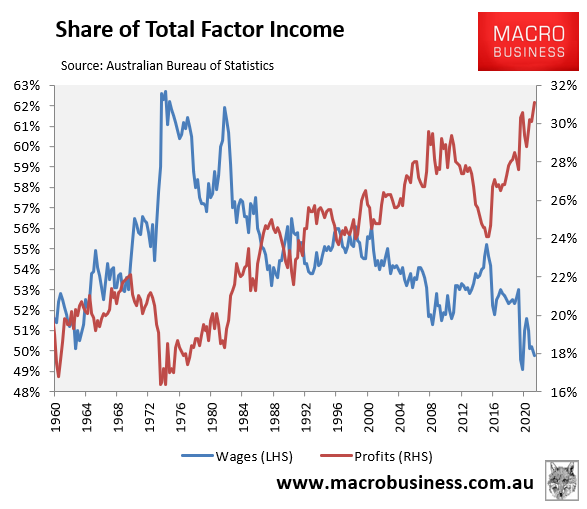
Australian workers neutered.
The upshot is that Australian workers have minimal bargaining power, thereby eliminating the prospect of a wage-price spiral ever eventuating.
Anybody that is genuinely worried about domestically driven inflation should instead go after businesses that continually jack up prices to juice their profits.
They should also demand East Coast gas reservation and coal/gas export controls and super profits taxes to delink Australian energy prices from the global market.
Stop worrying about the wages bogeyman. It isn’t the 1970s.
