
Mortgage experts have warned that Aussie home buyers that purchased near the peak of the market could find themselves in “mortgage prison” as house prices plunge and interest rates soar, since their ability to refinance will be impeded:
“The record-breaking property price increases seen in 2021 mean people who bought over a year ago are typically flush with equity at this point and won’t have a problem meeting a serviceability test when refinancing”, [Sally Tindall, RateCity.com.au research director, said].
“However, what goes up must come down … and people who bought last year, particularly in the second half, or earlier this year, may find their equity drop significantly”…
If property prices were to fall more than 20 per cent in Melbourne and Sydney by the end of 2023, as forecast by NAB, those who purchased median-priced houses with a 5 or 10 per cent deposit in December last year would find themselves in negative equity when their fixed term ended, RateCity modelling shows…
For those in negative equity, it would be near impossible to change lenders.
Shore Financial senior credit adviser, Derek Farmer, calls these people “mortgage prisoners, [because] they’re basically stuck with their existing lenders”.
The AFR’s latest survey of 31 economists revealed a median forecast for the official cash rate (OCR) of 2.85% by mid next year. If true, Australia’s OCR would rise another 1.5% from its current level.
The futures market remains even more hawkish, tipping a peak OCR of 3.6% by May 2023.
If either interest rate forecast came true, it would see Australian mortgage rates soar. Australia’s average discount variable mortgage rate would climb to 6.2% under the economists’ forecast (dashed red line below) and to 6.9% under the market’s forecast (solid red line below):
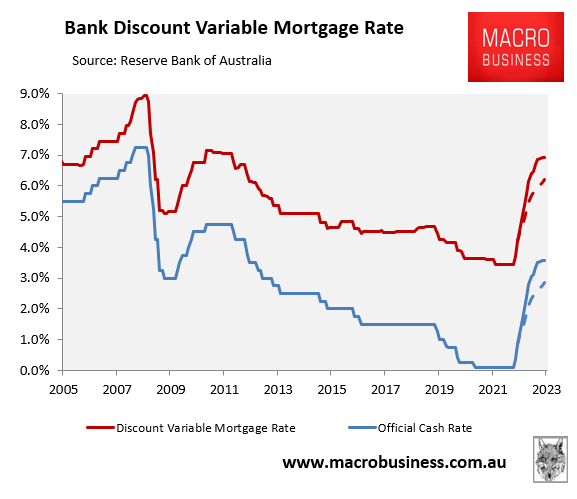
Australian mortgage rates are tipped to soar.
The market’s OCR forecast would mean that the discount variable mortgage rate would climb to precisely double its level (3.45%) before the Reserve Bank’s tightening cycle, whereas the economists’ forecast would be 0.7% lower.
Under either scenario, Australian households would face a mammoth rise in mortgage repayments, which would plunge many borrowers into severe financial stress at the same time as house prices fall sharply, especially in Sydney and Melbourne.
Many recent buyers would, in turn, be thrown into negative equity and would be unable to refinance into a better deal. They would become “mortgage prisoners” captive to their existing lenders.
