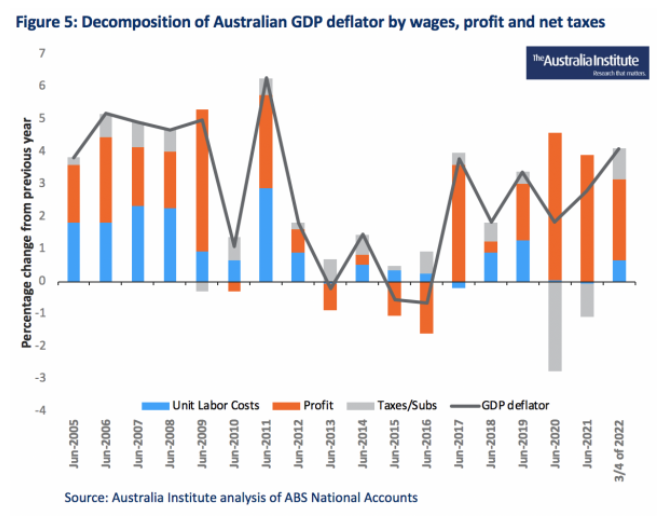
The Australia Institute (TAI) has published a new report arguing that wages made “no contribution” to inflation in the 2019-20 and 2020-21 financial years, and only a 0.6% contribution in the current financial year.
Instead, TAI says that a study of the national accounts reveals it is corporate profits that are pushing up inflation, with chief economist Dr Richard Denniss saying it is the corporate sector that needs to “tighten its belt”.
Below is the summary alongside key charts:
Key Points:
Wages made no contribution to Australian inflation in 2019-2020, or 2020-2021, measured using the ABS’s broadest indicator of inflation, the GDP Deflator.
Wages accounted for only 0.6 percentage points of the 4.1 percent increase in prices so far this financial year.
Research released today applies the European Central Bank’s methods for analysing the causes of inflation to ABS data.
Labour costs have played an insignificant role in the recent increase in inflation, accounting for just 15 percent of economy wide price increases while profits have played an overwhelming role, accounting for about 60 percent of recent inflation…
“Australia isn’t experiencing a wage-price spiral, it’s at the beginning of a price-profit spiral,” said Australia Institute Chief Economist Dr. Richard Denniss.
“The national accounts show it is rising profits, not rising costs, that are driving Australia’s inflation. While workers are being asked to make sacrifices in the name of controlling inflation, the data makes clear that it is the corporate sector that needs to tighten its belt.
“While companies are arguing that they have ‘no choice’ but to increase their prices, the fact that they are making record and rising profits is proof of how many choices they really have.
“It’s a shortage of competition, not a shortage of skilled labour, that is driving up the cost of living in Australia.
“Wages made no contribution to Australian inflation in 2019-2020, or 2020-2021, and accounted for only 0.6 percentage points of the 4.1 percent increase in prices so fat this financial year”…
“The European Central Bank recently analysed European price and wage data and concluded that ‘profits have recently been a key contributor to total domestic inflation.’”
The ECB report continues:
“To put it more provocatively, many euro area firms, though by no means all, have gained from the recent surge in inflation. The fortunes of businesses and households have diverged outside of the euro area, too, with corporate profits in many advanced economies surging over the past few quarters.”
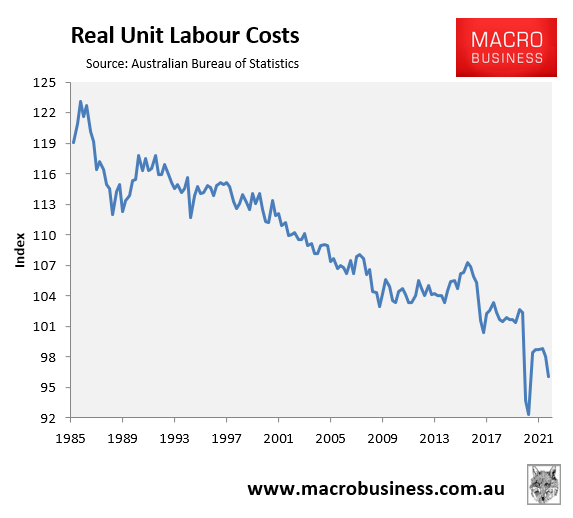
TAI is spot on. Australia’s real unit labour cost (ULC), which according to the Australian Bureau of Statistics “are an indicator of the average cost of labour per unit of output produced in the economy” and “are a measure of the costs associated with the employment of labour, adjusted for labour productivity”, collapsed 6.3% below their pre-pandemic level in the March quarter of 2022:
Advertisement
Australia’s real ULC has been falling for 35 years.
Therefore, Australian wages have actually been disinflationary, since real wage growth has been negative while productivity has lifted.
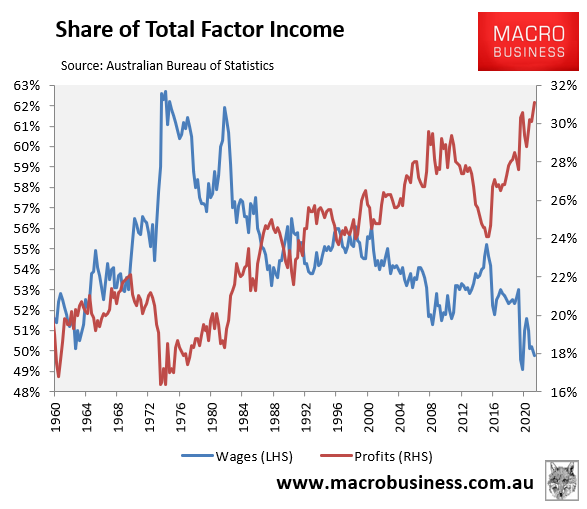
In turn, Australia’s businesses have enjoyed record profits as a share of the economy, while Australian workers’ share of the national economic pie has hit historical lows:
Advertisement
Businesses make pay dirt while Aussie workers go backwards.
Anybody worried about inflation should be attacking businesses for driving prices (inflation) higher, instead of attacking workers whose real wages (and share of national income) has fallen. They should also demand East Coast gas reservation and coal/gas export controls and super profits taxes to delink Australian energy prices from the global market to bring down inflation.
Stop wrongly blaming Aussie workers for inflation while businesses ruthlessly gouge consumers and make obscene profits.
Leith van Onselen is Chief Economist at the MB Fund and MB Super. He is also a co-founder of MacroBusiness.
Leith has previously worked at the Australian Treasury, Victorian Treasury and Goldman Sachs.