
CoreLogic’s daily dwelling values index recorded another heavy week of losses, with values down another 0.34% across the five major capital cities in the week ended 21 July.
It was the eleventh consecutive weekly decline in values at the 5-City aggregate level:
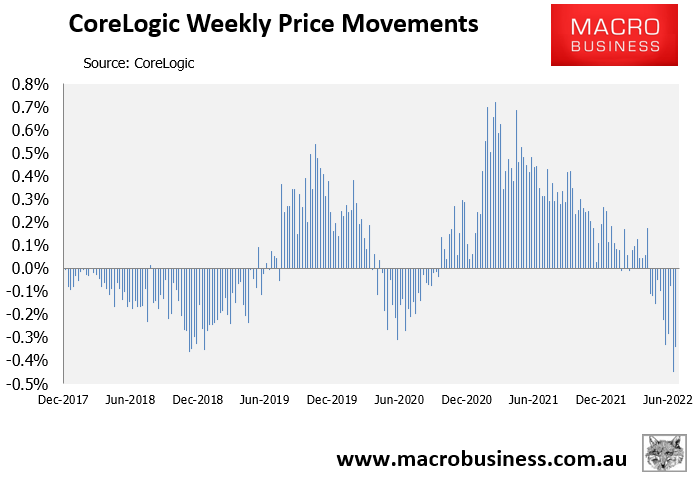
11th consecutive week of price decline.
The fall in values was driven by the three biggest capital city markets of Sydney (-0.56%), Melbourne (-0.30%) and Brisbane (-0.21%), more than offsetting small rises across the other two markets:
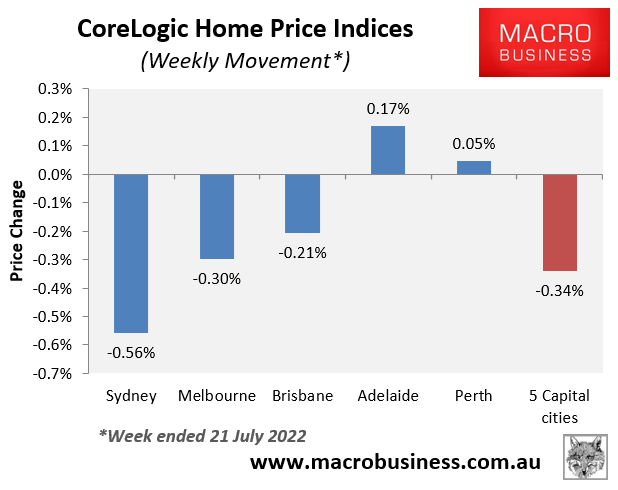
All three capital city markets now losing value.
So far in July, dwelling values at the 5-City aggregate level have fallen 0.86%, driven by steep falls across Sydney (-1.42%) and Melbourne (-0.88%), with Brisbane values (-0.26%) falling more moderately:
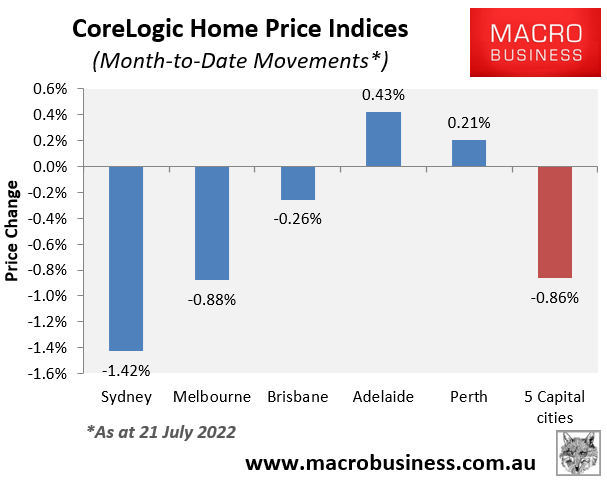
Australian house prices facing heavy falls in July.
The rate of quarterly decline has also steepened, with dwelling values down 2.0% at the 5-City aggregate level, again driven by heavy losses of 4.0% across Sydney and 2.7% across Melbourne:
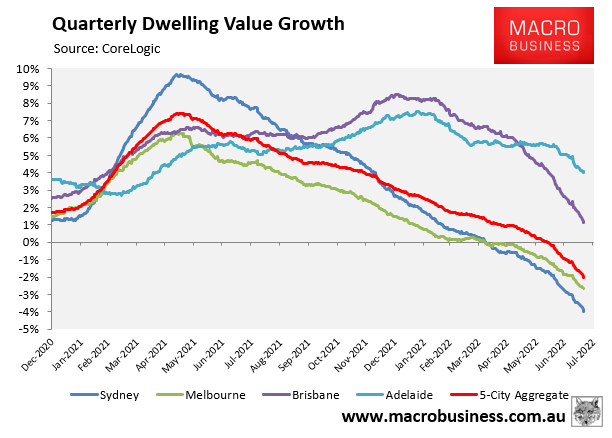
Quarterly price declines are accelerating.
In fact, Sydney dwelling values have fallen 4.6% from their February 2022 peak, whereas Melbourne’s values are down 2.9% from their peak. Brisbane’s dwelling values only began to fall in mid-June, and are down a cumulative 0.6%.
The Reserve Bank of Australia has so far only hiked the official cash rate (OCR) to 1.35%. With ANZ and the futures market tipping an OCR above 3% by year’s end, Australian house prices look set to record deep losses.
While Sydney and Melbourne will fare worst, owing to their status as Australia’s most expensive markets, it is only a matter of time before the correction spreads to nearly every housing market across Australia, both capital city and regional.
