
Credit Suisse with the note. I agree.
______________________________________________________________________________________________
Having reached our 0.6760 AUDUSD target faster than we anticipated, we turn more bearish on AUD and set our aims for 0.6550, also lowering our target range for AUDUSD from 0.6670-0.7100 to 0.6480-0.6950. Fears of RBA gradualism and renewed Chinese growth concerns drive our view.
We hold a 1.3000 USDCAD target ahead of today’s Bank of Canada rate decision, from which markets expect a 75bp hike. We do not expect the BoC to alter its assessment of housing risks, but markets will be on the lookout for dovish hints.
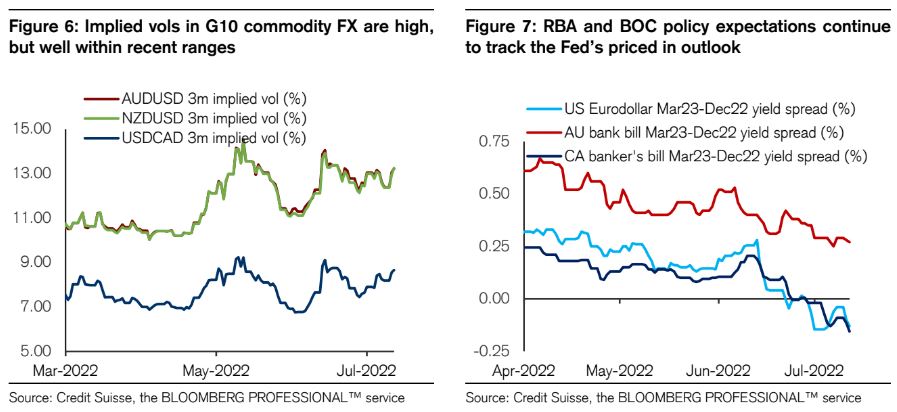
The G10 commodity currency complex remains at the same time deeply affected by the high realized volatility seen across FX markets, but also far from its EURfocused epicenter. This has made for a fairly nuanced performance: CAD, AUD and NZD have all weakened in Q3 so far vs the USD, with AUDUSD and USDCAD reaching our 0.6760 and 1.300 targets (link). At the same time, these currencies have outperformed all G10 currencies ex USD and JPY and show distinctly lower sensitivity to current events than their European peers. The response to the sharp pullback in commodities prices since mid-June has also so far been orderly. Implied vols are elevated but still well within the recent ranges, conveying a sense of concern, but hardly of urgency around weaker commodity prices.
While the views we expressed in our Q3 Outlook on the commodity FX complex skewed mostly bearish on the commodity complex (ex CAD), we still did not expect broad USD strength to realize as quickly as it did. As such we find ourselves having hit our 0.6760 AUD target earlier than expected. NZDUSD has also moved decisively closer to our 0.60 target, but without first trading at the 0.6400 level where we suggested to fade strength. CAD has been the most resilient of the bunch, as we had anticipated, with USDCAD currently trading around our 1.3000 target (our range for Q3 is 1.2670-1.3340). The faster than expected movements in these pairs calls for revisiting the assumptions that have underscored our rangefocused approach so far. These are:
1) Less investment: we assumed that the connection between commodity prices and commodity FX would be dulled by more modest investment flows into mining / exploration capital expansion, compared to previous historical periods of strength in energy and metals’ prices. In the case of Australia, we also considered the possibility that increased export revenues might be recycled into increased payments to foreign owners of local assets. Overall, we don’t see strong reasons to question this assumption, with even Bank of Canada highlighting the low level of energy capital expenditures in its Q2 Business
2) Aggressive central banks: the second key assumption of our views was that local central banks would likely remain aggressive in pushing back against domestic and global inflation risks, matching the Fed in its hawkish policy shifts, or at least giving markets reason to believe they would. The accuracy with which market-implied policy expectations in Australia and Canada have tracked the recent pullback in Fed tightening expectations (see Figure 10) is a testament of the market’s heightened awareness of this aspect.
Of these two assumptions, the latter one has been the more prominent source of FX volatility over the course of the past 12 months (especially in the case of AUD) and therefore requires ongoing attention. Against the backdrop of US CPI data, today’s BoC rate decision and Australian June employment data are the immediate points markets will focus on for possible hints on the monetary policy outlook.
AUD: “Lame duck” RBA meeting risks on the horizon
After many months in which monetary policy proved to be a stumbling block for AUD, the past two months have seen the RBA instead deliver more FX-supportive surprises, with the unexpected 50bp hike on 7 June followed by an equivalent increase in the cash target rate to 1.35% on 5 July. Markets remain nevertheless doubtful that the RBA will maintain the current pace of tightening, as bank bill futures are pricing in rate hikes of the 30-40bp magnitude for each meeting throughout the end of the year. This stands in contrast with the more aggressive and front-loaded path rate markets are pricing in for the Fed (Figure 11) and for the BoC and offers a compelling explanation for AUD’s lackluster performance.
One of the reasons for this more subdued set of expectations is the ongoing decline in consumer and business confidence indicators for the month of June produced by local banks NAB and Westpac (released on 11 July), likely exacerbated by sparse release calendar for hard Australian economic data indicators. The June employment report, due for release today, will provide a brief interruption in the data drought: markets anticipate a 30k increase in employment, down from 60k in May, with a new all-time low of 3.8% in the unemployment rate. News items pointing to government plans to increase skilled migration, aimed at addressing labor shortages, suggest limited potential for AUD-negative outcomes from the data.
Beyond today’s release, however, the next key data points will be Q2 CPI data on 26 July and the Q2 wage price index on 16 Aug. In between the two lies the RBA decision on 2 Aug: in order for AUD to become an enticing buying proposition for FX investors, hope of a more aggressive RBA policy stance will need to materialize.
And the risk we see, given the data release schedule, is that investors might question the RBA’s willingness to surprise more hawkish on 2 Aug, with a key piece of data (wage growth) on the calendar just a couple of weeks later.
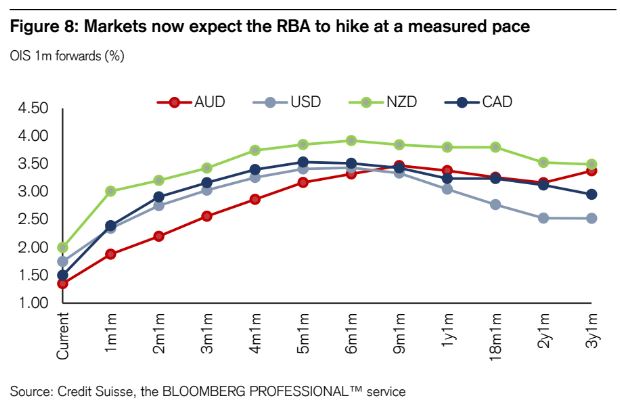
This fear of a “lame duck” RBA meeting is also exacerbated by the less constructive set of expectations that seem to be emerging around the Chinese growth outlook, following this week’s news of renewed lockdowns in Shanghai. The recent period of AUD weakness coincided with a lengthy stretch of investor optimism around Chinese reopening prospects. While the outcome of this latest lockdown is still unclear, this poor AUD performance amid a decently supportive local backdrop leaves us less than convinced in AUD’s prospects under current more uncertain
circumstances. As such, we opt to revise our AUDUSD target range lower from 0.6670-0.7100 to 0.6480-0.6950 and lower our Q3 target from 0.6760 to 0.6550.
