
Research by RMIT University has found many of the 44% of employees that have returned to working in an office environment full-time are dissatisfied with their post-pandemic working arrangements.
Some 71% of these workers said they would prefer to work from home at least one day a week, and more than 50% said they would rather work from home for at least two days a week. One-third also do not believe that attending the office is essential for productivity and collaboration.
By contrast, the majority of businesses want their employees to be back in the office as much as possible:
More than two-thirds of non-manager workers said “family time” was the biggest motivation for working from home, while 60 per cent of employees cited reduced costs – such as money spent travelling to and from the office – as a major drawcard for hybrid working.
The study found a majority of organisations wanted employees back in the office “as much as possible”, while 91 per cent of non-manager workers desired more flexibility.
RMIT Online interim chief executive Claire Hopkins said the survey revealed “significant frictions” between top leadership and employees. “There is a clear disagreement about hybrid work, the flexibility companies are willing to implement, and what workers want,” she said…
Just over half of all organisations have adopted hybrid working models (51 per cent), while 44 per cent have asked employees to attend the office full-time and 5 per cent of companies are operating remotely.
Allowing employees to work from home is an easy solution to the cost-of-living pressures afflicting Australians.
Recent ABS data compiled by Fairfax showed that workers face thousands of dollars of additional costs when forced to return to the office:
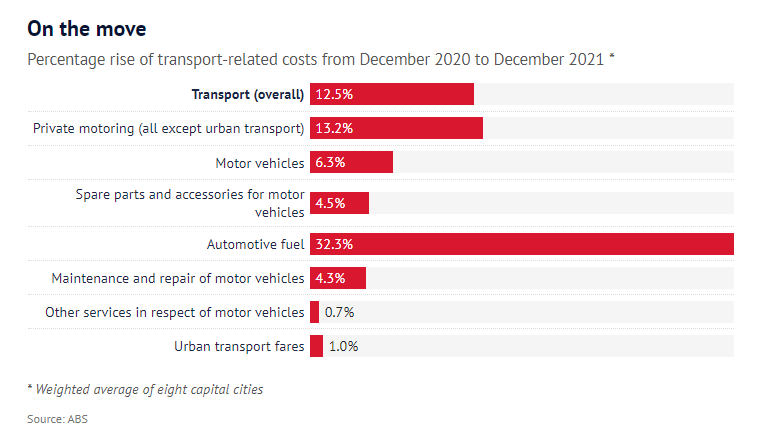
A separate survey from university academics similarly showed that remote work unlocked a whopping $5.6 billion in savings from travel time costs in Sydney alone:
“The $5.6 billion reduction in travel time costs represents a 54 per cent reduction in pre-COVID-19 total time costs of $10.3 billion, much of which we would suggest can be associated with congestion costs”…
Accordingly, forcing Australian workers to return to the office is equivalent to slashing their take home pay, which could then incentivise employees to increase their wage demands.
With the labour market so tight, employers will need to remain flexible on remote work to remain competitive in the war for talent. Demanding that workers return to the office full time will likely lead to many leaving for greener pastrures.
