
On Friday, the Albanese Government lodged a formal submission with the Fair Work Commission (FWC) recommending it lift the minimum and ‘modest’ award wages by the inflation rate of 5.1%:
Employment and Workplace Relations Minister Tony Burke said the new government had taken its first step today to end the previous government’s “deliberate” policy of low wages…
“The submission says this: ‘In considering its decision on wages for this year, the government recommends that the Fair Work Commission ensures that the real wages of Australia’s low paid workers do not go backwards,'” Mr Burke said.
“We don’t want anyone to go backwards … but this is at its most acute for low wage earners.
“It’s now in the hands of the Fair Work Commission as to how they handle that”…
“These low-paid workers were also on the front line delivering essential services during the COVID-19 pandemic, including in the retail, hospitality, aged care, cleaning, and childcare sectors.”
Unions have pushed for a slightly higher increase of 5.5 per cent, while the Coalition has refused to put a number on what it thinks would be a fair increase, saying the decision should be left to the FWC.
Tony Burke also rejected concerns of a ‘wage price spiral’:
“Inflation is not being driven by high wage growth”.
“The whole concept that the sort of spiral that may be referred to in the early 1980s does not reflect the economic conditions now.”
Unions welcomed the Albanese Government’s position:
“It’s a huge shift to have a government that accepts that there is a problem with wage growth in this country and is willing to do something about it” [ACTU secretary Sally McManus said].
“Workers’ share of national income is at a record low right now while productivity is strong and profits are at record highs”.
But as usual, the business lobby complained that a CPI increase for low workers is unaffordable:
“An unaffordable wage increase risks inflicting further pain on small businesses, and the millions of jobs they sustain and create,” Australian Chamber of Commerce and Industry chief executive Andrew McKellar said, who has backed a 3 per cent wage rise.
The notion that increasing wages by inflation is “unaffordable” and would set off a “wage-price spiral” is laughable.
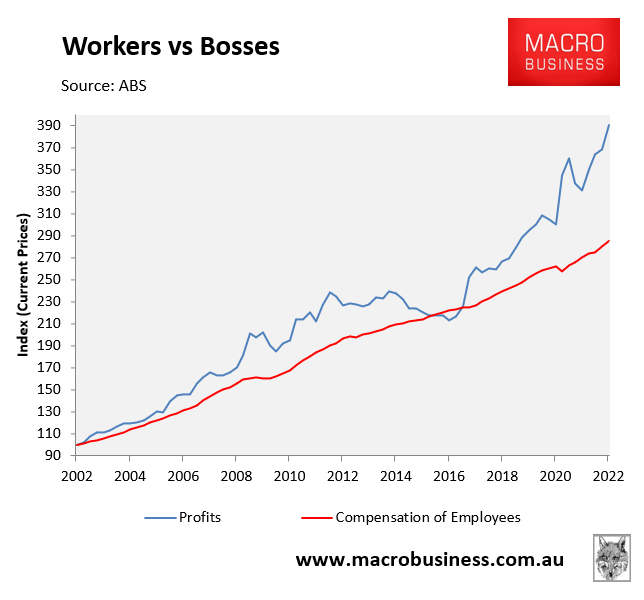
Last week’s Q1 national accounts showed that aggregate business profits have boomed, leaving Australian workers in their dust:
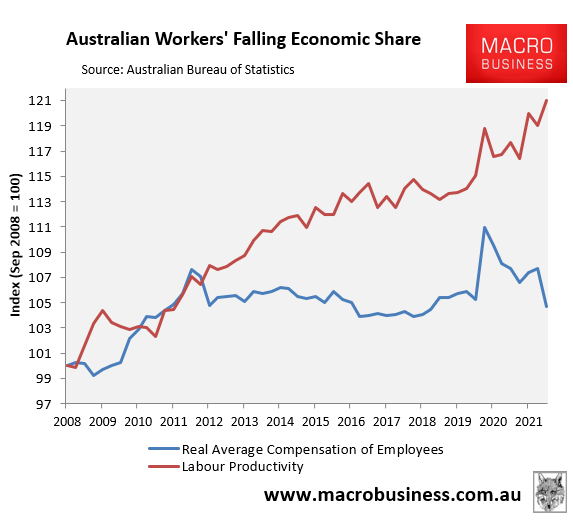
And while business profits have boomed, real average compensation per employee has remained stagnant for a decade despite rising labour productivity:
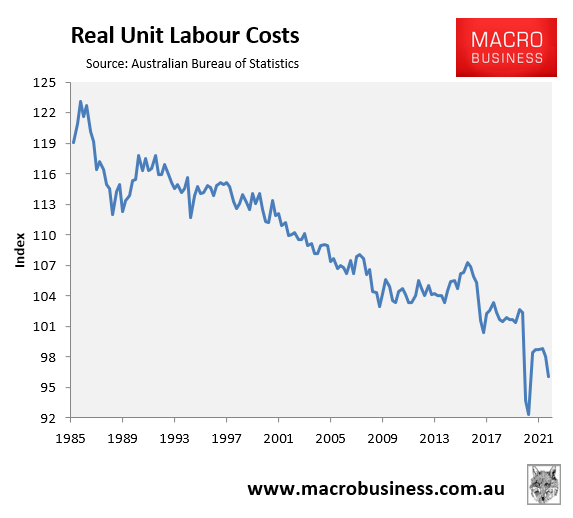
Accordingly, Australia’s real unit labour cost (ULC), which “are an indicator of the average cost of labour per unit of output produced in the economy” and “are a measure of the costs associated with the employment of labour, adjusted for labour productivity”, have collapsed 6.3% below their re-pandemic level and have fallen for the better part of 35 years:
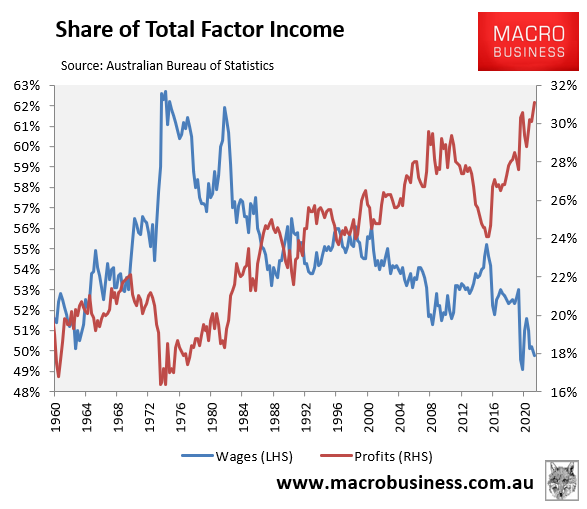
In turn, profits’ share of total factor income has soared to an all-time high while wages’ share of income has fallen near record lows:
In short, Australian workers have been completely shafted by businesses, who have made out like bandits.
Business groups scaremongering over a wage-price spiral should take a hard look in the mirror. The reality is that Australia is experiencing a profit-price spiral as companies gouge consumers and workers.
Having sided with the union movement on the minimum wage, the Albanese Government should do likewise with the ‘skilled’ visa system, which is also a giant farce.
