
Advertisement
Ahead of the Australian Bureau of Statistics’ (ABS) March labour market report later today, Roy Morgan has released its own estimate, with unemployment falling another 0.7% to 7.8% – the lowest since October 2019. However, underemployment rose by 0.6% to 8.4%:
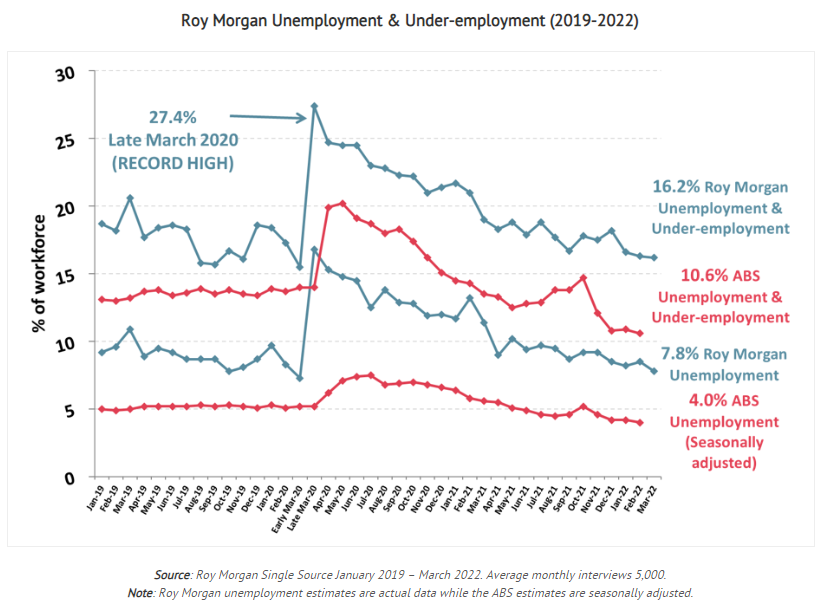
The key changes are as follows:
- Unemployment fell 94,000 to 1.13 million Australians (7.8% of the workforce) in March while under-employment increased 93,000 to 1.22 million (8.4% of the workforce). Overall unemployment and under-employment was virtually unchanged at 2.36 million.
- Workforce increased 80,000 in March as employers hire more workers. The workforce in March was 14,523,000 (up 80,000 from February) – comprised of 13,390,000 employed Australians (up 174,000) and 1,133,000 unemployed Australians looking for work (down 94,000).
- Employment increased driven by an increase in part-time employment. Australian employment increased by 174,000 to 13,390,000 in March driven by an increase in part-time employment, up 289,000 to 4,712,000. However, full-time employment decreased by 115,000 to 8,678,000.
- Unemployment was down in March and is well down on a year ago. 1,133,000 Australians were unemployed (7.8% of the workforce), a decrease of 94,000 from February with fewer people looking for full-time work (down 76,000 to 387,000) and also fewer people looking for part-time work, down 18,000 to 746,000.
- Under-employment was up in March as part-time employment increased. In addition to the unemployed, 1.22 million Australians (8.4% of the workforce) were under-employed – working part-time but looking for more work, an increase of 93,000 (up 0.6% points) from February. When part-time employment increases (up 289,000 in March), under-employment usually increases as well as more people working part-time leads to more people wanting to work more hours.
- Compared to early March 2020, before the nation-wide lockdown, in March 2022 there were almost 200,000 more Australians either unemployed or under-employed (+0.6% points) even though overall employment (13,390,000) is over 500,000 higher than it was pre-COVID-19 (12,872,000).
The full text of this article is available to MacroBusiness subscribers
Cancel at any time through our billing provider, Stripe
About the author

Leith van Onselen is Chief Economist at the MB Fund and MB Super. He is also a co-founder of MacroBusiness.
Leith has previously worked at the Australian Treasury, Victorian Treasury and Goldman Sachs.
Advertisement