
I’ve read some dodgy analysis in my time but Ticky Fullerton has dumped a load today:
If Scott Morrison grabs victory from the jaws of defeat on May 21, it will be because of inflation.
Only three months ago such a victory was hard to imagine, but look what has happened since.
Food and grocery prices are rising. Mortgage rates are increasing ahead of an RBA rate rise expected in June, the first in over a decade.
Petrol prices, despite falling in the last week even more than the 22c tax cut at the bowser, have hiked dramatically this year as the energy crisis grips global markets.
Yet real wages have not risen and Australians have no confidence that they will rise any time soon.
If the electorate gets the message that Labor’s spending will be high, with no better solution to wages growth than the Coalition, and if it gets the message that higher spending means higher inflation, then there is every chance that Scott Morrison’s spin power will get him across the line.
So, the opposition is going to lose the election based upon cost of living pressures that it had nothing to do with it?
If this were the case then John Howard would have won the 2007 election in a landslide as he promised but failed to deliver low-interest rates, owing to Labor’s profligate spending from opposition
In short, this analysis is a triumph of myth over reality.
How hard is it going to be for Labor to blame the Morrison Government for this as its run around the country dropping $16bn in handouts to marginal electorates?
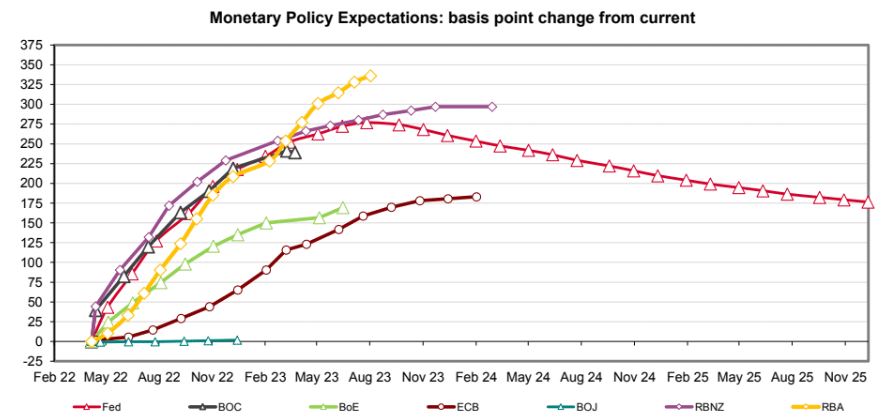
14 interest rate hikes by mid-2023 are now priced into futures markets thanks, in part, to a budget spewing unproductive pork.
The RBA itself has confirmed that that will crash property prices. From Friday’s FSR:
After nationwide housing prices increased by 22 per cent over 2021 (the strongest annual growth rate since the late 1980s), the pace of housing price growth moderated in most markets in early 2022. It is important that lenders and borrowers consider the potential for falls in housing prices, particularly for loans at high LVRs. Housing demand and the outlook for prices are uncertain due to a range of factors, including significant changes in population growth. Future increases in interest rates could also weigh on housing and other asset prices. Estimates using a model of the housing market that takes into account historical relationships between interest rates and both demand and supply factors suggest that a 200 basis point increase in interest rates from current levels would lower real housing prices by around 15 per cent over a two-year period, relative to the baseline model projection in the absence of an interest rate shock.
Add another six rates hikes and pick a number to the downside for property prices, which would not stop falling until they reached a clearing price that triggered a mass purge in household balance sheets.
More to the point for the election and its rhetoric, this is what the Morrison Government has delivered: the steepest interest rate rise outlook in modern history which will crash the property market.
This is the diametric opposite of what got Morrison over the line in 2019 which was fear of property price impacts from Labor’s tax reform platform which is now long-dumped.
Cost of living pressures to save Morrison, my butt, Ticky.
