NAB’s business survey for February has been released, which reported a solid rebound in conditions and confidence as Omicron faded from view:
Key messages:
Business conditions and confidence strengthened in February as the Omicron virus wave eased and the late 2021 momentum was regained. After a fall in January, the conditions index rebounded to be above its long-run average. The rebound came on the back of a strong rise in the employment index – reflecting fewer health-related employment disruptions and strong labour demand – as well as improvements in trading and profitability. Almost all mainland states and industries shared in the upswing, but WA saw conditions fall as the planned border reopening was postponed. There was also a broad-based improvement in confidence, again with the exception of WA and Tasmania, and forward indicators rose. Businesses continued to report elevated costs growth, although purchase cost growth eased slightly from the record levels reached in January. Final product price inflation also remained elevated with retail prices strengthening to over 2% in quarterly terms, suggesting that cost pressures are increasingly being passed on to consumers. Still, prices continue to be driven more by temporary purchase cost factors rather than more sustained wage and labour cost pressures. How these forces evolve over the coming months remains a key uncertainty, with wages growth likely to strengthen as purchase costs ease.
Highlights:
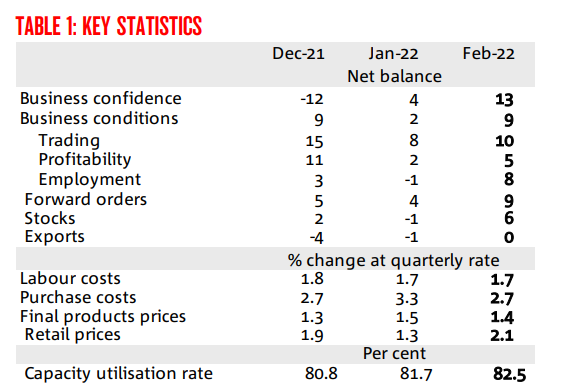
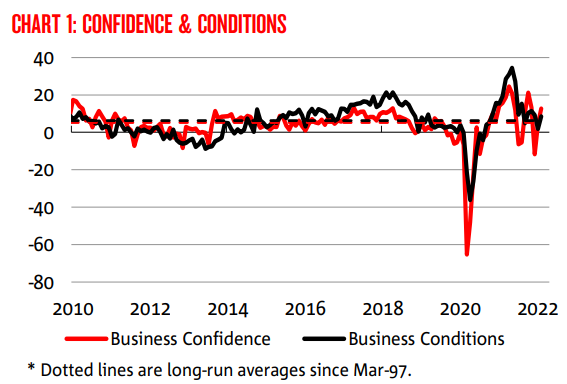
How confident are businesses? Business confidence rose 8pts in February to +13 index points, building on a strong rise in January after a sharp fall in December.
How did business conditions fare? Conditions rose 7pts to +9 index points, to be back above their long-run average.
What components contributed to the result? The result was driven by a sharp rise in the employment index which rose 9pts to +8 index points. Trading conditions (up 2pts to +10) and profitability (up 3pts to +5) also rose.
Which industries are driving conditions? All industries outside of mining saw conditions improve, with the largest improvements seen in retail (up 15pts) and transport & utilities (up 10pts). In trend terms, mining, wholesale, finance, business & property, and retail were strongest. Recreation & personal services remained in negative territory (-6 index points in trend terms) despite seeing some improvement in the month.
Which industries are most confident? Confidence rose across every industry, with the largest increases in recreation & personal services (up 20pts), mining (up 18pts), transport & utilities (up 14pts) and retail (up 10pts).
Where are we seeing the best conditions by state? Conditions rebounded strongly in Vic (up 10pts), NSW (up 7pts), and SA (up 5pts) but deteriorated in WA (down 6pts) and Tas (down 5pts); Qld was largely unchanged (up 1pt). Despite this, in trend terms conditions remained strongest in WA and Tas.
What is confidence like across the states? As with conditions, confidence rose in NSW (up 14pts) and Vic (up 10), while Qld also saw confidence rise considerably (up 9pts). Confidence fell in WA (down 3pts) and Tas (down 11pts).
Are leading indicators suggesting improvement? Forward orders improved 4pts to +9 index points, and capex also strengthened 5pts to +8 index points. Capacity utilisation edged higher, from 81.7% to 82.5%, largely driven by retail.
What does the survey suggest about inflation? Purchase cost growth came in at 2.7% in quarterly terms, down from January’s record rate but still near historic highs (including the Quarterly survey back to 1989). Labour cost growth and final product price growth were both steady but remain elevated. Retail price inflation strengthened to 2.1% in quarterly terms, back to the highs seen at the end of 2021.
Key Data:
The full text of this article is available to MacroBusiness subscribers
Leith van Onselen is Chief Economist at the MB Fund and MB Super. He is also a co-founder of MacroBusiness.
Leith has previously worked at the Australian Treasury, Victorian Treasury and Goldman Sachs.