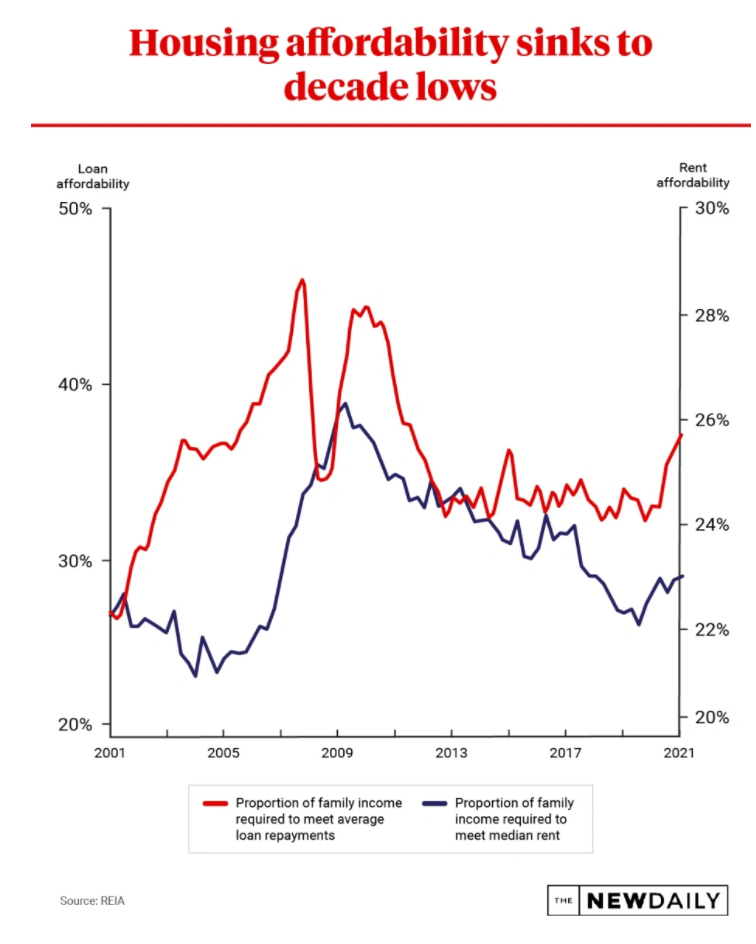
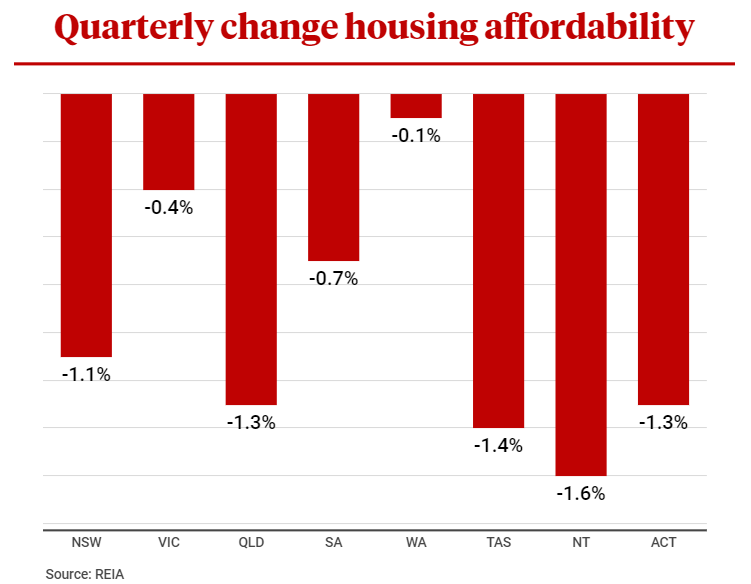
Data from the Real Estate Institute of Australia (REIA) shows that housing affordability declined by 3.9% for home owners in 2021, and by 0.3% for renters. The figures also show that mortgage affordability has fallen to its lowest level since 2010, and rental affordability is at its lowest level since 2017. REIA president Hayden Groves warns that many Australians will be “priced out” of the housing market when interest rates eventually rise. He has called for government action to increase housing supply.
REIA said weighted average capital city house prices rose to $1.02 million over the December quarter, capping off a 25 per cent rise over 2021…
REIA’s report measures this by defining affordability as the proportion of the median household income needed to meet average home loan repayments.
Rental affordability is measured in the same way, but with rents instead.
The below graph shows how the COVID property boom affected affordability.
Median weekly household incomes rose 5.3 per cent to $2051 last year, largely thanks to government pandemic support measures. But over the same period, the average monthly home loan repayments rose a whopping 17.7 per cent to $3289.
That means 37 per cent of the median household income is needed to pay an average-sized mortgage each month, REIA said.
And the picture isn’t much better for renters, either. REIA’s weighted median rent index has risen much faster than overall inflation during COVID-19…
“We are urging governments to get on the front foot with this issue by prioritising [policies to address] housing supply shortages,” [REIA president Hayden Groves said].
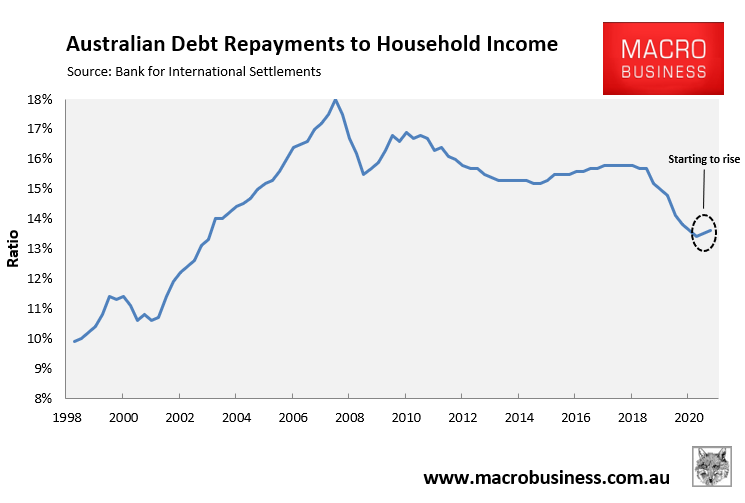
The latest household debt repayment data from the Bank for International Settlements (BIS), which is only current to September 2020, shows that principal and interest repayments as a share of household disposable income were already rising over Q2 and Q3 2021, despite the ongoing fall in average mortgage rates:
Advertisement
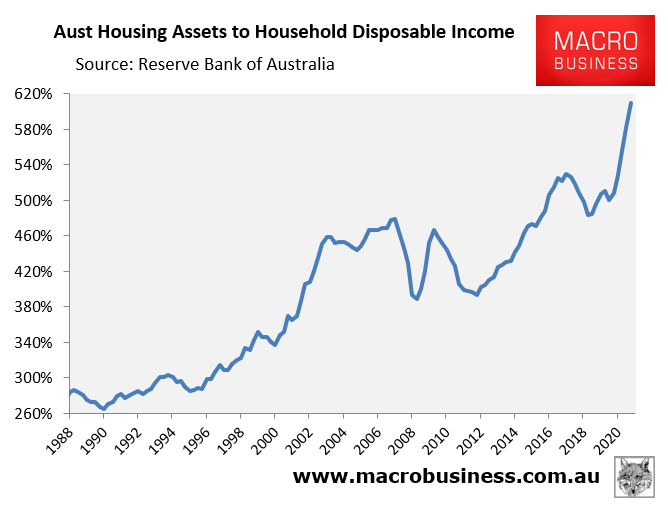
This has been driven by the extreme rise in housing prices relative to incomes over the pandemic:
Advertisement
Basically, the rise in mortgage principal repayments due to higher house prices exceeded the fall in mortgage interest repayments due to declining rates.
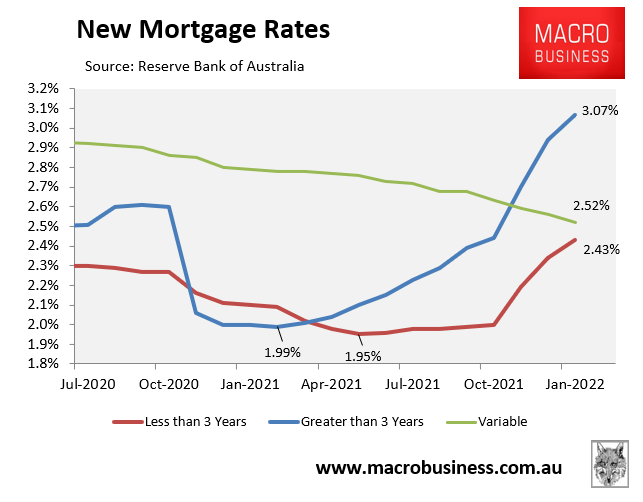
The implication going forward is obvious. Fixed rate mortgages have already risen quite sharply since the September quarter (see next chart) and variable mortgage rates are tipped to rise this year as the RBA lifts the cash rate.
Advertisement
The upshot is that the share of household income going towards debt repayments are about to rise quite sharply, which will cause ‘housing affordability’ as measured by the REIA to plummet.
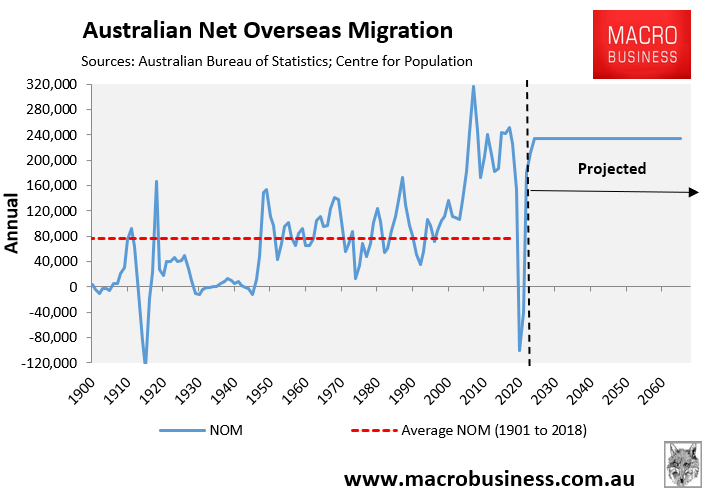
Finally, Hayden Groves’ call for governments to “get on the front foot with this issue by prioritising [policies to address] housing supply shortages” is ridiculous given the federal government plans to quickly reboot the mass immigration ‘Big Australia’ program:
Advertisement
Why not simply run a sustainable immigration program under 100,000 people a year – basically the historical average – instead of the projected 235,000 a year? Why create the supply problems in the first place?
Leith van Onselen is Chief Economist at the MB Fund and MB Super. He is also a co-founder of MacroBusiness.
Leith has previously worked at the Australian Treasury, Victorian Treasury and Goldman Sachs.