
Westpac with the Budget profile as we enter Frydenberg’s MMT pork era.
—
Leading into the 2022 Budget, Australia’s economic performance has exceeded expectations. The unemployment rate, which peaked at 7.4% in mid-2020, is 4.0% currently and is set to move below 4% for the first time since 1974. Accordingly, the focus of policy shifts, from supporting demand (the priority during the pandemic to date), to supporting supply – boosting participation in the workforce and increasing productivity.
Also in focus are rising global prices, across commodities, particularly fuel prices, as well as goods more generally – with the inflation spike reducing households’ spending power. The upside on commodity prices, particularly relative to official forecasts, lifts national income and provides a boost to the budget. These significant developments are unfolding ahead of the upcoming Federal election, which is due by May.
Budget deficit path revised lower
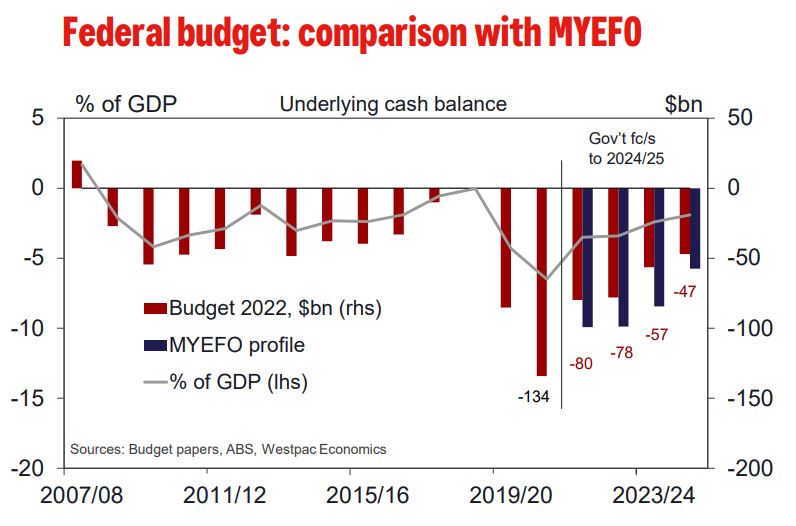
The budget deficit profile has been revised lower reflecting the windfall from a stronger economy and after incorporating the cost of new spending initiatives. The cumulative deficit for the four years 2021/22 to 2024/25 is reduced to $261.4bn, down from $340bn in MYEFO, an improvement of $78.6bn.
The budget deficit peaked in 2020/21 at $134bn, representing 6.5% of GDP. For the current year, 2021/22, the deficit is now expected to be $79.8bn, an improvement of $19.4bn on MYEFO. The deficit is little changed in 2022/23 to $78bn (a $20.9bn improvement); and then moderates to $56.5bn in 2023/24 and $47.1bn in 2024/25 (a $10bn improvement) and representing 1.9% of GDP.
Budget windfall and new policy
The stronger economy delivers a budget windfall of $114bn across the four years to $2024/25, centred on a $123bn increase in revenue. Payments are somewhat higher, increasing by $9.2bn – higher inflation and wages growth adds to the cost of outlays. About 70% of the windfall has been directed to reducing deficit and debt.
The Government has unveiled $35.4bn in new policy measures since MYEFO – with expenditure up by $26.9bn and revenue down by $8.5bn. New policy represents 1.5% of GDP spread across the four years, (alternatively, including the 2025/26 year, the figure over five years is 1.7% of GDP). Initiatives are focused in the remaining months of the 2021/22 financial year, $8.9bn (0.4% of GDP) and 2022/23, $17.25bn (0.75% of GDP). Thereafter, new policy is worth around $4.7bn a year (0.2% of GDP).
New policy measures span a cost of living package, including a reduction in the fuel excise tax over a six months period. There is additional spending for training and skills, as well as tax initiatives for small business, and there are measures to boost labour force participation. Infrastructure spending and health are key priorities, so too defence. For a more detail discussion of new policy see pages 2 and 3.
Payments down from peak, remain above long-run average
Payments spiked to peak at 31.7% of GDP in 2020/21 as the government responded to the health and economic challenges of the pandemic. Payments are expected to moderate to 27.8% of GDP this year and then glide lower to 26.3% by 2025/26 – which is still 1.4ppts above the historic average pre-pandemic. This largely accounts for the deficit in 2025/26, at a forecast 1.6% of GDP. Receipts recovered to 25.1% of GDP in 2020/21 and is expected settle around 24½% of GDP.
Debt profile lowered, gross debt to peak in 2024/25
The net debt profile has been marked materially lower reflecting the fiscal consolidation achieved in this Budget. In MYEFO, net debt was expected to lift from 28.6% of GDP in 2020/21, rising to 37.4% of GDP in 2024/25. The 2024/25 forecast has been cut to 33.1% of GDP, representing the peak. The peak in gross debt has been lowered and brought forward. The forecast peak is now 44.9% of GDP at June 2025, in MYEFO it was 50.3% of GDP out in 2028/29.
Risks
The economic forecasts in the March 2022 Budget for the 2021/22 year have moved broadly into line with that of Westpac. However, the nominal GDP growth forecast for 2022/23 of 0.50% appears to be overly cautious and describes a very different economy to that of the Westpac forecast of 6.8%. The Budget elevates the downside risks posed by a likely lift in omicron cases over winter as central to the 2022/23 view, as well as retaining cautious assumptions around commodity prices. On balance, the likelihood is that the budget forecasts will see another, material upgrade. For a more detailed discussion of the economic outlook and the Budget forecasts see pages 4 and 5. Another risk is around the upcoming Federal election – and the extent of new policy commitments during the campaign period.
