
By Gareth Aird, head of Australian economics at CBA
Key Points:
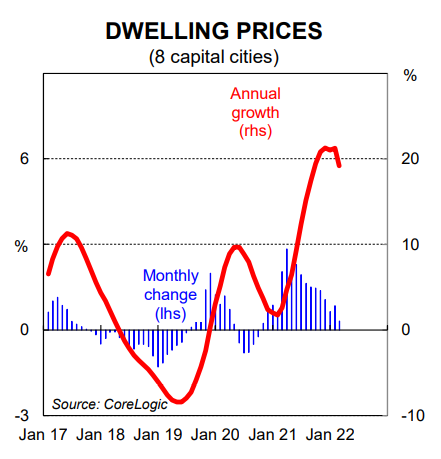
- Dwelling prices rose by 0.3% across the eight capital cities in February. Annual growth sits at 19.2%.
- Price outcomes were mixed over the month; Sydney and Melbourne posted broadly flat outcomes while strong gains were recorded in Brisbane, Adelaide and Perth.
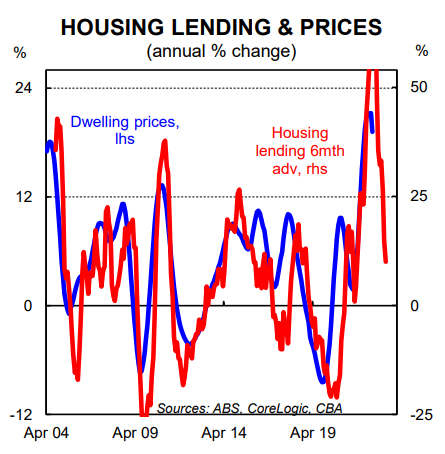
- We now expect national dwelling prices to peak in mid-2022 when we anticipate the RBA to commence a tightening cycle.
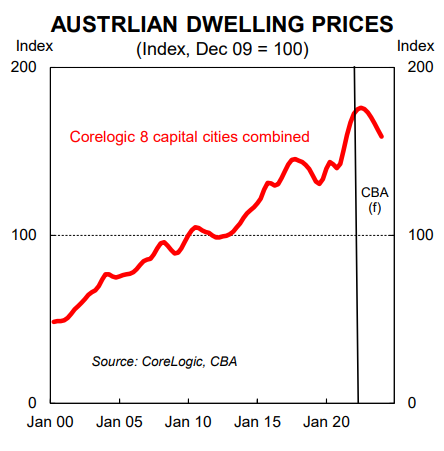
- We forecast national home prices, as measured by Corelogic’s eight capital average benchmark index, to end 2022 flat.
- We look for national home prices to decline by 8% in 2023 (we expect the RBA to take the cash rate to 1.25% at Q1 23 and then remain on hold over the rest of 2023).
A divergent housing market has emerged
Australian home price growth slowed considerably in the early part of 2022. According to CoreLogic, property prices rose by a modest 0.3% across the eight capital cities in February. This compares with average monthly dwelling price growth of 1.6% in 2021.
In November 2021 we wrote, “we expect prices to continue to rise through the first half of 2022, but at a more modest pace. Higher fixed mortgage rates, the increase in the minimum interest rate buffer from 2.5% to 3.0%, affordability constraints and natural fatigue will all exert a cooling influence on the market.”
The cooling influence we anticipated has been a lot stronger in Sydney and Melbourne, while prices rises have continued to rise briskly in others capital cities. Indeed the data today paints the picture of a divergent housing market.
National prices are expected to continue to edge higher, but the evidence indicates dwelling prices are likely to have peaked in Sydney and Melbourne, our two biggest cities. Auction clearance rates remain at healthy levels in Sydney and Melbourne. Notwithstanding, dwelling prices in Sydney declined by 0.1% in February while prices were flat over the month in Melbourne.
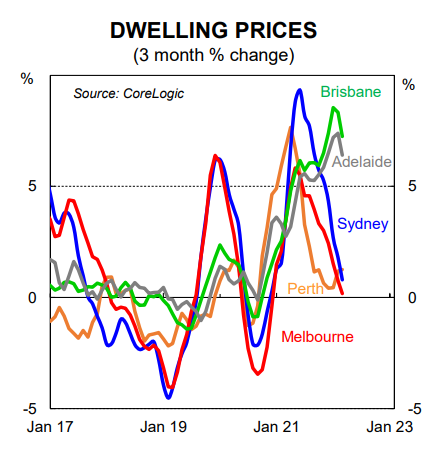
In contrast, home prices rose strongly over February in Brisbane (+1.8%), Adelaide (+1.5%), and Hobart (1.2%). More modest price gains were posted over the month in Darwin (0.4%), Canberra (0.4%) and Perth (+0.3%).
Regional markets continue to display strong conditions. The combined regions home price index rose by 1.6% in February. Stock remains low in regional Australia and many retirees are moving out of the major capital cities to regional Australia, particularly the coastal fringes. This has supported strong price gains.
According to Corelogic, advertised supply levels are gradually normalising after tracking close to 25% below the prior years’ level before spring 2021.
Outlook
Home price booms cannot go on indefinitely and this cycle looks to have run its course in Sydney and Melbourne. Some other markets across the country, however, have a bit further to go in this cycle.
We have updated our forecast profile for home prices to take into account: (i) a peak in home prices in Sydney and Melbourne earlier than we had anticipated; and (ii) an RBA tightening cycle expected to start in June 2022 (our previous home price forecasts assumed the tightening cycle commenced in November 2022).
We now expect national dwelling prices, as measured by the 8 capital city average, to end the year flat (versus our November 2021 call for prices to rise by 7%). Our forecast profile has national prices continuing to rise modestly over H1 22 to peak in mid-2022 when we expect the RBA to commence normalising the cash rate. From there we expect a gradual decline over H2 22 that would see national prices end the year broadly unchanged.
Sydney and Melbourne are forecast to end the year lower given prices are expected to have already peaked. In contrast, the other capital cities, most notably Brisbane and Adelaide, are forecast to end the year higher given strong monthly gains are anticipated to be posted in the early part of 2022 (see Table 1).
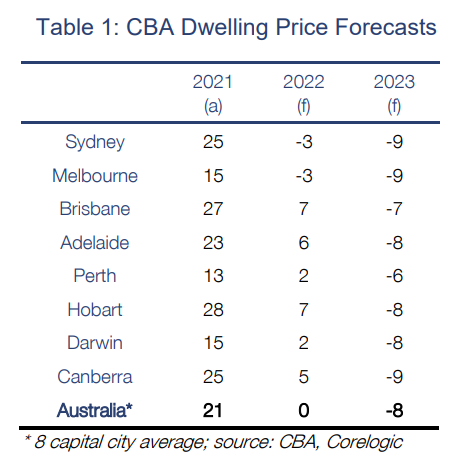
We expect an orderly correction in dwelling prices of 8% in 2023 (versus our previous forecast for a 10% decline in 2023). On the surface, this may appear counterintuitive given we are now looking for a slightly smaller decline in 2023 compared to our previous call. But this expected contraction is only lower in percentage terms. In levels terms prices are forecast to end 2023 a little lower than previously, given we are looking for a flat outcome nationally now in 2022.
Our forecast profile for home prices is conditional on a gradual and shallow RBA tightening cycle that takes the cash rate to 1.25% by Q1 2023 (see here for our RBA call on the cash rate). Our expectation is that the RBA holds the cash rate at 1.25% over 2023 as the Australian household sector adjusts to higher interest rates. There is a lagged impact on changes in the cash rate and the impact on home prices and the broader economy so we anticipate that home prices will correct lower over 2023 despite our call for the RBA to be on hold for most of next year.
The cash rate is forecast to lift in June 2022 because the economy will be at full employment and annual wages growth will be on an accelerating path to the desired level of 3%. Stronger wages growth will provide a partial offset to rising interest rates on the property market. In addition, a lift in population growth as the international border reopens will boost the underlying demand for bricks and mortar, particularly inner city apartments.
Finally, we remind our readers that context is key. Price gains in 2021 nationally were extraordinary. A correction lower in dwelling prices is a natural response to rising interest rates given it was record low interest rates that drove the phenomenal lift in prices in 2021.
We expect the RBA to be cognisant of the nexus between changes in interest rates and the impact on home prices, household behaviour and the broader economy. The economy is not static. Rising interest rates will generate changes in behaviour, which in turn will impact economic outcomes. For context, we estimate there are over one million home borrowers who have never experienced an increase in mortgage rates.
The RBA will need to assess the impact of rate hikes on the economy, particular the household sector and the housing market, as they move through the tightening cycle. This means that we expect the central bank to be patient and a gradual and a shallow rate hike trajectory is our base case.
