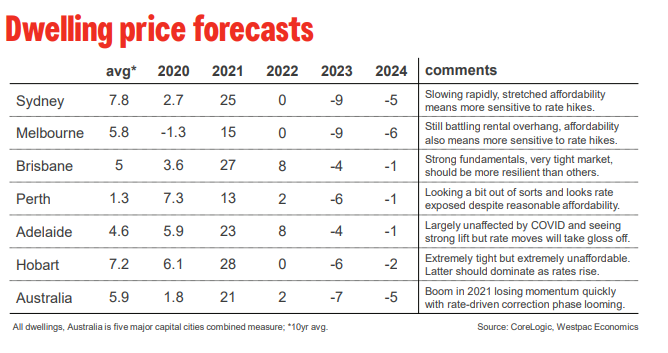
Westpac has released its Housing Pulse for February 2022, which forecasts that Australian dwelling values will fall in both 2022 and 2023 on the back of rising interest rates. Sydney and Melbourne will also suffer the biggest falls owing to their stretched affordability:
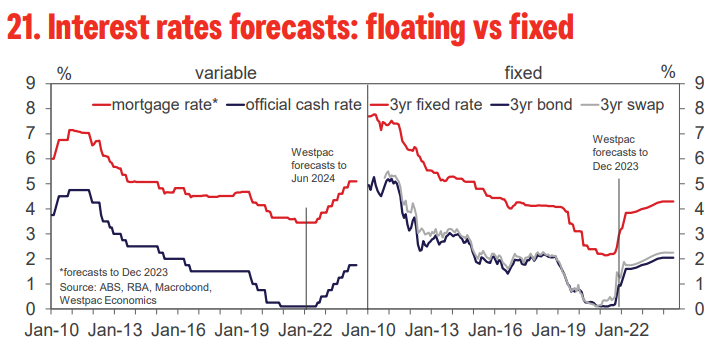
In light of the shifting inflation and labour market outlook, we amended our forecasts for official rates in Jan with the expected start of the RBA tightening cycle brought forward from Feb 2023 to Aug 2022 and the projected ‘terminal’ cash rate peak in lifted to 1.75% in the first half of 2024.
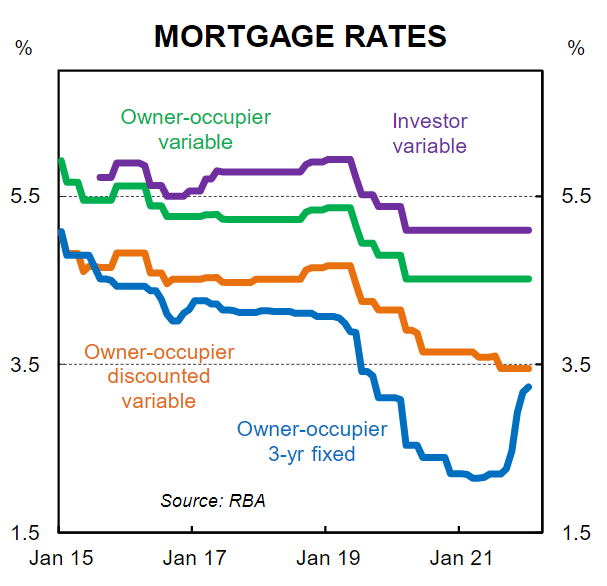
This earlier and slightly more aggressive tightening cycle has clear implications for the residential property. Housing will be ‘collateral’ damage in the RBA’s efforts to keep inflation on target over the medium term. The sector is highly sensitive to interest rate changes. With affordability already stretched in many markets, rate rises will have a direct impact on the borrowing capacity of buyers and their ability and willingness to sustain high prices. The extraordinary surge in prices over the last year has seen affordability deteriorate to be near previous lows in 2010 and 2007 – both of these earlier benchmarks were at times when the average discounted variable mortgage rate was materially higher than it is now (around 7% and 9% respectively versus nearer to 3% today).
Under our previous interest rate scenario, we had expected macro-prudential tightening and rate increases to drive a gradual move into a correction phase for Australia’s housing market. Prices were forecast to lift by 8% in the first half of 2022, before flattening out in the second half prior to falls of 5% in both 2023 and 2024.
We now anticipate an earlier fade in momentum, prices expected to flatten by May this year, ahead of a move into outright correction in the December quarter. Overall, that would see a net gain of just 2% over 2022. Prices are then forecast to fall 7% in 2023 and by a further 5% in 2024, stabilising towards the end of that year. Nationally, the peak to trough fall of 14% is around the average of corrections seen historically.
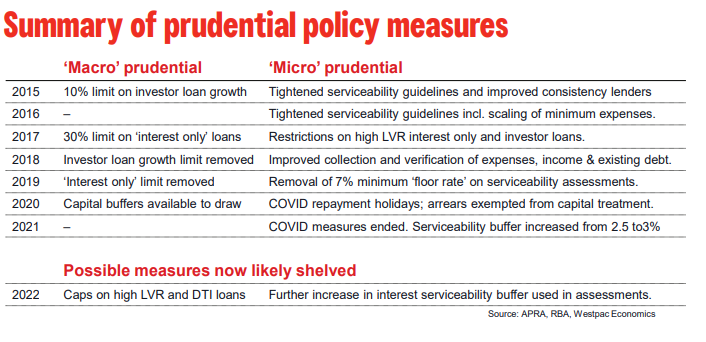
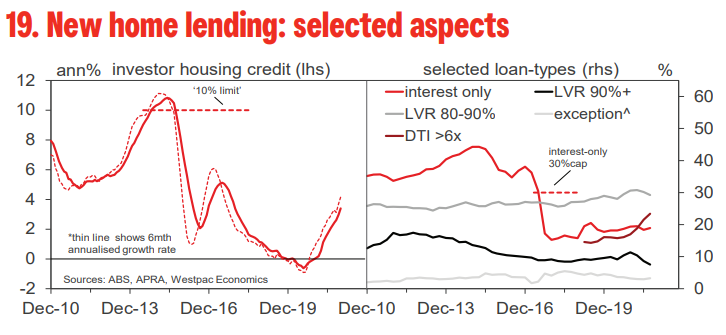
The shifting policy view on interest rates effectively sidelines the use of more housing-targeted macro-prudential policy measures.
Prior to recent inflation and labour market developments, this policy space looked to be very much ‘live’ in 2022… Rate hikes clearly preclude the need for this more focussed style of policy intervention…
The 2022-24 period may be one of hibernation for prudential policy but it shapes as a critical test of past performance…
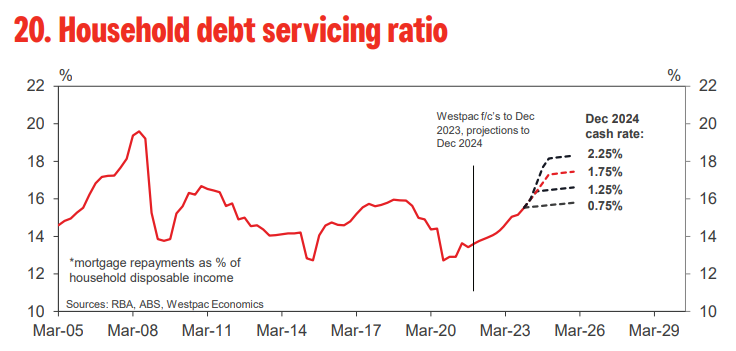
Consumers have not experienced a sustained tightening cycle for over a decade. Our forecast cash rate peak of 1.75% is conditioned on an estimated debt repayment burden that is well above recent peaks, albeit short of the highs in 2007–08 (Chart 20). Most consumers expect rates to rise but few appear ready for this scale of increase.
Finally, there is a more specific issue around the surge in fixed rate loans in 2021. Many of these were on extremely low rates that will see a significant step up when the fixed period rolls off, some potentially facing a ‘rate reset shock’ in the order of 1-2ppts.
While there is debate over the timing of when the RBA will lift the cash rate, mortgage rates are certainly going to rise.
Already fixed rates have risen markedly:
Advertisement
And as borrowers roll-off fixed rates over coming years, they will be refinancing their loans at a materially higher interest rate, which will have a significant impact on the interest cost of debt and household finances.
Given the cratering of mortgage rates was behind the current house price boom, it stands to reason that rising rates will trigger a correction.
The most expensive (and volatile) markets of Sydney and Melbourne, alongside expensive regional locations, face the biggest downturns.
Leith van Onselen is Chief Economist at the MB Fund and MB Super. He is also a co-founder of MacroBusiness.
Leith has previously worked at the Australian Treasury, Victorian Treasury and Goldman Sachs.