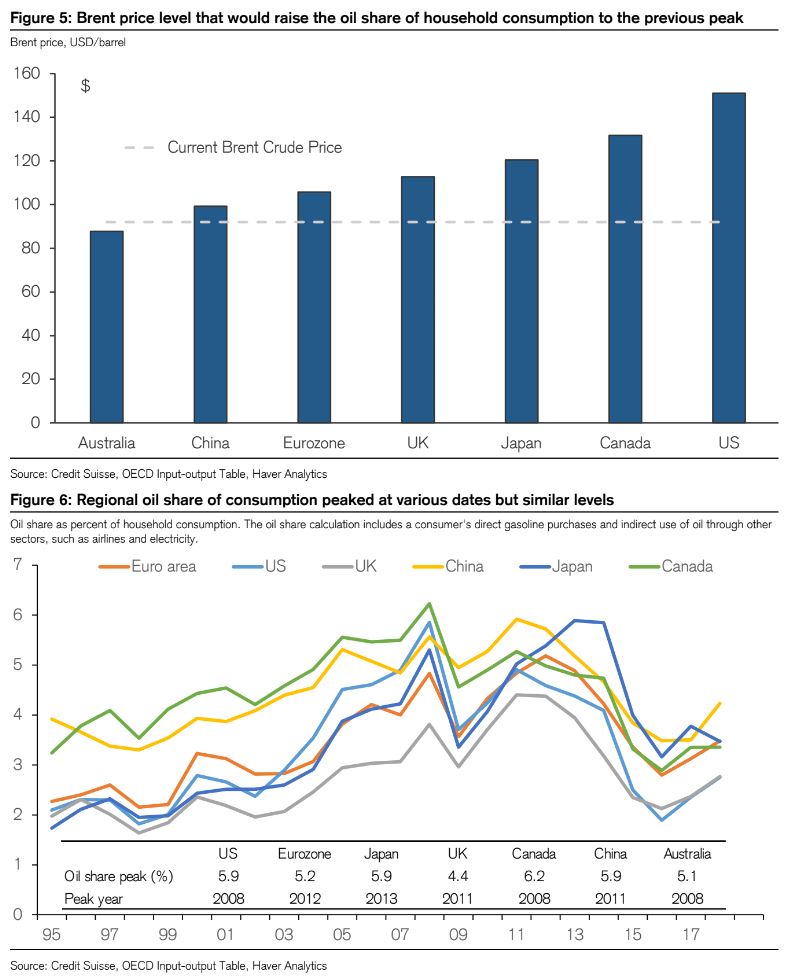
After adjusting for inflation, the crude oil price has risen to a seven-year high, and the sharp move is comparable to run-ups of past oil bull markets (Figure1). Back then, rising energy costs compounded, escalating problems in income, profits, and credit quality, and led to lower purchasing power among households. In comparison, today’s consumers in industrialized countries enjoy strong economic tailwinds. However, persistently elevated Brent prices may still crowd out other items on their shopping list. This may start to happen to the major economies if Brent rises and stays above $100. Meanwhile, the threshold varies significantly across geographies. We estimate the crude price that would raise the oil share of consumption to its past peak in each region (Figure5), a point where expensive oil may start squeezing consumer budgets. For instance, if the current $92 Brent persists until year-end, Australia’s oil share of consumption should exceed its 2008 peak. China would be the next to meet the level if oil stays at $100. Industrialized economies are generally further away, but Europe would get it earlier than Japan and North America.
I can’t see this getting any better in the very near term as the Ukraine situation dominates and the AUD is weak owing to Fed tightening.
The full text of this article is available to MacroBusiness subscribers
David Llewellyn-Smith is Chief Strategist at the MB Fund and MB Super. David is the founding publisher and editor of MacroBusiness and was the founding publisher and global economy editor of The Diplomat, the Asia Pacific’s leading geo-politics and economics portal.
He is also a former gold trader and economic commentator at The Sydney Morning Herald, The Age, the ABC and Business Spectator. He is the co-author of The Great Crash of 2008 with Ross Garnaut and was the editor of the second Garnaut Climate Change Review.