By Gareth Aird, head of Australian economics at CBA:
Key Points:
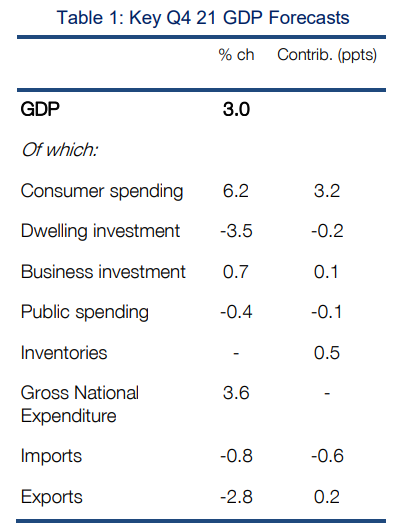
- We expect Q4 21 real GDP to increase by a large 3.0% which would take the annual rate to 3.6%.
- A massive bounce in household consumption due to the easing of restrictions in NSW and Victoria will be responsible for the large expansion in output.
- Business investment and inventories are also forecast to support growth in the quarter.
- Residential construction, public spending and net exports are anticipated to weigh on growth.
- We expect nominal GDP to increase by 3.5% over the quarter.
A big rebound in GDP as restrictions were eased
The Q4 21 national accounts, due on Wednesday 2 February, will confirm that the Australian economy expanded solidly in the December quarter. Restrictions were eased in NSW and Victoria and that underpinned a big lift in economic activity. The data will indicate that the Australian economy closed out 2021 with considerable momentum despite the significant setback in Q3 21 due to the delta outbreak (recall that Q3 21 GDP contracted by 1.9%).
On our preliminary forecast real GDP rose by 3.0% in Q4 21. Such an outcome would see GDP 3.6% higher over the year and 1.0% above its Q2 21 peak.
We will finalise our forecast on Tuesday 1 March once the final partial data has been released. But at this stage on the expenditure side we expect to see:
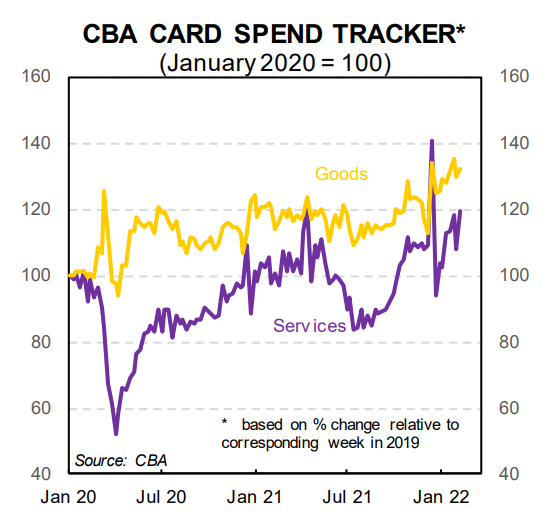
- a massive lift in household consumption as lockdown restrictions were lifted in NSW and Victoria: CBA(f) +6.2% (note that this is the key source of uncertainty). For context, household consumption fell by 4.8% in Q3 21 while already released partial data indicates retail trade volumes rose by a whopping 8.2% in Q4 21 following a 4.4% fall in Q3 21.
- a decline in residential construction driven by both a fall in new building and alternations & additions (a big contraction in Victoria is anticipated): CBA(f) -3.5%;
- a modest increase in business investment driven largely by non-residential construction: CBA(f) 0.7%;
- a small fall in public demand which comprises a decline in recurrent expenditure partially offset by an increase in public investment: CBA(f) – 0.4%.
- a small decline in inventories which will add 0.5ppts to growth; and
- a decent 0.5ppt negative contribution to growth from net exports (export volumes were down by more than import volumes).
See Table 1 opposite for our Q4 21 GDP call by component.
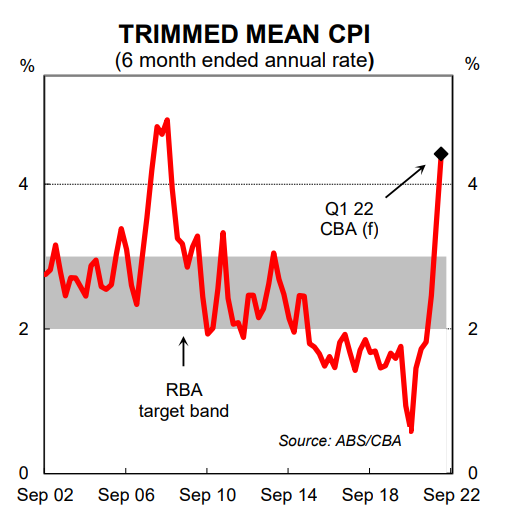
An anticipated 2.2% decrease in the terms of trade over Q4 21 will have a negative impact on nominal GDP, the broadest measure of national income. Nominal GDP will also capture the solid lift in consumer inflation over the quarter (recall that the Q4 21 trimmed mean CPI rose by 1.0%/qtr). And inflation in the building and investment space is also expected to have lifted. As such, we have the GDP deflator at 0.5% in Q4 21 which means we expect a quarterly increase in nominal GDP of 3.5% and an annual lift of 10.2%.
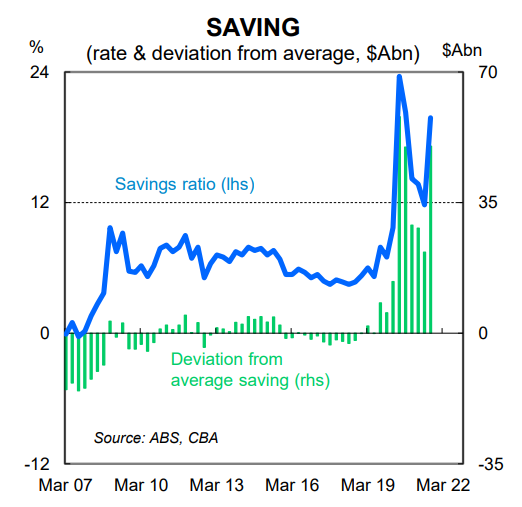
The savings rate will decline in Q4 21 from its very elevated level in Q3 21 courtesy of a big increase in household expenditure. CBA’s forecast is for the savings rate to fall from 19.8% in Q3 21 to 12.5% in Q4 21 – such an outcome would see the savings rate still well above its pre-pandemic average of ~6.0% (see facing chart).
The RBA’s forecast profile puts Q4 21 GDP at 5.0%/yr which implies a quarterly increase of 4.5%. That number looks incredibly strong to us and very hard to achieve based on already released partial data. Nonetheless, we don’t think the Q4 21 GDP data is particularly relevant from a monetary policy perspective.
GDP is backward looking and next week’s national accounts will simply confirm that the economy rebounded sharply in Q4 21 following the lengthy period of lockdowns and restrictions in NSW and Victoria.
Inflation data as well as upcoming labour market and wages data will determine when the RBA commences normalising the cash rate. The Russian invasion of the Ukraine adds an additional layer of uncertainty to our RBA call. But our base case remains that the will RBA will conclude at the June Board meeting that, “inflation is sustainably within the target range” and we expect them to lift the cash rate.