
CoreLogic has released its Best of the Best Report – an annual review of the Australian property market. Below are the key extracts:
2021 in review
In the 12 months to November 2021, the Australian housing market recorded outstanding figures. Distinct growth trends seen since the onset of the pandemic, along with the institutional responses to it, have been carried through to 2021.
The estimated value of residential real estate reached new record highs of $9.4 trillion through November. Sales volumes climbed to the highest levels in almost 18 years with an estimated 614,635 sales in the past 12 months. Nationally, dwelling values recorded an annual appreciation of 22.2%, the highest increase since 1989.
Strong housing market performance over the year was driven by multiple factors, including low interest rates, fiscal and institutional support for households, high household savings and relatively low levels of advertised listings. Rates of housing turnover have also been relatively low for a number of years before these factors boosted housing demand, which may also help explain the elevated volume of sales recorded over the past 12 months, which at November was 32.6% above the decade annual average.
2021 showed some similar growth trends to 2020. Annual growth in detached house values was 24.6% nationally, outperforming the 14.2% uplift in national unit values. The preference for detached housing may partly reflect the ongoing dominance of owner occupier demand in the housing market through 2021. ABS housing finance data suggests owner occupiers accounted for 72.6% of secured finance for the purchase of property in the past 12 months, compared to the decade average of around 65%. Previous research from CoreLogic has pointed to investor participation in the housing market having a stronger correlation with unit turnover, so the relatively low participation of investors through 2021 may have contributed to the relative weakness of growth in that sector.
The relatively weak performance of unit values may also be put down to the composition of unit stock in Australia. CoreLogic estimates that around 56% of Australian units are located in Sydney and Melbourne, where rents and values have also been particularly impacted by a lack of housing demand from overseas migrants amid international border closures.
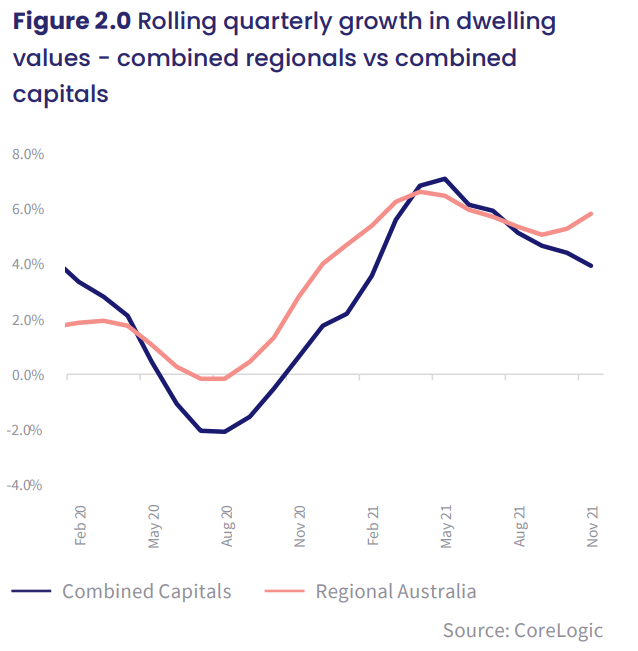
The combined regional dwelling market also continued to outperform in 2021, increasing 25.2% in the 12 months to November, compared with a 21.3% rise in combined capital city values. The preference for regional dwelling markets is due to a variety of factors, including extended lockdowns through 2021 reinforcing remote work trends which have eroded some of the appeal of cities, and the relative affordability that regions present for high income, remote workers. In the year to March 2021, ABS migration data suggests internal movement from cities to regions increased 5.9% on the previous year, while the number of people leaving regional Australia for the capital cities declined 3.5% in the same period.
The popularity of regional Australia is reflected in many aspects of the 2021 Best of the Best report. The quiet coastal suburb of Yamba, in the Coffs Harbour-Grafton region of NSW, achieved the highest annual growth in units for suburbs across Australia, at 56.6%. Regional suburbs were represented in many of the top value growth spots, including Ocean Grove units in Geelong (up 41.7% in the year), Fraser Island units in Wide Bay (up 48.2%), and Campbell Town houses in Tasmania (up 50.5%).
Similarly to strong regional performance, 2021 also saw relatively high growth rates across lifestyle markets within metro markets, such as the Mornington Peninsula in Melbourne, the Northern Beaches in Sydney, and the Gold Coast and Sunshine Coast markets in South East Queensland. This may, in part, be attributable to how COVID-19 continued to shape demand trends, with coastal or leafy settings being more desirable as more workers were empowered to work remotely.
However, this phenomenon may also just reflect market dynamics that have been observed in the housing market cycle over about a decade, where more expensive markets (particularly in Sydney and Melbourne) tend to show more volatility. This means during the upswing phase of the housing market cycle, expensive markets in these cities will generally see higher growth rates.
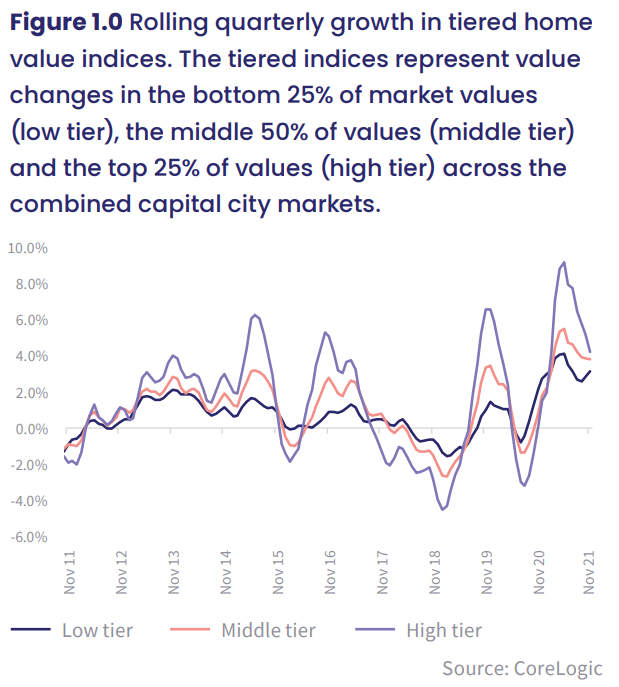
The strong performance across high end markets is also reflected in the 2021 Best of the Best report with the highest annual growth rate for houses recorded across St Andrews Beach in the Mornington Peninsula (with total house stock seeing an uplift of 58.6% in value over the year). The highest estimated value of turnover for houses was across Mosman ($1.8 million), one of the most expensive markets in Sydney, though two other Sydney suburbs saw the total value of sales for houses tip over $1 billion mark in the year to September.
Rental value appreciation was also high over the year to November with national rents recording the highest annual growth rate since January 2008 at 9.4%. This was led by growth of 12.5% across the combined regional market, compared with 8.3% across the combined capital cities. Unlike 2020 however, rental market increases have become more broad-based. Even the Melbourne unit market, which saw a peak to trough decline in rents of -8.5% between March 2020 and May 2021, has seen a recovery trend, with rent values now 1.7% higher over the year.
Despite extraordinary figures for the housing market, 2021 has also been marked by a softening of growth trends, with many of the driving forces behind the current upswing losing some impact in recent months.
As lockdowns lifted toward the end of 2021, there has been a surge in vendor activity, adding more listings supply to the market. In the four weeks to December 5th new listings hitting the market totalled almost 51,000, while the equivalent period in the previous five years averaged 41,800. The number of properties taken to auction across the combined capital cities reached a record high through the week ending 28th of November (at 4,251 auctions), before breaking the record again in the week ending December 12th (with just under 5,000 properties going to auction). Notably, by the end of 2021, total stock levels largely normalised across Sydney and Melbourne, which is where some of the fastest slowdowns in value growth rates have occurred.
The expansion of housing credit has also seen more elevated levels of potentially risky lending, which prompted a response from the banking regulator, APRA. Through October, the regulator announced changes to borrower serviceability assessment, which may slow credit growth moving forward, particularly in the investor segment. For owner occupiers, average new mortgage rates appear to be bottoming out, with RBA data suggesting they held at 2.73% for the three months to October. Any change in the finance segment that would constrain the availability of housing credit would have the effect of cooling housing market conditions.
Additionally, affordability has become a larger constraint on demand. The ratio of dwelling values to household incomes reached a new record high of 7.7 in June 2021, as did the number of years it takes to save a 20% home loan deposit (10.2 years). With higher barriers to entry, especially for new home buyers who do not have the benefit of accrued equity behind them, it is likely housing demand will be progressively impacted in the coming year as fewer households can afford to buy.
The constraints of slightly tighter credit conditions, the erosion of housing affordability and a higher level of listings being added to the market are expected to see softer growth in property values through 2022.
Outlook for 2022
It is likely that 2021 marked the peak of value growth across Australian dwellings, and may have also marked a peak for sales and listings activity.
As noted in the previous section, affordability constraints have worsened, vendor activity has surged toward the end of the year, and the housing finance space is currently showing signs of tightening and slowing. The accumulated force of these individual headwinds have led many of the major banks to forecast softer growth outcomes for 2022.
Softer growth rates are likely to coincide with fewer purchases, where sales and listings activity eventually move with momentum in price. The ‘time to buy a dwelling’ component of the Westpac-Melbourne Institute consumer sentiment reading has been softening, averaging 90.4 in the three months to November, down from 94.0 in the three months to August. Lower growth rates, and the possibility of a decline in dwelling values over the next few years, may also lead to a decline in vendor activity, as the opportune time to sell passes.
However, a slowdown in buyer and seller activity also mean a slowdown in debt accrual for Australian households. This may also mitigate the need for further interventions around risk in housing lending, following the increase to serviceability assessment buffers for borrowers by APRA in October.
Further near-term trends for housing market performance are outlined below.
A continuation of the changing buyer profile
In the three months to October, ABS housing finance data showed total values secured for the purchase of property fell -6.3% compared to the previous quarter, led by a decline in housing finance secured by owner-occupiers (both first home buyer, and non-first home buyer owner occupier finance fell).
First home buyer demand is expected to continue to fall in 2022, having fallen consecutively for the past nine months. Although in decline, the number of first home buyer loans secured (which was 11,402 through October) remains above the decade average (8,612), but could have further to fall amid deteriorating affordability, and the winding down of first home buyer incentives, which brought forward demand. This decline could be partially offset by any reactionary government policies in 2022, such as a refresh of federal government home loan guarantee schemes. First home buyer activity could also steady as property market conditions, such as typical days on market and new listings, start to shift in favour of buyers.
ABS housing finance data also shows investor activity has been the only source of growth in housing finance over the five months to October. But even in the investor segment, growth rates are starting to slow. In the three months to October, growth in secured housing finance for the purchase of investment property rose 4.2%, down from a recent high growth rate of 29.3% in the three months to May 2021.
Notably, international border closures have been accompanied by record low rates of foreign purchases of Australian real estate, highlighted in the June 2021 quarter NAB Residential Property Survey. NAB reported that the share of foreign buyers in established housing markets hit a record low 2.0% in the June quarter, and trended slightly higher at 2.2% in the September quarter. As with domestic housing purchases, more liberated international travel in 2022 and 2023 may see a ‘catch-up’ period of foreign acquisition of Australian real estate, as overseas investors and migrants can visit to inspect property. The return of foreign buyers and overseas visitors is likely to see a revitalisation of areas that have been traditionally popular with overseas arrivals, such as inner-city markets of Sydney and Melbourne.
More ‘affordable’ housing markets to see temporary boost
Periods of very high growth across desirable housing markets can push demand towards relatively affordable markets. In the three months to November, this has already become evident across several markets:
- Across Melbourne, outer-suburban areas such as Wyndham and Melton local government areas, among the lowest annual growth rates in dwelling values over the past year, are now among a handful of regions experiencing increased momentum in growth.
- Across Sydney, quarterly growth rates fell from 6.4% in August to 4.3% in November, as the median house value hit almost $1.4 million. The relatively affordable regional NSW, offering a median house value of around $695,000, has seen quarterly growth rates accelerate to 6.6% in the three months to November, up from 6.5% in the previous quarter.
- Across Canberra, quarterly growth rates are seeing an uplift across the unit segment, while growth rates are fading in the detached house segment.
While these more affordable housing markets may see a temporary boost through to the end of the current upswing, the momentum is expected to be temporary, with lower value housing markets expected to follow higher-end markets into a cyclical downturn.
A temporary resurgence in regional demand
The beginning of 2022 may be marked by a surge in demand for regional lifestyle markets, similar to the surge which followed the 2020 lockdowns. At the end of the extended Melbourne lockdown in 2020, migration patterns across Victoria saw a surge in departures from Melbourne to regional Victoria and Queensland in the fourth quarter of 2020 and the first quarter of 2021. It is not far-fetched to imagine this being repeated through the end of 2021 and beginning of 2022, as eased border restrictions make physical inspection and purchase of property easier for those who had been in lockdown across Sydney, Melbourne and the ACT. Given the popularity of South East Queensland regions from interstate migrants, the Sunshine state is expected to be a relatively strong performer through 2022.
This trend towards regional lifestyle markets is also supported by recent growth trends which has shown a notable divergence in the trajectory of quarterly growth between regional and capital city markets.
However, there may be forces that offset demand in regional Australia. For some buyers, housing markets that currently see better buying or renting conditions, such as the inner city suburbs of Melbourne, may draw demand from those that have been displaced from regional lifestyle markets. There may also be some mitigation of remote work trends through vaccine rollouts and return to office initiatives. The April 2021 edition of ABS Business Conditions and Sentiments survey indicated that while over 40% of Australian firms had embraced some level of remote working since the onset of the pandemic, this is expected to decline long-term. This may limit the number of feasible relocations from major metropolitan areas over time.
