Westpac with the note:
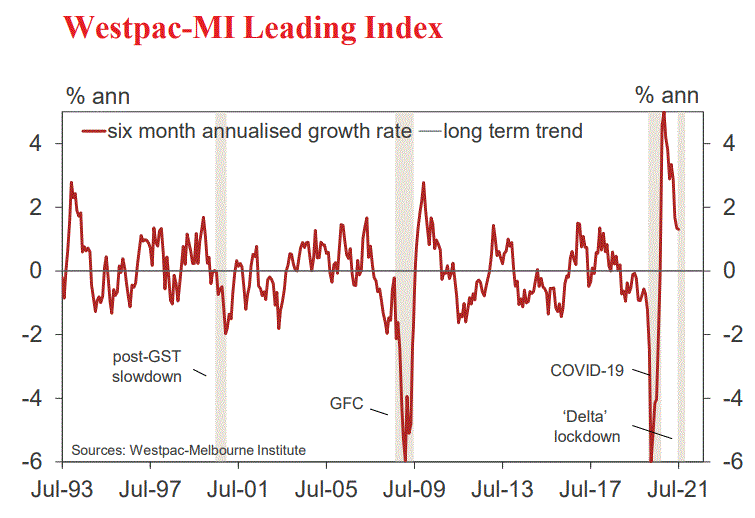
The Leading Index continues to slow but is still consistent with above trend growth over the next 3 to 9 months.
No Leading Index can accurately predict the impact of sudden virus lockdowns, although the direct effects of measures will start to become more apparent in the August Index.
With the deteriorating outlook in NSW and Melbourne, Westpac has revised down its forecasts for the September quarter to a contraction of 2.6% to be followed by a recovery in the December quarter of 2.6% and very strong growth of 5.0% in 2022.
We are expecting growth to resume at a solid above trend pace once the economy emerges from current lockdowns but are mindful of the uncertainties associated with the current health situation.
The Leading Index growth rate has slowed materially since the start of the year, from 3.83% in January to the current 1.30%. The component breakdown highlights the different drivers at play.
In some cases, the slowing is due to cycling a period of very strong gains, e.g. US industrial production (contributing 0.69pts to the headline slowdown) which has been moving out of a very strong post-COVID rebound, and dwelling approvals (–0.6ppts) which have been cycling a strong pull-forward in activity associated with the Federal government’s HomeBuilder scheme.
The deteriorating virus situation locally shows through clearly in sentiment-based components with big declines in the Westpac-MI UE index and the Westpac-MI CSI expectations index contributing 1.78ppts to the weakening since January. The deterioration and the ‘Delta lockdown’ in NSW are set to have a much bigger impact in coming months, particularly as hours worked are impacted – this component has been a significant positive for the growth pulse, adding +0.62ppts since January.
Momentum has been more mixed across ‘financial market’ components, commodity prices (measured in in AUD terms) adding about +0.1pt to growth momentum since Jan but moderating sharemarket gains and a slight narrowing in the yield spread more than offsetting this positive (–0.16ppts on a combined basis). The Reserve Bank Board next meets on September 6. At the August meeting the Board decided to maintain its policy stance, including the planned tapering of weekly bond purchases from $5 billion to $4 billion from early September. That surprised us given the sharp deterioration in the near-term outlook as Greater Sydney went into lockdown. Westpac advocated that the Board should instead immediately lift its purchases to $6 billion per week with a review at the November Board meeting.
Since the August meeting, Westpac has extended our assumptions about the likely timing of easing lockdown measures in NSW, from end September (the timing adopted by the RBA at the time of the Board meeting) to end October. We now also expect Melbourne to remain in full lockdown at least until early September.
At the August meeting the Board characterised the sudden deterioration in the economy as a short-term development and maintained prospects for a strong recovery.
Westpac’s forecasts agree with that broad assessment, but we also accept that there are significant uncertainties around this central scenario.
As noted, since that meeting, an even more severe near-term contraction seems certain. That may prompt a change in policy if more doubt were to emerge in the Board’s thinking on the pace and timing of the recovery.
It was also surprising that the advice to the Board, as set out in the Bank’s revised forecasts, was that the likely contraction in the economy in the September quarter will be “at least 1%” – much smaller than Westpac’s forecast at the time of a contraction of 2.2%. As noted, we have since revised that forecast contraction to 2.6%.
Given that the Board did not respond to risks in August it seems, for now, that it is likely to take the same approach in September. If so, we would see the bizarre development where the health situation causes a sharp contraction near term and the Board proceeds almost immediately with a tightening of its only active policy instrument.
The September Board meeting is three weeks away and as we have seen since the August meeting much can change over that period. We certainly cannot rule out a policy change in September especially if, as we assess, developments have raised some questions as to the vulnerability and timing of the expected recovery.