
As Melburnians suffer through their 200th day of lockdown since the beginning of the pandemic, medical experts have urged the Victorian Government to rethink its ban on playgrounds, warning the negative mental health impacts outweigh the tiny risks of coronavirus transmission:
Pediatrician Margie Danchin said the playground shutdown must be replaced with a nuanced plan to keep playgrounds open and protect children’s physical and mental health.
“We can’t underestimate how devastating these lockdown impacts are on children,” she said.
Parents taking their children to the park during lockdown had been an “absolute essential lifesaver for many families”, she said.
Professor Danchin called on the government to develop a plan that kept playgrounds open and where parks were regulated so groups of adults were not congregating, symptomatic children were banned, face masks were worn and food and drinks were prohibited.
Infectious disease paediatrician Robert Booy has also questioned the logic behind closing playgrounds, noting the risk of outdoor transmission was “very low”.
“If you put children under curfew, and you’re spending all of your time in cramped conditions with poor ventilation, where’s the transmission going to happen?” he asked. “Seventy-five per cent of transmission occurs right now in people’s homes”…
Melbourne paediatrician and child psychiatrist Alberto Veloso, is also treating a growing number of children, as young as five, who are struggling with anxiety and depression.
The Australian Medical Association (AMA) has also questioned the playground ban, claiming that evidence is needed to support the measure:
GP and former president of the AMA Dr Tony Bartone said the closure of children’s play areas was “a contentious point”.
“Children in this current outbreak are being overrepresented in the numbers”…
Authorities had “every right” to investigate the potential exposure at outdoor playgrounds “while we are at this really precarious state”.
“Clearly, once we have got that information, if it is not proven to be the case, we need to balance the mental health impacts and the wellbeing impacts by not allowing children into that playground area and providing their daily routine or their daily exposure to exercise and enjoyment.”
The Victorian police union is unhappy about the playground ban:
Police Association Victoria has taken a veiled swipe at the Andrews government over the closure of playgrounds as part of tougher COVID-19 restrictions in Victoria…
Police Association secretary Wayne Gatt said making officers enforce the closures risked damaging the relationship between police and the community…
“Please don’t assume that our members will be bursting out of their beds this morning to do this. It’s not something they signed up to do, it’s not something that drives them.”
Mr Gatt said officers would not refuse to enforce the closures, but they didn’t want to lose people’s confidence.
Whereas Victorian COVID commander, Jeroen Weimar, yesterday admitted there is no concrete evidence that virus has been transmitted at playgrounds, according to the ABC:
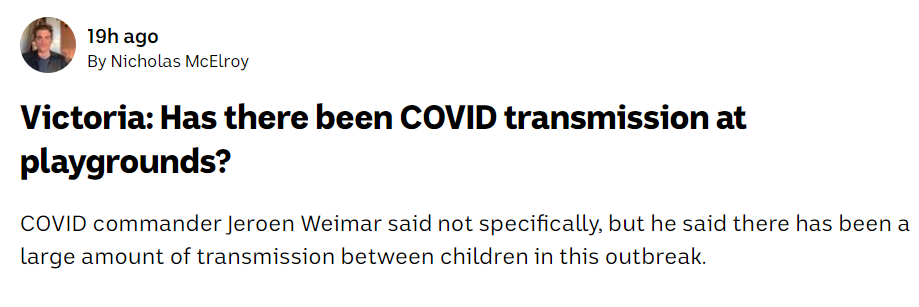
The Victorian Government keeps telling the community that it is “just following the evidence” when imposing COVID restrictions. Where is the evidence that playgrounds are risky vectors of virus transmission?
Public policy should be based on more than ‘the vibe’, especially when it negatively impacts people’s mental and physical wellbeing.
