From CBA’s head of Australian economics, Gareth Aird:
Key Points
- Next week the ABS will publish the Q2 Wage Price Index (18/8)and the July labour force survey (19/8).
- Hours worked will fall sharply, but the level of employment is expected to hold broadly steady in July.
- The August and September labour force surveys will capture the impact of the Greater Sydney lockdown on the level of employment.
- We expect the WPI to increase by 0.6% in Q2 21which would see the annual rate step up to 1.8%.
What to expect in the July labour force survey
The NSW economy is going through a big negative shock because of the extended lockdown in Greater Sydney. The lockdown started on 26 June and our assumption is that it extends through to the middle of the December quarter when ~80% of the adult population are expected to be fully vaccinated from COVID-19. This means that we expect a big negative hit to GDP and employment. But the impact of the lockdown on the level of employment will not be captured in the July labour force survey. Rather it will show up in the August and September surveys (we expect employment to contract by 300k over August and September with the risk of a bigger fall, particularly if the lockdown in Victoria is prolonged).
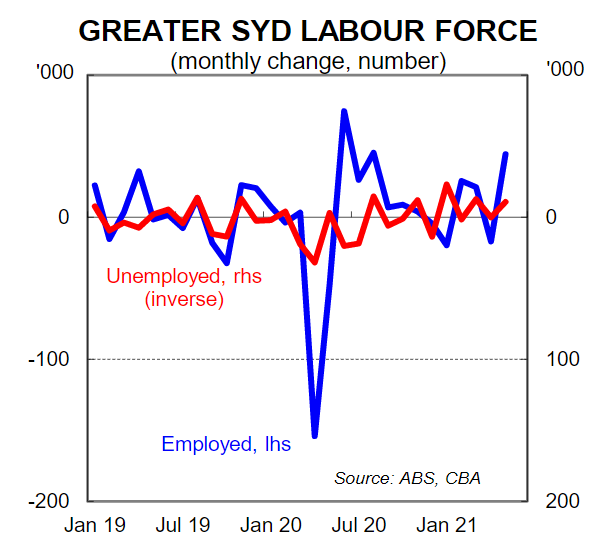
The reference weeks for the July labour survey are 27 June to 11 July. The ABS considers someone to be employed if they had a job but were not at work and were: away from work for less than four weeks up to the end of the reference week; or away from work for more than four weeks up to the end of the reference week and received pay for some or all of the four week period to the end of the reference week. This means that anyone in the July survey who did not work over the reference weeks due to the lockdown will be considered employed.
Our forecast is for employment to post a modest rise of 10k in July and for the unemployment rate to remain at 4.9%. We expect markets to discount the data. Instead markets will be focused on the August and September labour force surveys.
What to expect in the Q2 21 Wage Price Index (WPI)
The Q2 21 WPI is an important data release. It will give us an indication of how wages growth was tracking as the labour market was tightening (recall the unemployment rate was 4.9% in June). Private surveys suggest that wages growth accelerated over Q2 21. Indeed rising labour costs were a familiar theme that emanated from discussions with our client base over the June quarter.
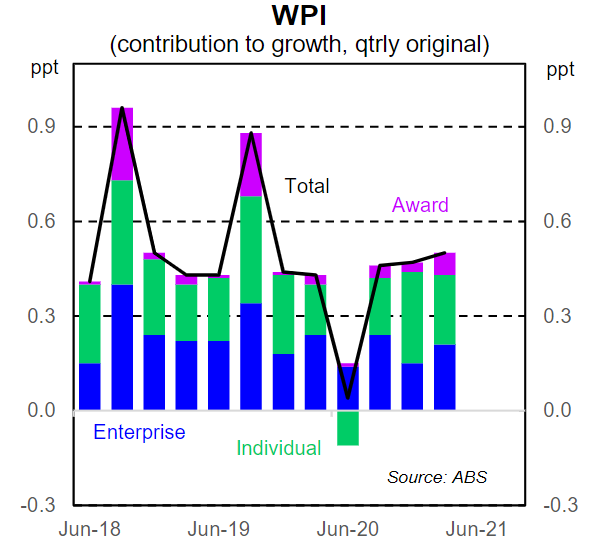
We expect the WPI to increase by 0.6% over Q2 21 which would take the annual rate to 1.8%. On a six month annualised basis we expect wages growth to be travelling at 2.4% in Q2 21.
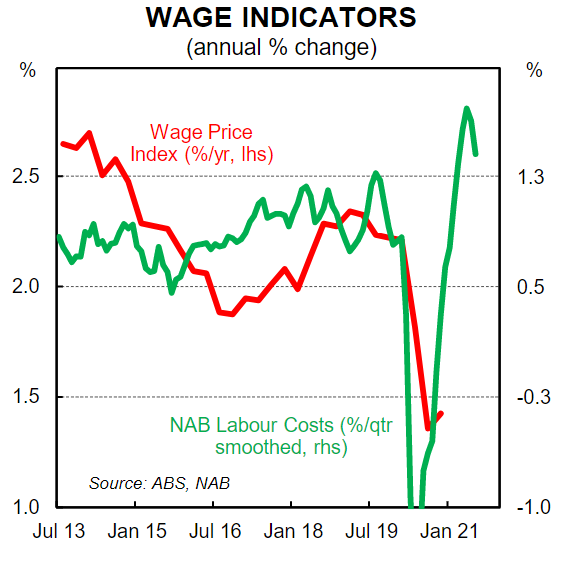
The outlook for wages growth is pivotal to the monetary policy outlook, particularly the cash rate. A lift in wages growth of 0.6% or above in Q2 21 would challenge the RBA’s forecasts in the August Statement on Monetary Policy that it will require an unemployment rate of 4.0% to see wages growth lift to 2¾%.
Our expectation is that wages growth will accelerate to 2¾% with an unemployment rate of 4.5% in late-2022 provided net overseas migration does not catapult back to its pre-COVID level when the international border is reopened.