
By Gareth Aird, head of Australian economics at CBA
Key Points
- We expect Q2 21 real GDP to rise by a modest 0.4%/qtr.
- We have downwardly revised our Q3 21 GDP estimate to look for a contraction of 4½%/qtr (from ‑2¾% previously).
- Economic outcomes in Q4 21 will be determined in large part by the length of the Victoria lockdown.
- There is a clear risk that Victoria joins NSW in being unable to achieve COVID zero and therefore stays in lockdown until a vaccination threshold has been reached.
- We estimate that 550k workers have been stood down because of the lockdowns in NSW and Victoria – the contraction in employment will show up in the August and September labour force surveys.
- We think that it will take time for the labour market to fully heal and forecast the unemployment rate to be 5.3% at end‑2021 and 4.9% by mid‑2022.
- We expect the RBA to announce at the September Board meeting that it will continue to purchase bonds at a rate of $A5bn per week until November (i.e. that it will delay the tapering of bond purchases).
Q2 21 GDP – a look in the rear vision mirror
The ABS will publish the Q2 21 national accounts on Wednesday 1 September. For most of the June quarter the Australian economy was travelling well. Production was rising and job creation was strong. Indeed the labour market was tightening quickly and the economy had transitioned from recovery to expansion mode.
But in late June the delta variant arrived in NSW and the subsequent COVID outbreak changed the game for the Australian economy. As such, the Q2 21 national accounts should be of little consequence to financial markets. Economists, however, will still dissect them to better understand how the economy was going over the June quarter. And of course we will look for information that contains a forward looking element.
Our preliminary assessment is that real GDP rose by 0.4% over Q2 21. That figure may appear a little soft compared with other economic data over the period. But lockdowns over the quarter will have had an impact on production. Consumer spending, which is the key source of uncertainty, is forecast to increase by 0.5%. Business investment will post a decent rise courtesy of a solid lift in plant and equipment spend. Public demand should be strong due to higher consumption and investment. Dwelling investment and net exports, however, will be a drag on growth.
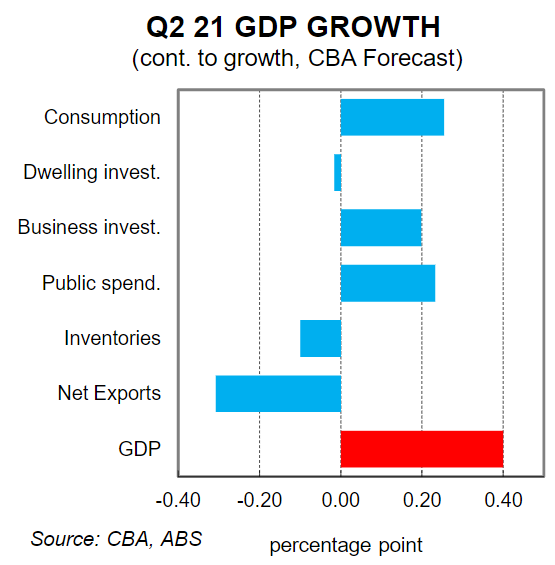
There is a risk that the ABS throws up a negative quarterly growth rate for Q2 21 GDP. Such an outcome would rubber stamp that the Australian economy is in recession. That said, we don’t place much weight on the technical definition of a recession which is defined as two consecutive quarters of GDP contraction. For all intents and purposes the Australian economy is currently in a manufactured recession as we go through another huge negative shock.
Q3 21 GDP –the hole has gotten bigger
In our updated economic outlook of 28 July we raised a few eyebrows with our assumption that Greater Sydney would be in lockdown until 80% of the 16+ NSW population were fully vaccinated. That seemed like a bold and rather pessimistic call to make. But it seemed the most likely outcome based on the trend in daily new COVID cases and the reaction function of the NSW Government. It meant that we forecast a very large 2.7% contraction in Q3 21 GDP and only a partial rebound of 1.9% in Q4 21. That forecast took us to the most pessimistic end amongst the major forecasters. But analysts across the board now recognise NSW will be in lockdown until a vaccination threshold has been reached and so the consensus has shifted towards a big negative GDP print in Q3 21.
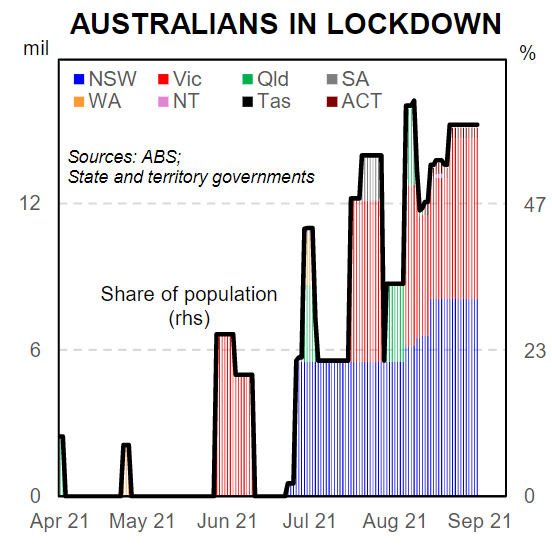
We are not in the habit of ‘nowcasting’ as throwing out too many revisions can confuse the message. But our forecast of 28 July needs to be refreshed to take into account the situation in Victoria.
Most residents in Victoria have been in lockdown since mid-July. There was a short reprieve in early August, but the lockdown weeks are adding up and so is the economic damage. At the time of publication the number of daily COVID cases in Victoria continues to trend higher which means the reopening date is getting further away.
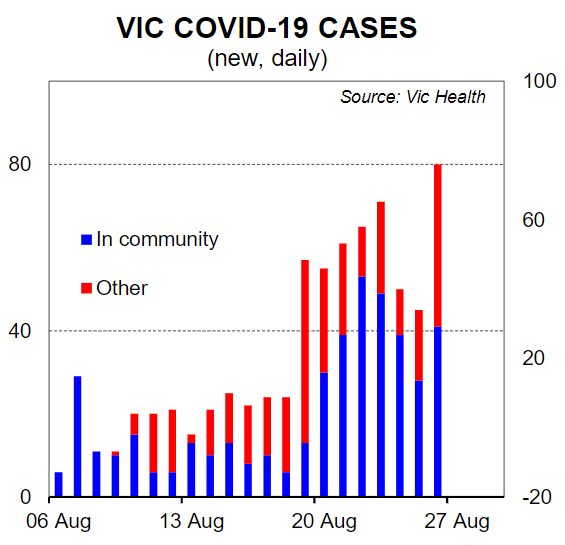
We are not ready to say that Australia’s second largest state is consigned to the same fate as NSW and that Victorians will be in lockdown until a vaccination threshold has been reached. But it’s not looking good. Either way, we don’t expect Victoria to be out of lockdown before the end of September which means the hit to GDP and the labour is very big.
We now expect GDP to contract by 4½%in Q3 21.
Q4 21 GDP –rebound conditional on Victoria
The extent of the rebound in GDP over Q4 21 will largely be dictated by when Victoria comes out of lockdown. If Victoria has managed to achieve their objective of COVID zero and has reopened by early in the December quarter then the bounce in activity will look solid. But if they are stuck in lockdown until they have hit their vaccination target the rebound will be muted given we expect NSW will also be in lockdown until the middle of Q4 21.
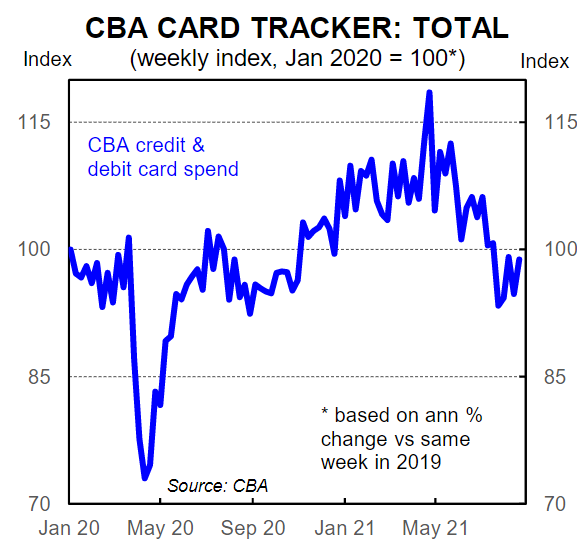
Of course the economic data must get better once NSW and Victoria reopen as the base will be so low. However, working the other way will be a surge in COVID cases on reopening in NSW which will add all sorts of complications to the near term economic outlook. As discussed last week, residents in NSW will be the first Australians to experience ‘living with COVID’. There will be a significant period of adjustment for households and businesses as the virus circulates within the community in large numbers and hospitalisations rise. It will mean that the economic recovery, at least initially, is a bumpy ride. And it will simply be a matter of time before the virus has spread across the entire country.
If Victoria is out of lockdown by the start of October then we expect a rebound in GDP of ~3¾% in Q4 21. Such an outcome would see GDP in the December quarter 0.9% below its Q2 21 level. This is our central scenario. If, however, Victoria remains stuck in lockdown until the 80% vaccination target has been reached we would expect a more muted rebound of ~2¼%. Note that on current vaccination rates NSW will hit the 80% threshold earlier than Victoria.
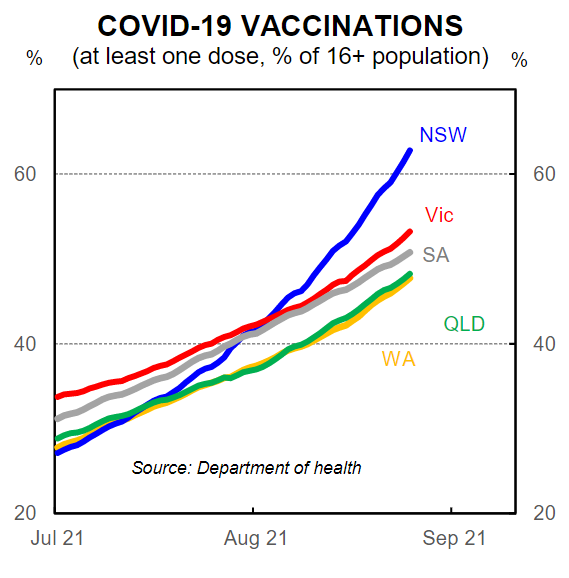
Our central scenarioputs GDP at 1.4%/yr at Q4 21 and 4.7%/yr at Q4 22.
What happens to the labour market
The ABS July labour force survey threw up a hodgepodge set of numbers as lockdowns and classification issues impacted the results. That is likely to remain the case over coming months as people drop out of the labour force temporarily which renders the unemployment rate misleading. Notwithstanding, the hit to the labour market from the NSW and Victoria lockdowns will be evident in the August and September reports. We remain of the view that employment in NSW will contract by ~300k (it will show up in the August and September surveys). We now also expect to see a fall in employment of ~250k in Victoria with the bulk of job losses showing up in the September survey. These outcomes would see national employment down by ~550k in September as compared with July (we don’t expect much job creation across the rest of the country).
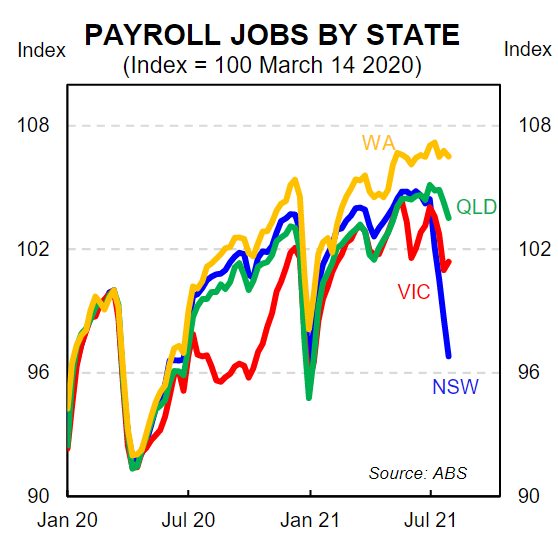
The significant majority of workers stood down in NSW and Victoria will drop out of the labour force. This means that the participation rate will fall and the rise in unemployment will be a lot more modest than the fall in employment. Most workers will return to employment when lockdowns are over, but not all. There are still expected to be restrictions on activity which will weigh on consumption and by extension employment. In addition some businesses will have closed their doors permanently as a result of the extended lockdowns.
We have nudged up our 2021 year end unemployment rate forecast to 5.3%.
The economy in 2022 –a tale of two halves
The intention of this note is not to take a deep dive into the economic outlook in 2022. We will do that in due course. For now, however, we think the best way to think about the outlook in 2022 is through the sporting analogy of a tale of two halves.
The first half of 2022 will be about adapting to ‘life with COVID’. It will be a new experience for Australia. The economy will move forward, but it won’t be smooth sailing. For a large chunk of the population, pent up demand will be unleashed and that will boost services consumption. But many individuals may be deterred in the beginning from getting out and about as COVID cases increase significantly. Indeed it is likely that a large chunk of office workers will want to continue to work from home as COVID cases rise, which would have implications for CBDs. More targeted fiscal support will be required to keep businesses afloat during this period.
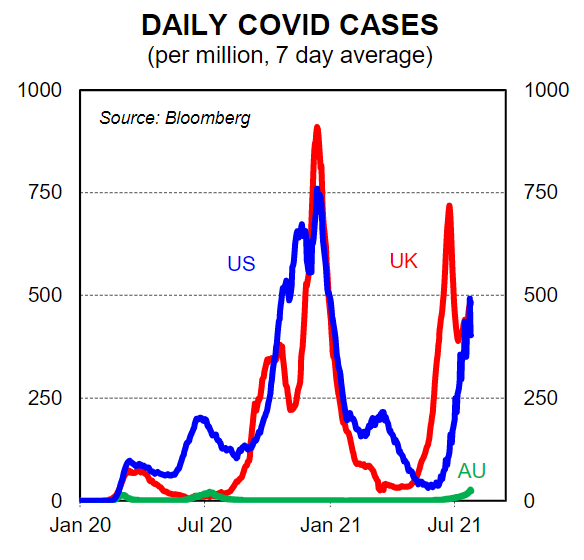
The second half of 2022 should look very good. We are optimistic that by the middle of next year Australians will have adjusted to ‘life with COVID’. Our expectation is that we will have moved to a place that is similar to where the UK is now. Namely that life has returned to normal and we treat COVID in much the same way as we treat other viruses. At that point we think the economy will start to fire on all cylinders.
The international border is set to be fully reopen by mid-2022 which will boost demand in the economy. Consumer confidence should be high and households are likely to dip into the unprecedented war-chest of savings that will have been accumulating since the pandemic started. We estimate households will have put away at least $A200bn or 10% of GDP above and beyond what is normally saved over the pandemic period. The savings rate could drop like a stone if consumers get the taste to make up for lost spending. And business investment should lift as uncertainty generated by COVID recedes and animal spirits return.
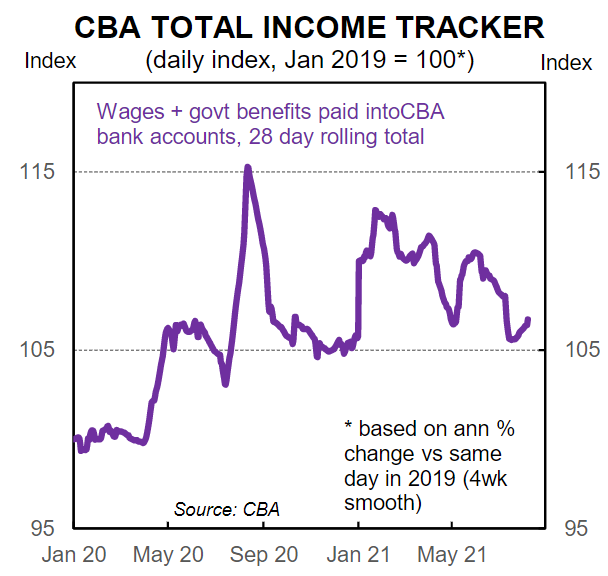
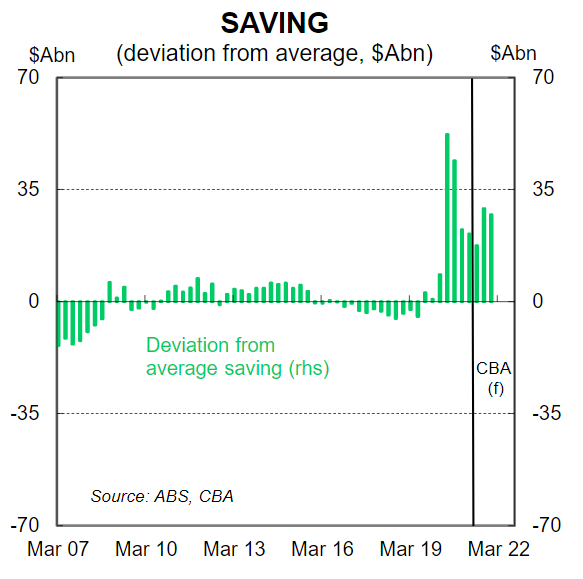
The future beyond our adjustment period therefore looks very good. But policymakers cannot focus solely on the medium term. They have a very important role to play over the next 6-9 months as Australians move away from lockdowns and learn to live with COVID.
Will the RBA stick with its decision to taper in September?
The RBA surprised us at the August meeting by sticking with its decision announced at the July Board meeting to taper bond purchases from early September. We had expected the Board to announce that it would defer its decision to taper given the lengthy lockdown in Greater Sydney. The August Statement on Monetary Policy(SMP) published a few days later gave us more detail as to what underpinned the decision not to reverse the taper. In a nutshell the RBA had an incredibly rosy baseline for the economy. The RBA’s central scenario for the economy had GDP down by ‘only’ 1.0% in Q3 21 before increasing by 2.4% in Q4 21. The RBA assumed that Greater Sydney would be out of lockdown by the end of September and the economy would “bounce back quickly”. Clearly that picture has changed and the baseline scenario in the August SMP is no longer fit for purpose.
At the September Board meeting we expect the RBA to recognise that the hit to GDP and employment will be a lot more significant than they anticipated in August. And we expect them to acknowledge that ‘living with the virus’ will be a new experience for Australia that will create more economic challenges, at least initially, than they previously expected. The appropriate policy response is therefore not to proceed with the taper.
To be clear, the impact on the economy of buying bonds at a rate of $A4bn per week as opposed to $A5bn a week is negligible. And we understand the RBA’s reluctance to reverse course. But the optics of tapering when the national economy is going through a huge negative shock with a highly uncertain future do not look good. The path of least regret should be to keep the pace of bond buying steady, particularly given debt issuance will step up due to the negative economic shock.
We do not subscribe, however, to the idea that the RBA will scale up its bond purchases (i.e. shift from $A5bn to $A6bn per week). The decision not to proceed with the taper will be a significant enough deviation from the announcement in August. And the signalling that scaling up carries would detract from the RBA’s messaging around the medium term outlook for the economy.
As such, our working assumption is that the Board will simply announce in September that they will continue to purchase bonds at the current rate of $A5bn per week through to November.
