
From Gareth Aird, head of Australian economics at CBA:
Key Points:
- We expect Q1 21 real GDP to increase by a strong 2.0%.
- Annual growth, revisions aside, should step up to 1.1%.
- Household consumption, dwelling investment and business investment will make significant contributions to growth.
- Net exports will be a big drag on growth.
- We expect nominal GDP to increase by a large 4.4% which would see annual growth accelerate to 4.7%.

The Q1 21 national accounts, due for release on Wednesday, will confirm that the Australian economic expansion continued at a strong pace in the March quarter. A big increase in employment will underpin the lift in production despite some short and sharp localised COVID-related lockdowns across a number of jurisdictions.
On our estimates real GDP rose by a big 2.0% in Q121. Such an outcome would see GDP 1.1% higher over the year. On our figuring quarterly GDP in Q1 21 moved above its pre-COVID high by 0.8%(recall that GDP contracted by 0.3% in Q1 20 and the peak in economic output was Q4 2019).
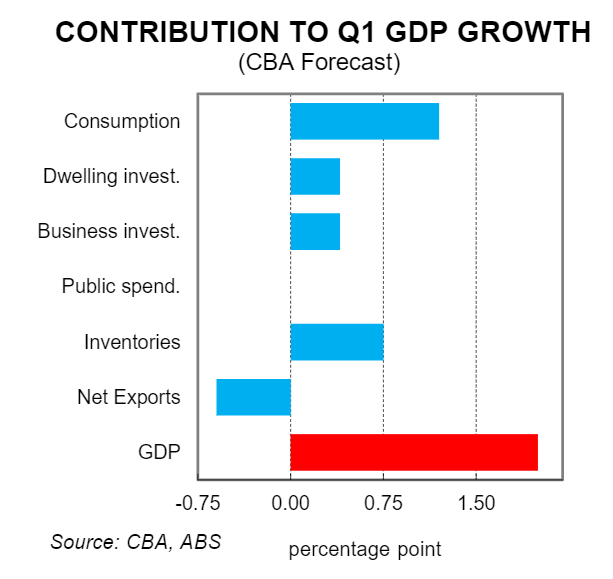
The quarterly GDP growth rates have naturally moderated since the low point in GDP in Q2 20.But it is worth keeping in mind that our2.0% forecast increase in Q1 21 GDP is a very strong outcome considering population growth has ground to a halt. It means that the growth in total output is roughly equal to the growth rate of per capita output which ultimately underpins living standards.
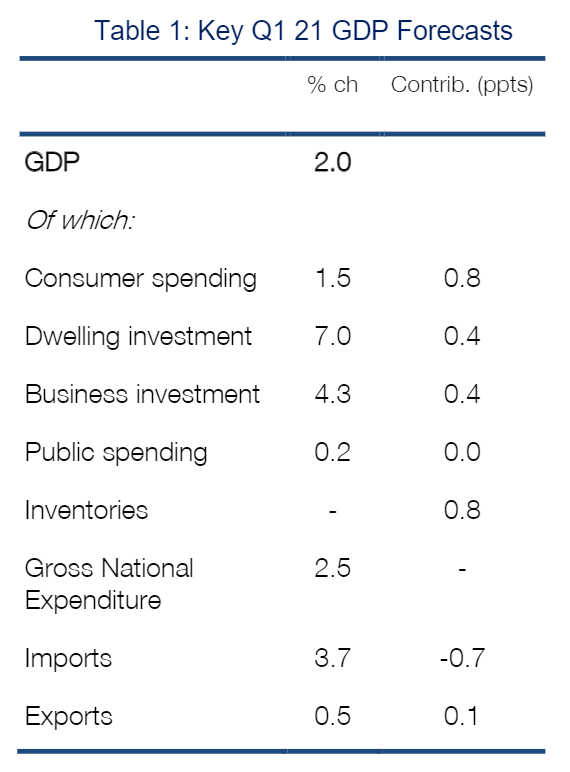
The breakdown of GDP (E) is expected to indicate that all key components of private domestic final demand contributed solidly to growth in the March quarter. In contrast, the external sector will be a decent drag on growth because export volumes rose by a lot less than import volumes. In summary, the data for Q121is expected to show:
- another solid increase in household consumption driven by spending on discretionary services: CBA(f) +1.5% (note that this is the key source of uncertainty);
- a very large rise in residential construction because of strong rise in new buildings and massive increase alterations & additions: CBA (f) +7.0%
- a sharp lift in business investment driven by plant and equipment: CBA(f) +4.3%
- a modest lift in public demand which comprises a strong lift in public investment partially offset by a fall in recurrent expenditure: CBA(f) +0.2%;
- a 2.1%increase in inventories which will add 0.8ppts to growth
- a solid 0.6ppt negative contribution to growth from net exports.
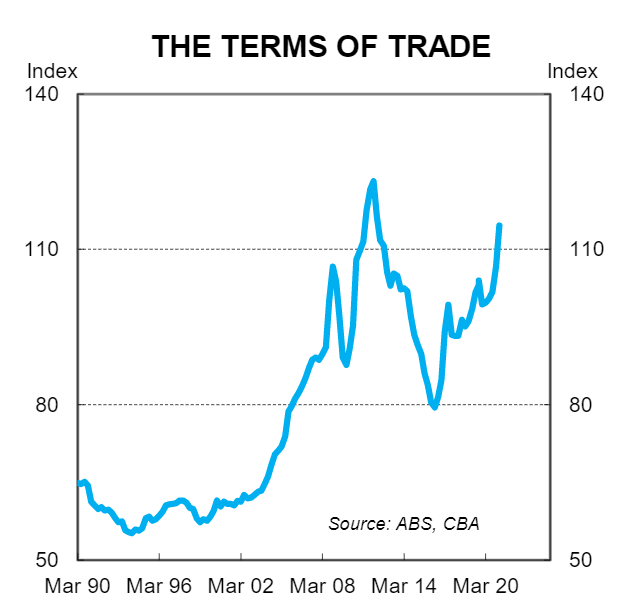
The whopping 7.4% increase in the terms of trade over Q1 21 will have a large positive impact on nominal GDP which will also reflect the modest rise in consumer prices (recall that the Q1 21 trimmed mean CPI was +0.3%/qtr). We have the GDP deflator at 2.4% in Q1 21 which means we expect a quarterly increase in nominal GDP of4.4%. Such an outcome would see national income 4.7% higher through the year – a remarkable achievement in many respects.
The household income account will once again be a particular focus for us in Wednesday’s national accounts. A big lift in household disposable income was one of the defining features of the economic landscape over the COVID period. Our internal data indicates that household income remained elevated in Q1 21 despite the tapering of government stimulus as privately generated income grew strongly.
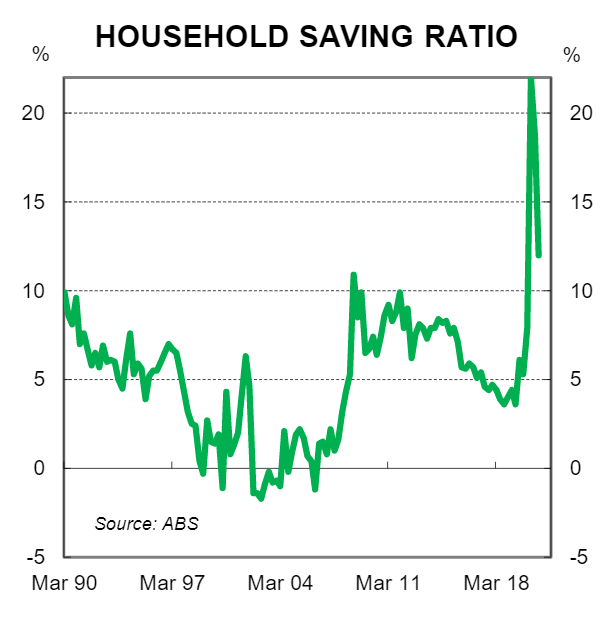
The savings rate is expected to fall over Q1 21 but still remain well above pre-COVID levels which means there will be a further accumulation in savings across the household sector (CBA (f) is for the savings rate to be 9½% in Q121 – down from 12% in Q4 20).
There are unlikely to be any direct policy implications from the national accounts on Wednesday. GDP is backward looking and the JobKeeper program remained available to eligible businesses over the March quarter. Policymakers are much more focused on the state of the economy post-JobKeeper and how the expected further tightening in the labour market will impact the outlook for wages and inflation. There is not a lot of information in the national accounts outside of the income and savings figures that will help with that assessment. That said, a lift in real GDP of 2.0% that pushes the quarterly level of GDP above its pre-COVID high supports our view that the RBA will not shift the target bond for yield curve control (YCC) to the Nov 24 bond at the July Board meeting. And it supports our view that the RBA will taper its asset purchase program (note that we hear from the RBA at 2.30pm today–no policy changes are expected).
Finally, the recent outbreak of COVID-19 in Victoria and resultant lockdown is a stark reminder that health outcomes are still very important for the economic outlook. Our bullish outlook for the economy and our above consensus forecasts for wages and inflation are contingent on the assumption that any outbreaks of COVID-19are traced and well contained and significant restrictions are not reimposed for an extended period.
