
By Gareth Aird, head of Australian economics at CBA
Key Points
- Lockdowns to stop the spread of COVID‑19 have a large and immediate negative impact on consumer spending and by extension GDP and hours worked.
- But government compensation payments to households and businesses help to cushion the financial blow from lockdowns.
- Household savings spike during lockdowns which supports a swift rebound in spending when restrictions are eased.
Overview
The old adage that ‘one person’s spending is another person’s income’ rings true in normal times. Indeed the standard relationship between spending and income and by extension consumption and production is at the heart of a capitalist economy. But in many respects capitalism is temporarily suspended during lockdowns. The reduction in income that would normally occur through a fall in spending is offset (either partially or fully) by government compensation payments to households and businesses.
Snap lockdowns to stop the spread of COVID-19 in Australia have unfortunately returned. Melbourne exited a two week lockdown on 10 June while Greater Sydney is currently in a two week lockdown that is scheduled to end on 9 July. Perth, Brisbane and Darwin are also in the midst of short lockdowns.
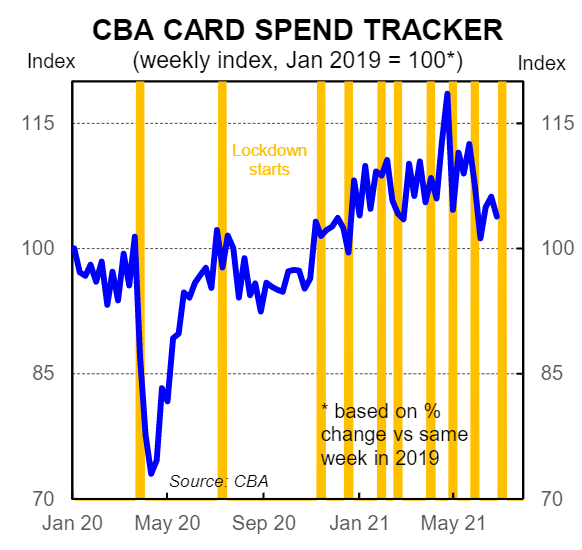
Lockdowns have a very large and immediate negative impact on spending. Indeed that is the natural consequence of placing restrictions on households and businesses to limit the spread of COVID-19. But the impact on income is not as big due to ‘compensation’ payments from the public to the private sector.
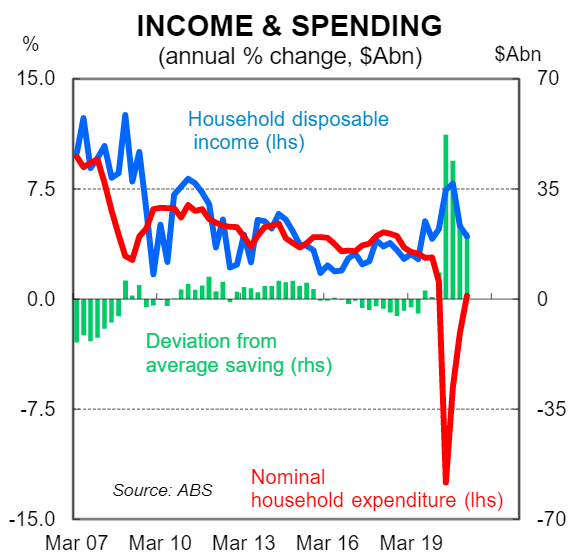
Last year is an interesting case study. The fiscal payments to households and businesses during the national lockdown were so large that a counterintuitive situation unfolded. More specifically, household income and company profits went up as spending collapsed. Huge payments from government to households and businesses held the economic machine together as private demand collapsed. In fact, the positive shock to income continued even as restrictions were eased over the second half of 2020.
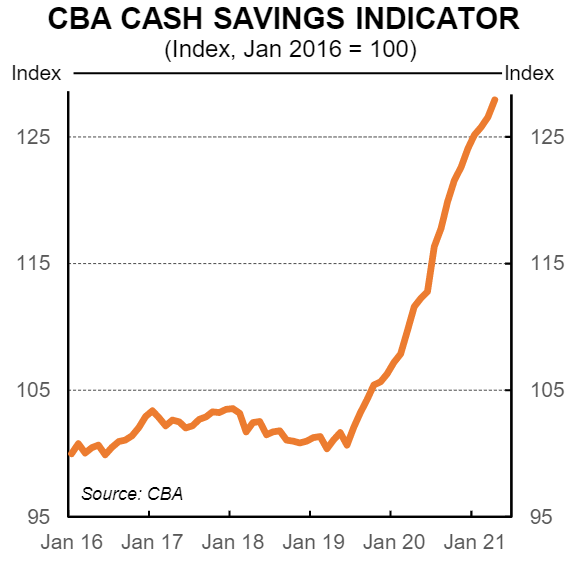
A similar dynamic is underway because of the latest lockdowns, albeit the compensation payments to households are not as large. Basically the drop in spending means less GDP (this is the direct economic cost). But the loss in income that would normally be commensurate with such a decline in GDP is nowhere near as big because of government payments. This means that households are still accumulating savings at a much faster rate than usual and the savings rate will remain well above its pre-COVID normal over Q2 21 and Q3 21. A partial drawdown of savings will be a tailwind on household consumption in 2022.
To be clear, we are not suggesting that lockdowns don’t have negative economic consequences for households and businesses. Rather we are simply highlighting that there is a clear difference between the hit to spending as compared with the hit to income.
Compensation to households and businesses for the financial costs associated with a lockdown is fair. It also means that the economic damage from a lockdown is minimised and spending can rebound swiftly out of a lockdown. If the current lockdowns across the country end as scheduled then the damage on the macroeconomy will be minimal and the economic outlook will remain strong.
