On Wednesday 11 March 2020, the World Health Organization (WHO) declared COVID-19 a global pandemic. Restrictions were progressively rolled-out across Australia and the nation was subsequently plunged into a nation-wide lockdown.
Australia’s property market was initially negatively impacted. Inspections and auctions were stopped, millions of Australians lost their jobs or were thrown onto the JobKeeper wage subsidy, and the 5-City dwelling values index began to fall.
However, the subsequent rebound has been spectacular, with all major capitals experiencing strong growth since the depths of the COVID-19 recession.
To commemorate the one year anniversary of the COVID-19 pandemic in Australia, I have plotted the evolution of the CoreLogic daily dwelling values index across the five main markets from 15 March 2020 (the unofficial beginning of the pandemic) to 15 March 2021:
After suffering initial losses, Australia’s property market has rebounded strongly.
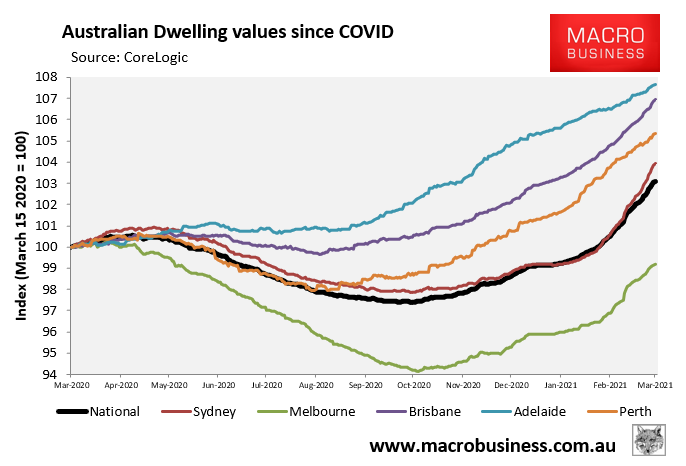
Below are the key price changes across each major market.
Sydney:
Sydney dwelling values initially fell 2.1%, bottoming on 13 October 2020.
Since then, Sydney values have rebounded 6.2% to be 3.9% higher than the pre-COVID level on 15 March 2020.
Melbourne:
Melbourne dwelling values initially fell very sharply, declining 5.9% to 18 October 2020.
Values have since rebounded strongly, rising 5.4%. However, they remain 0.8% below their pre-COVID level on 15 March 2020.
Brisbane:
Brisbane only experienced a moderate 0.3% decline in dwelling values, bottoming on 16 August 2020.
Since then, Brisbane values have surged 7.3% to be 6.9% above their pre-COVID level.
Perth:
Perth values initially declined 2.0%, bottoming on 22 August 2020.
The rebound has been swift, with Perth values rising 7.5% from their low to be 5.3% above their pre-COVID level.
Adelaide:
Adelaide dwelling values did not suffer any value decline during the initial stages of the COVID pandemic. Instead, values have risen 7.7% from their pre-COVID level on 15 March 2020.
5-City Aggregate:
Dwelling values at the 5-City level initially declined 2.6%, bottoming on 13 October 2020.
The rebound has been swift, rising 5.9% from their low to be 3.1% above their pre-COVID level.