CoreLogic’s head of research, Eliza Owen, has produced interesting research on the massive surge of rental listings across Australia’s inner-city markets:
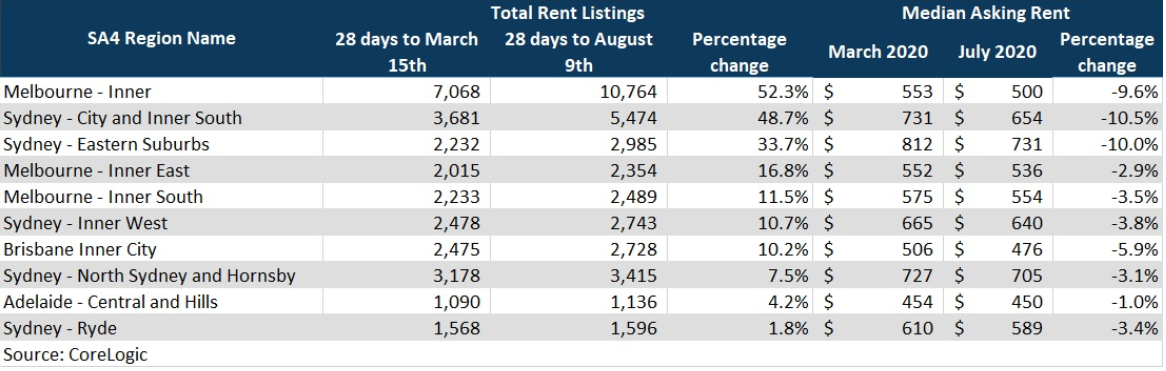
The increase in rental listings represents the change in the level of total rental stock counted in the 28 days leading up to the 15th of March, the week in which Australia recorded its 100th case of COVID-19, compared with that counted in the 28 days to August 9th.
Of the 88 SA4 regions measured across the country, 78 regions saw a decline in the volume of rental listings between these dates. Focussing on the 10 regions that have seen an uplift in total rental stock, 8 were regions across Sydney and Melbourne, while inner-city Brisbane and the Adelaide Central and Hills have also seen an increase in rental stock.
The dominance of Sydney and Melbourne with regards to heightened rental supply highlights the much localised nature of the shock to rental demand that has been seen since the onset of the pandemic.
It is expected seasonally that most areas would see a decline in rental listings, as rental stock on market is usually highest at the beginning and end of each year. For the four years prior to 2020, rental stock on market at mid-August has on average, been -3.2% lower than what is seen over mid-March.
However, the 10 regions that did see an uplift in rent listings are large rental markets. Together, CoreLogic data suggests these regions account for about 27.6% of Australia’s total rent market.
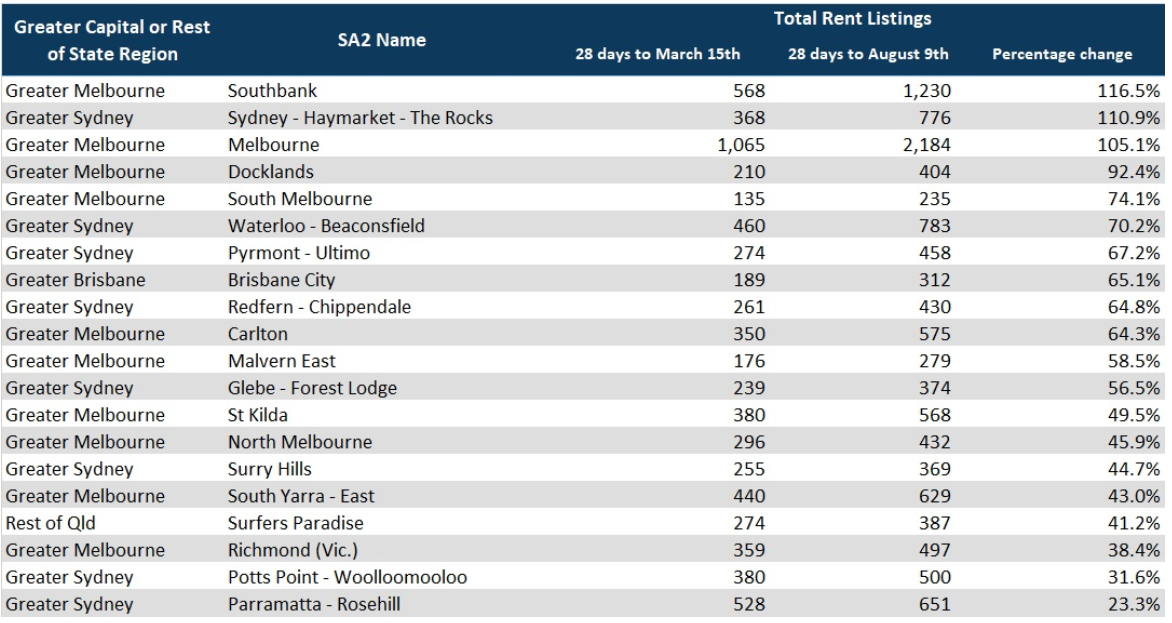
More geographically granular data shows some of the highest uplift in rental stock is across Inner Melbourne and Sydney City and Inner South. SA2 regions with the largest uplift in advertised rental stock are shown below.
The regions with large accumulations in rental stock reflect many of the pain points that have come with the COVID-19 downturn, particularly more recent commentary which has highlighted the gaping hole in housing demand because of international border closures. This is because the majority of new migrants to Australia are renters, at least initially. The 10 SA4 regions which have seen an uplift in rental listings between March and August, together accounted for 29.1% of the net overseas migration to Australia over the year to June 2019.
Other factors contributing to the heighted level of rent listings include a recent history of significant supply additions via a surge in high-rise construction activity, while the demand side has been additionally impacted by the weakness in labour markets typically associated with renters, including food and accommodation as well as the arts and recreation sector.
These trends highlight some of the acutely impacted markets. Due to the relatively high level of investor concentration, particularly in inner-city apartment markets, the patterns in rental supply and demand point to added downside risk for values in these precincts until international borders re-open and labour market conditions tighten.
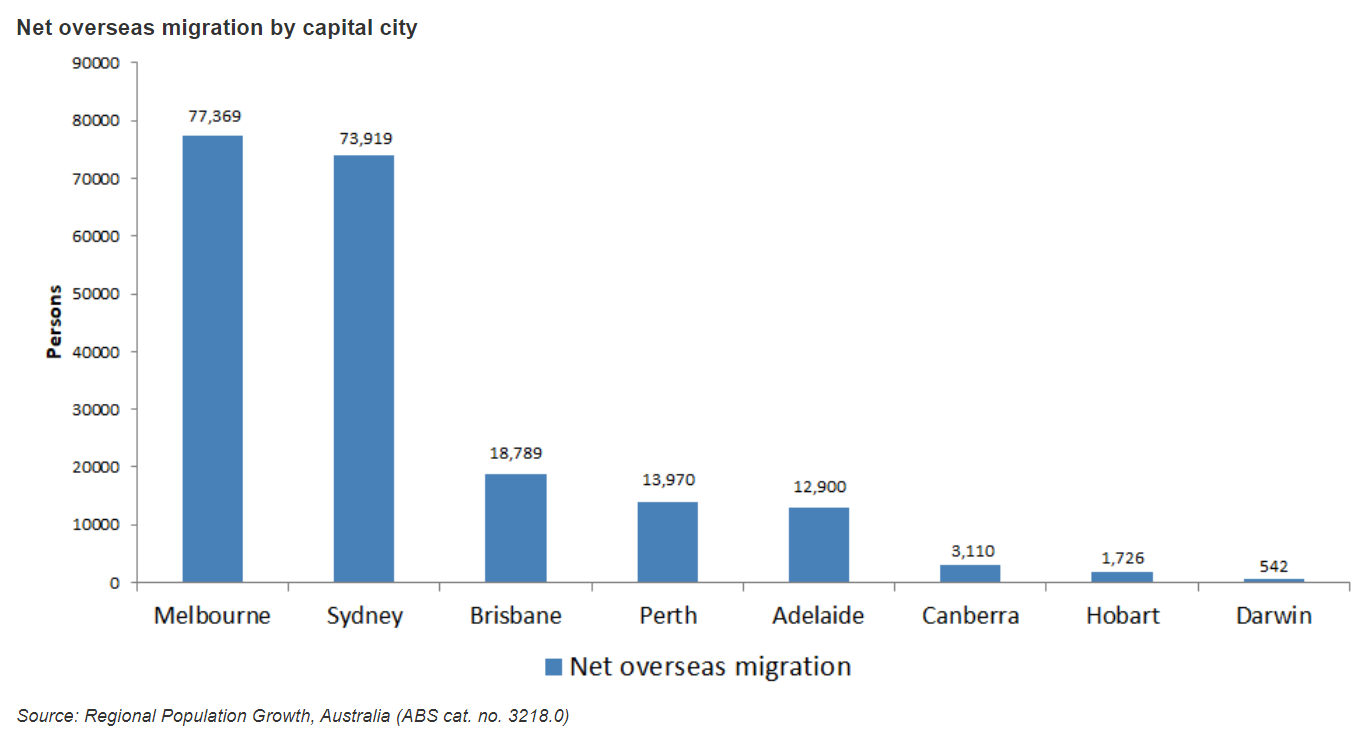
Property investors in Sydney and Melbourne are obviously most at risk, given these two cities are by far the key landing points for migrants, which has collapsed (2018-19 net overseas migration shown below):
Advertisement
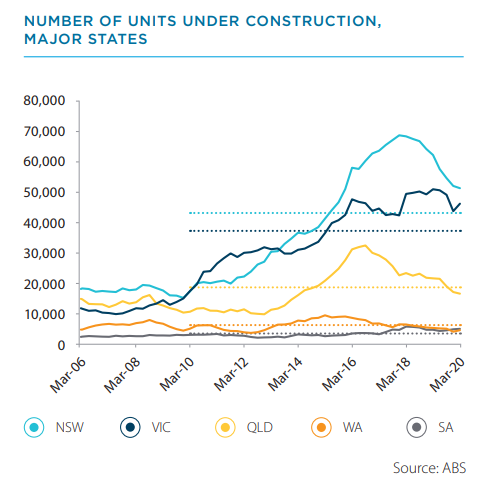
To add insult to injury, the supply pipeline remains strong in these two markets, with lots of dwellings yet to come online, especially in the investor-dominant apartment space:
With both property prices and rents falling across Sydney and Melbourne, there is the clear and present danger that loss-making investors will sell en masse, thus leading to a feedback loop of falling prices and forced sales.
Leith van Onselen is Chief Economist at the MB Fund and MB Super. He is also a co-founder of MacroBusiness.
Leith has previously worked at the Australian Treasury, Victorian Treasury and Goldman Sachs.