Associate Professor Salvatore Babones has released another terrific paper illustrating how an obsession with climbing the international university rankings has driven Australia’s elite Group of Eight (Go8) universities to binge on Chinese students:
Executive Summary:
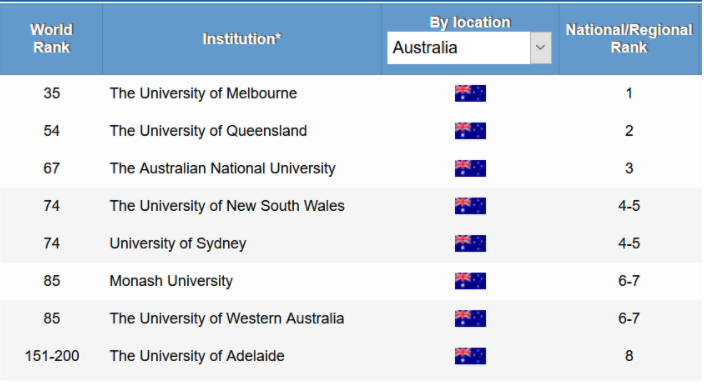
Australian universities are always keen to tout their international rankings success, but the Academic Ranking of World Universities (ARWU) published August 15 was explicitly designed to meet the policy priorities of the Chinese government:
It includes Nobel Prizes, but excludes those in Literature or Peace
It gives credit for Scientific research, but excludes the Arts and Humanities
It focuses entirely on research, with credit for teaching or service
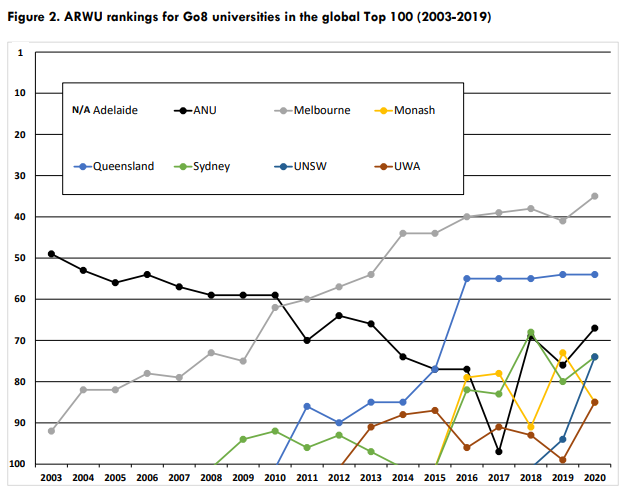
Australia’s Group of Eight (Go8) universities have risen on the ARWU rankings mainly through the recruitment of a small number of ‘Highly Cited Researchers’ (HCRs), with circumstantial evidence suggesting that many of them have been recruited from overseas:
Australia’s proportion of the world’s HCRs has risen from 1.71% in 2004 to 4.36% in 2019
The company that produces the HCR list specifically notes that “Australian research institutions appear to have recruited a significant number of Highly Cited Researchers since 2014”
Only 4 of the Go8’s 162 HCRs are in the social sciences, and none in the humanities (which are not included in the list)
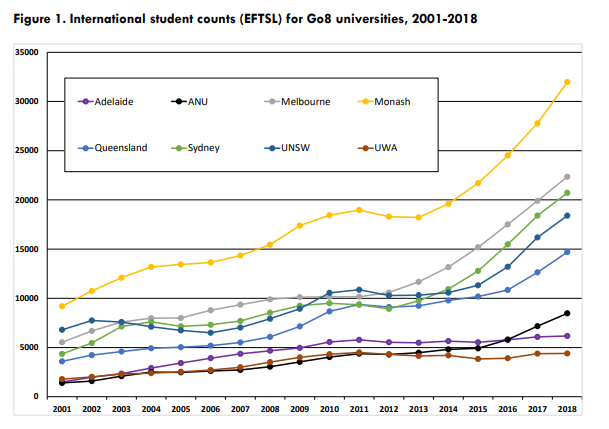
The recruitment of overseas HCRs has been made possible by excess revenues extracted from international (primarily Chinese) students, whose numbers have increased dramatically at Go8 universities since the turn of the millennium:
Since 2001, international student enrolments at Go8 universities have increased 272%, from 34,185 in 2001 to 127,176 in 2018
Throughout the 2010s, an average of 37.3% of Australia’s international students have come from China
Chinese students account for approximately 68% of international students and 26% of all students at Go8 universities
Since 2012, the five Go8 universities that have experienced high and expanding Chinese student enrolments have rapidly improved their ARWU rankings:
Monash
Melbourne
Sydney
Queensland
UNSW
Meanwhile the three Go8 universities that experienced more modest growth in international student enrolments saw their ARWU rankings fall, or didn’t make it into the global Top 100 at all (ANU, Adelaide, UWA).
In order to succeed in China’s ARWU rankings system, Go8 universities have relied heavily on pulling one specific lever: the recruitment of star academics from a limited global list of HCRs. The five universities that have been particularly successful in doing so are the same five universities that, before the coronavirus crisis, became most reliant on Chinese student fee income: Monash, Melbourne, Sydney, Queensland, and UNSW.
As they now face massive revenue shortfalls, Go8 universities are aggressively lobbying for a financial bailout – and a quick return to business as usual for international student recruitment. They should instead refocus their ambitions away from the pursuit of Chinese rankings and toward the education of Australian students.
Too right. MB has frequently questioned the odious links between international students and university rankings.
In a nutshell, a system has been created by the federal government and Australia’s universities to encourage strong growth in full fee paying international students via:
Advertisement
The Australian government offering the world’s most generous student visa working rights and opportunities for permanent residency; and
Australia’s universities dropping entry and teaching standards.
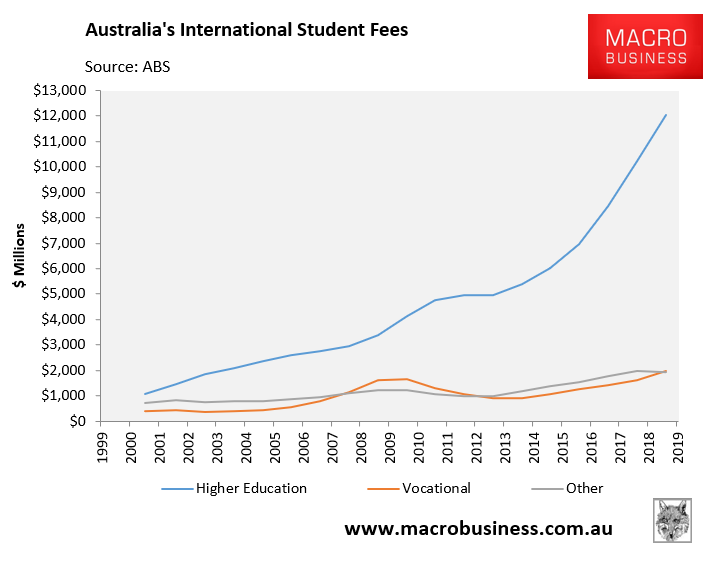
The bounty from exploding student numbers (see next chart) has then been funneled into research aimed purely at propelling Australia’s universities up international rankings.
As gaining a higher ranking equates to more prestige and is a sign of quality, these rankings were then used as a marketing tool to further grow international student enrolments, alongside justifying higher fees.
Advertisement
What was lost in this whole debacle was the deleterious impacts on local students.
While Australia’s universities funneled international student dollars into research to boost their rankings, actual teaching quality was degraded.
Advertisement
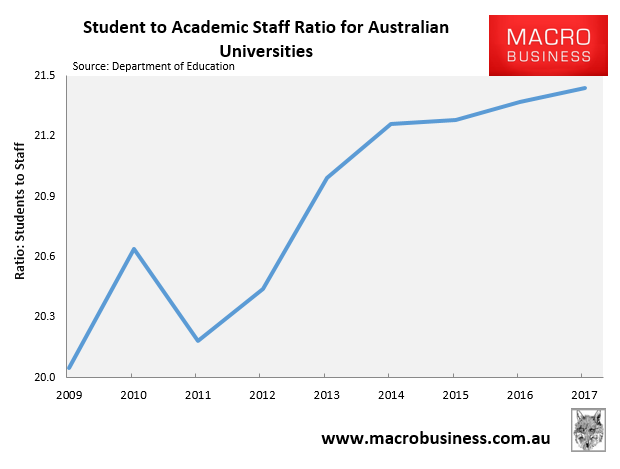
This is illustrated by the next chart plotting the ratio of students to academic staff, which rose considerably across Australia’s universities over the long international student boom:
As we know, the lion’s share of international students arrive from Non-English Speaking Backgrounds (NESB), and presumably require much more teaching effort than domestic students. As such, the bigger student loads, along with the higher effort required for international students, suggests a significant erosion of both teaching capacity and quality across Australia’s university sector.
Advertisement
Domestic students have also been made to carry NESB students through their courses via group assignments, which occurred alongside growing incidences of cheating and soft marking as international student numbers soared.
Instead of fussing over bogus rankings to pump-up international student numbers, Australia’s universities must return to their primary function of providing high quality education to local students.
Operating low-quality degree factories for maximum revenue was never in the national interest.
Leith van Onselen is Chief Economist at the MB Fund and MB Super. He is also a co-founder of MacroBusiness.
Leith has previously worked at the Australian Treasury, Victorian Treasury and Goldman Sachs.