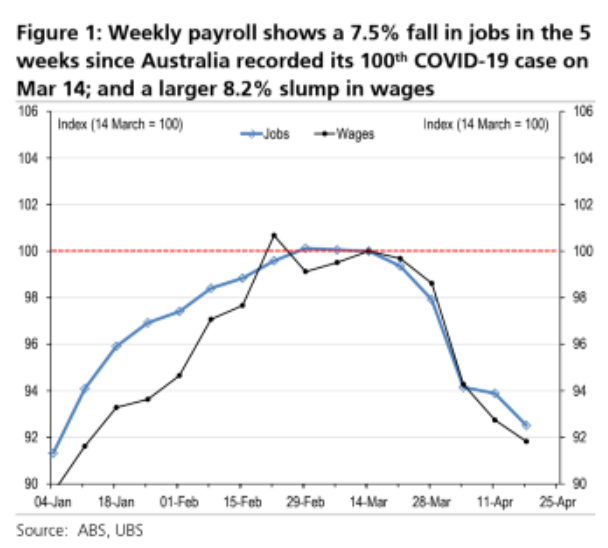
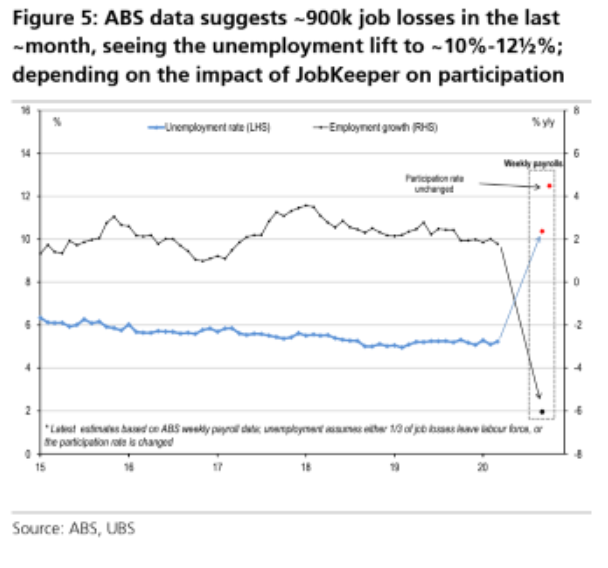
Yesterday, UBS released grim analysis showing that Australia’s unemployment rate had likely surged to around 12% on a constant participation rate basis, with aggregate wages also falling by around 8.2%:
Implied unemployment rate now ~12%+; upside risk to our 10½% forecast. If we assume no offsetting decline in participation, the ~1mn job losses would see unemployment hit ~12%+, the highest since the Great Depression. That said, even assuming 1/3 of these job losses result in lower participation (and hence not count as ‘unemployed’), then the unemployment rate would still spike to ~10%…
Wages already slump 8.2% in 5 weeks, or -$22bn, equivalent to ~4½% of GDP. The payrolls data also shows a further 2.6% decline of wages in the two weeks to April 18, after -5.7% in the prior 3 weeks, for an even larger total drop of 8.2% since March 14. Assuming this 8.2% fall translates to both quarterly wages (i.e. Compensation of Employees) and small business income (i.e. unincorporated household enterprises, or Gross Mixed Income), the total drop in income is $22bn, or ~4½% of quarterly GDP.
Separate data from the ANU also shows that “declines in employment are largest for those aged 18-24 years”.
St George economics chief economist Besa Deda said while house prices still rose across Australian capital cities in April, the full effect of job and wage losses had not been felt in the housing market.
“It’s still too early and the falls will come as the months go by, as the stress builds up in households, incomes become under pressure and unemployment starts to rise,” Ms Deda said…
“It does suggest that housing demand will weaken and we will see falls in house prices,” Ms Deda said.
“But as we’ve seen in previous downturns, the annual average house price decline can be quite small.”
During the early 1990s recession, unemployment rose to just over 10 per cent, but house prices across Australia’s capital cities only fell by about 6 per cent.
Economists have predicted anywhere between a 10 and 20 per cent decline in house prices as a result of COVID-19 depending on how long the lockdown lasts, and how the economy recovers once it reopens.
“The economic outlook has improved over the past few weeks with our success in controlling COVID-19, but it’s still going to be tough times for many months ahead,” Mr Wiltshire said…
“The reality is if people feel nervous about their jobs, it’s not conducive to making a big purchase like a home.”
While the outlook is obviously uncertain, falls in house prices of more than 10% seem all but certain, especially in Sydney and Melbourne where prices are most overvalued.
Consider the strong headwinds:
Advertisement
Heavy job losses and falling household disposable incomes;
Collapsing immigration;
Rising rental supply and falling rents as Airbnb’s get dumped on the long-term market; and
Credit tightening as banks become more cautious about borrowers’ job security.
These are to worst conditions facing the Australian housing market in generations.
Leith van Onselen is Chief Economist at the MB Fund and MB Super. He is also a co-founder of MacroBusiness.
Leith has previously worked at the Australian Treasury, Victorian Treasury and Goldman Sachs.