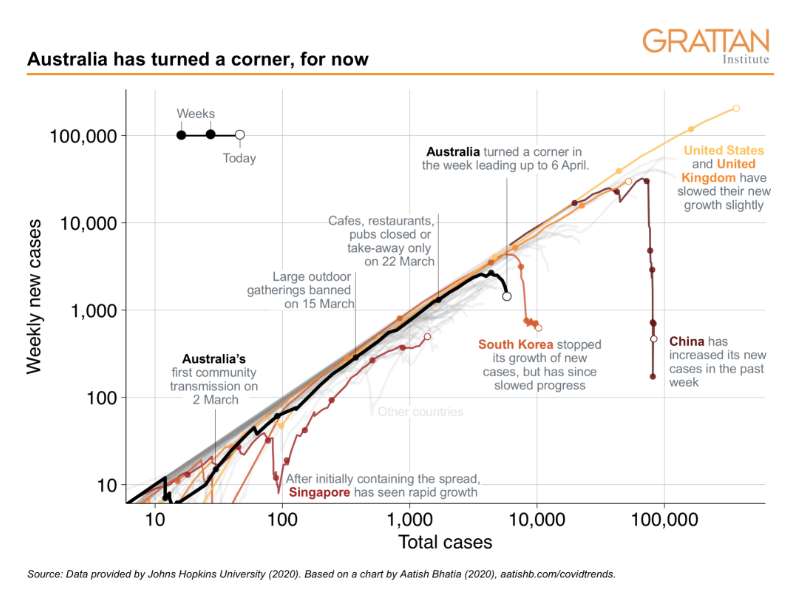
The Grattan Institute has provided more data showing that the lock downs across Australia are working to slow the spread of the coronavirus; although it recommends against policy makers becoming complacent and lifting restrictions too quickly:
Our new chart below, inspired by Aatish Bhatia, shows total COVID-19 cases on the horizontal axis and new weekly cases on the vertical axis, both on a log scale.
Five countries are highlighted, some with trajectories like ours, others not so. The United States and United Kingdom had several weeks of exponential growth, with little sign of slow down.
China hit 80,000 total cases and then sharply turned the corner, reducing new cases dramatically. But while new cases have fallen in China, and South Korea like it, new cases have lingered at between 200 and 600 per week. This shows that getting to near-zero new cases is not a given after countries slow the spread.
Singapore minimised the spread of COVID-19 early by tightly controlling its borders and implementing broad contact tracing. But it then had a dreaded ‘second wave’ – a second round of rapid growth in new cases. In response, Singapore has introduced more stringent social or spatial distancing measures, closing schools and ordering non-essential workers to work from home.
Australia has turned a corner, but we cannot afford to become complacent. Relaxing our spatial distancing efforts could result in the number of new COVID-19 cases in the community increasing again. Lifting our restrictions too early could result in a second wave of rapid growth.
The message from Grattan’s new graph is clear: Australia must be careful about when we lift restrictions, what restrictions we lift, and in what order.
Obviously, more good news on the virus containment fight. However, this will be a long and painful war that will probably only end once a vaccination has been developed. How long’s a piece of string?
Leith van Onselen is Chief Economist at the MB Fund and MB Super. He is also a co-founder of MacroBusiness.
Leith has previously worked at the Australian Treasury, Victorian Treasury and Goldman Sachs.