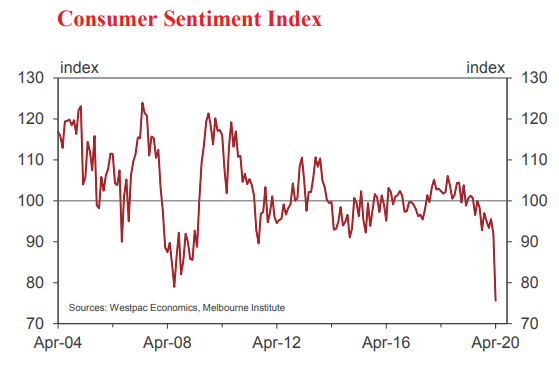
The Westpac-Melbourne Institute Index of Consumer Sentiment plunged 17.7% to 75.6 in April from 91.9 in March.
This is the single biggest monthly decline in the forty seven year history of the survey, taking the Index beyond GFC lows to levels only seen during the deep recessions of the early 1990s (64.6) and early 1980s (75.5).
However, it is pertinent to note that the lows in previous recessions were reached after one to two years of continuous deterioration compared to the one month collapse we have seen here. Certainly we cannot rule out the Index dropping below the historic low of 64.6 we saw in November 1990.
The details of the survey which are discussed below are all very disturbing and reflect the large shocks to jobs and spending. However the most surprising message is the collapse in confidence in the housing market.
The survey comes after an extremely turbulent month in which the Coronavirus outbreak has evolved from serious concern to full-blown pandemic. Confirmed cases globally have soared from around one hundred thousand at the time of the last survey to nearly two million currently. In Australia, the number of cases has surged from just 76 a month ago to around 6,500. Australian governments have instituted widespread shutdowns on movement and social activity that have effectively banned many forms of economic activity.
While the drop in confidence this month is severe, it could well have been worse. Despite the bleak and threatening backdrop, Australia’s pandemic experience to date has been much less debilitating than that of the hardest hit areas abroad. The number of cases is high but has not overwhelmed Australia’s health system, with recent evidence showing a clear slowing in new cases that indicates policy measures are working to contain the spread. These developments give some support to our view that the Australian economy will lift in the December quarter following three consecutive quarters of economic contraction.
We have also seen a swift and effective response from governments, highlighted by the Federal government’s $130 billion JobKeeper Payment scheme. Westpac has estimated that without the Payment the unemployment rate would have soared to 17% by the end of June compared to a peak of 9% with the Payment scheme. Note that previous recessions saw the unemployment rate peak at 11.2% (early 1990s) and 10.4% (early 1980s).
All five component sub-indexes fell in April. By far the biggest falls were in the near term outlook for the economy and in attitudes towards spending – reflecting the immediate effects of the shut-down.
The ‘economy, next 12 months’ sub-index recorded a spectacular 31% drop (the biggest monthly fall on record), taking it to 53.7. That compares to a low of 53.2 during the GFC and lows during previous recessions of 34.2 (early 1990s) and 42.1 (early 1980s).
However, the extreme negative economic outlook is confined to the near term with the ‘economy next 5yrs’ sub-index down just 3.8% in the month. At 87.0, this subindex is still comfortably above recent cyclical lows (it averaged 85.5 over the second half of 2014). We suspect the relatively resilient medium term view on the economy reflects the expectation that virus disruptions will be temporary whereas respondents were unable to envisage the sequence of events that would rescue the Australian economy in the 1980s and 1990s recessions.
Views on family finances show a substantial hit with more pressure expected in the year ahead, albeit with a less negative assessment than for the wider economy. However, unlike the short term economic outlook, there have been sharper historical monthly falls in this sub-index.
The ‘finances vs a year ago’ sub-index dropped 14.8% to 70.4, an eight year low. However, the ‘finances next 12mths’ sub-index recorded a milder 6.6% decline, holding at just under 91 – a negative view overall but far less negative than the 12mth expectation for the economy.
Component-wise, the biggest drop this month was in the ‘time to buy a major household item’ sub-index which posted a 31.6% plunge – the sharpest on record – to 76.2.
This was the lowest reading since the record low of 71 set in October 2008. The plunge likely reflects multiple factors including health concerns around being in shopping environments, ‘social distancing’ restrictions making shopping more difficult, direct pressures on family budgets and a reluctance to make ‘big ticket’ purchases at a time of heightened risks around the economy and job security. Not surprisingly the sub-index is signalling very difficult times for retailers selling major household goods.
This month’s survey included several additional questions covering: work arrangements; the ability to cope with school and childcare closures; and how consumers plan to spend the Federal government’s stimulus payments.
The responses on work arrangements make for particularly sobering reading. Of those that were employed in March, 7% reported losing their job over the last month. A further 14% reported being temporarily stood down without pay.
This survey result implies that over one in five workers have lost their entire wage income.
Unsurprisingly, the highest incidence of lay-offs and unpaid stand downs – running at 47.5% – is amongst those in the accommodation, café and restaurant sector. The recreational services and retail sectors also reported a high incidence of labour shedding. More surprisingly, the ‘health and community services’ sector also had a high incidence of shedding suggesting conditions are contracting sharply outside of the core health services sector (i.e. hospitals, GPs etc). Note that the wider ‘health sector’ also includes gyms, fitness centres and ‘allied health services’ such as physiotherapists and chiropractors. Other sectors that reported a surprisingly high incidence of lay-offs and both paid and unpaid stand downs were manufacturing (34%) and construction (26%).
Just over 34% of those employed reported they were working from home most of the time, with a particularly high incidence amongst those working in sectors such as communications (79%), finance and insurance (69%), education (60%) and government administration (57%).Just under a third of respondents who worked said that closures of school and day care centres would impact their ability to work, with 7.4% saying they would be unable to work at all.
On the Federal Government’s fiscal payments – the $750 Economic Support Payment, and the $550/fortnight top-up to the Jobseeker Payment – responses were a little mixed.
Amongst the 53% of consumers receiving or expecting to receive a payment, 27% intended to spend it all and a further 20% expected to spend over half. That is decidedly more restrained than the spending associated with similar fiscal stimulus measures during the GFC (when 62% of consumers reported spending all of the payment).
The Westpac-Melbourne Institute Unemployment Expectations Index jumped 8.2% in April following on the sharp 8.5% jump in March. At 158.1, the index is at a five year high (recall that higher readings indicate that more consumers expect unemployment to rise in the year ahead).
While the index has deteriorated sharply over the last two months, the overall level is not as dire as for general sentiment – the latest reading is still well below the GFC peak of 183 and 165-170 peaks seen during the early 1990s and early 1980s recessions. This more balanced response may also reflect the expectation that job losses, while extreme in the near term, are unlikely to be sustained through the whole year.
Sentiment around housing collapsed in April with assessments of both ‘time to buy’ and ‘price expectations’ plunging to the most negative levels since the GFC. The drop was consistent across all major states.
The ‘time to buy a dwelling’ index dropped 26.6% – the biggest monthly decline on record. That said, at 82, the index is still above the GFC low of 67.1 and previous cyclical lows in December 2003 (73.2), June 1989 (44.8) and September 1974 (61.5).
Consumer expectations for house prices fell even more sharply. The Westpac-Melbourne Institute Index of House Price Expectations Index dropped by over half (–50.8%) to just 69.7 in April. While this measure has a much shorter survey history, the fall is nearly four times bigger than the largest monthly decline since we started running the question regularly in 2009. Responses to a similar survey run prior to 2009 suggest the index level in April 2020 is comparable to the weakest reads seen during the GFC.
The Reserve Bank Board next meets on May 5 with the Bank also due to release revised economic forecasts in its May Statement on Monetary Policy on May 8.
The Bank has lowered the overnight cash rate target to the effective lower bound of 0.25%; achieved a target level for the three year bond rate of 0.25% through direct purchases in the secondary market; used open market operations to restore adequate liquidity to the money markets; acted across the bond curve to restore order; and provided the banks with a $90b three year term funding facility at 0.25% to ease funding costs.
It seems likely that the Board considers it has done its duty to support the economy and will now look to governments if further support for the economy is required.
David Llewellyn-Smith is Chief Strategist at the MB Fund and MB Super. David is the founding publisher and editor of MacroBusiness and was the founding publisher and global economy editor of The Diplomat, the Asia Pacific's leading geo-politics and economics portal.
He is also a former gold trader and economic commentator at The Sydney Morning Herald, The Age, the ABC and Business Spectator. He is the co-author of The Great Crash of 2008 with Ross Garnaut and was the editor of the second Garnaut Climate Change Review.