A group of planning academics from the University of Wollongong have penned a paper in Australian Planner (the journal for town planners) entitled “Portrayals of the tiny house in electronic media: challenging or reproducing the Australian dream home”, which attempts to portray “tiny homes” as a possible replacement for the Great Australian Dream of owning a detached house:
ABSTRACT
The Australian home is embedded within social norms that align the ideal dwelling with the large detached suburban house and mass-consumption.
In this paper, we present a Foucauldian discourse analysis of Australian electronic media representations of the tiny house to better understand how this dwelling type might challenge the normalisation of the Australian dream home.
Our analysis suggests that the tiny house is a crucial site both for contesting and normalising sets of ideas that constitute the Australian dream home.
Those advocating for tiny house living tap into narratives of ‘less is more’ and ‘debt free living’ that trouble dominant Australian housing social norms by generating material spaces that suggest affinities with affordability, slower-paced off-grid living, and enhanced sustainability.
Yet, the electronic media representation of the tiny house simultaneously reproduces dominant housing social norms around luxury (even ‘in nature’) and a still unfettered material consumption.
To conclude we draw out the broad implications of these contradictory media representations of the tiny house for Australian planners.
If papers like this means that Australia’s planning movement is fastening to tiny homes as a solution to Australia’s housing affordability crisis, then they have badly failed the Australian public.
Let’s be clear: tiny homes are really just a rebranding of caravans, made to make them appear trendy and sustainable.
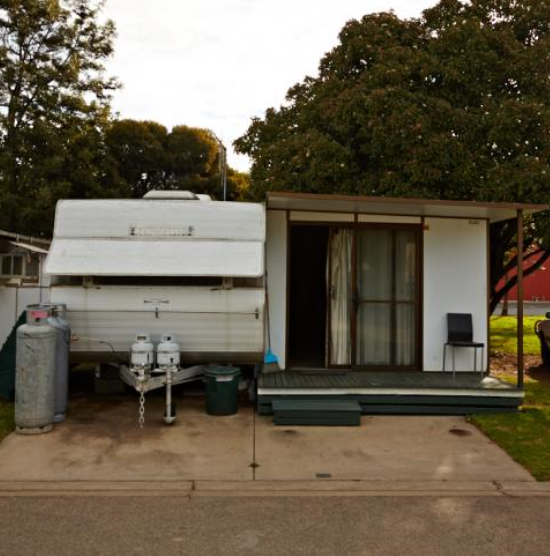
But if planners were to use the honest term of “caravan park” instead of “tiny home”, they would be given short shrift. Because doing so would automatically conjure up images of living in poverty, since caravan parks are where some of the poorest and most disadvantaged in society live, often on the fringe of homelessness.
Again, tiny homes are really just marketing spin and a policy band-aid designed to divert attention away from the real housing policy solutions, namely:
- Slashing immigration (to reduce housing demand);
- Reforming negative gearing and capital gains tax concessions (to reduce housing demand);
- Substituting stamp duties for land taxes (to penalise land-banking and improve land-use);
- Freeing-up artificial land use and planning restrictions (to lower land costs); and
- Investing in public housing (to boost rental supply for poorer households).
Abandoning the Australian Dream in favour of what is effectively caravan living is a retrograde step and represents the antithesis of societal progress.