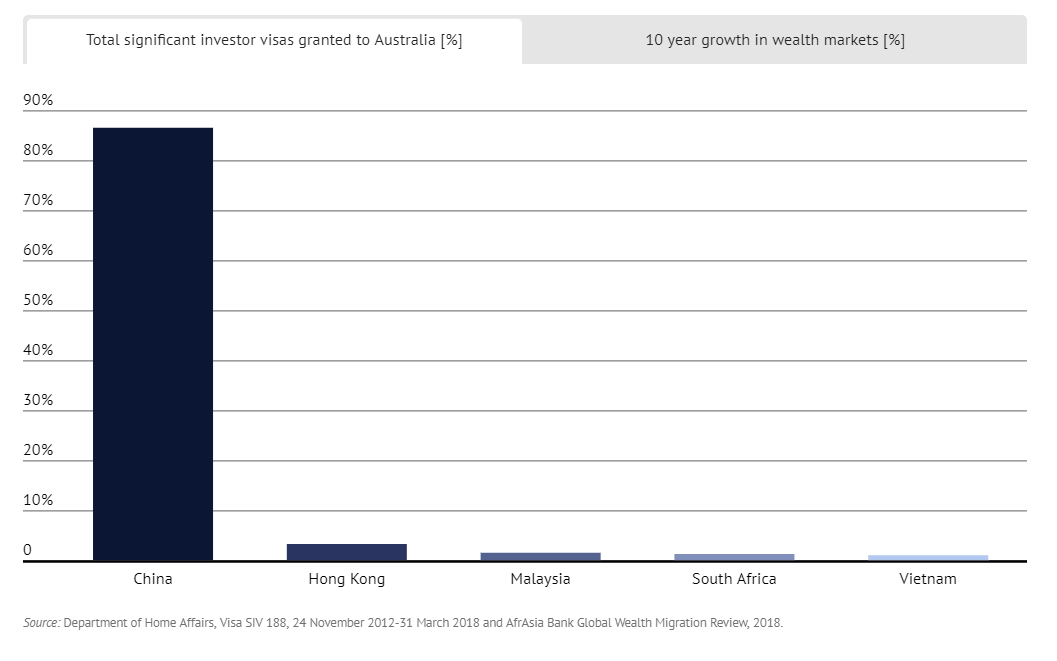
The Productivity Commission’s (PC) 2016 Migrant Intake Australia report explicitly called for the abolition of the Significant Investor Visa (SIV), whereby Australian citizenship is sold to high net worth individuals without the usual (albeit weak) checks and balances:
Because there are no English-language requirements for the Significant Investor Visa and Premium Investor Visa, and no upper age limits, it is likely that these immigrants will generate less favourable social impacts than other immigrants. Further, compared to other visa streams, investor visas are prone to misuse and fraud. Concerns about visa fraud played a part in the Canadian Government’s decision in 2014 to scrap its investor visa scheme…
There is a risk that SIV and PIV might be used as a pathway for investing ‘dirty money’ in Australia, an issue that has been raised for other similar schemes (Sumption and Hooper 2014)…
Overall, the case for retaining the Significant Investor Visa and Premium Investor Visa streams is weak and the Government should abolish these visas.
With this background in mind, and against the PC’s recommendations, these types of visas are booming:
Advertisement
The number of millionaires streaming into Australia has surged to 7260 in the past year…
Visa applications in the Business Innovation and Investment Programme, which includes investors with more than $1 million in business assets, jumped by 74 per cent in 2016-17 up from 5781 to 9051. Of those 7260 were approved, compared to 6484 in 2014-15…
The “significant investor stream” asks investors to stump up $5 million for Australian bonds, shares and venture capital projects. By March 2018 up to 2000 had been approved…
Australia had a net-inflow of 10,000 millionaires in 2017… “That is the highest net migration of millionaires to any country last year in absolute terms, let alone correcting for population,” said Grattan Institute chief executive John Daley…
China accounted for 90 per cent of all high-net worth investors coming to Australia in 2016-17…
NSW Premier Gladys Berejiklian, via a spokesman, justified the government’s participation in the scheme on economic grounds…
“Each of these individuals invested at least $5 million into the NSW economy, creating opportunities and jobs for the broader population,” the spokesman said.
The NSW Department of Industry also endorsed the program, with a spokesman saying NSW was “well positioned to leverage additional investment from business and investor migrants to the benefit of NSW”.
Advertisement
Clearly, Australian Citizenship is up for sale to anyone with enough money to pay. Few questions are asked, there’s no rigorous background checks on the persons or the source of their money, there’s no requirement to speak English, and there’s no requirement to work or contribute to society.
Now compare and contrast these visas to genuine humanitarian migrants who are treated by our policy makers as if they have the plague.
But wait, the PC’s recommendations have not only been ignored on SIVs, but elderly parental visas as well. Recall the PC’s recommendations in its 2016 Migrant Intake Australia review:
Advertisement
There is a strong case for a substantial increase in visa pricing in relation to some elements of the family reunion stream. This would provide scope to recoup at least a portion of the high fiscal costs typically associated with immigrants in this category. In the medium term, the allocation of parent visas should be revised…
The contributory visa charge of just under $50 000 meets only a fraction of the fiscal costs for the annual intake of roughly 7200 contributory parents. And an additional 1500 parents make a minimal contribution. Overall, the cumulated lifetime fiscal costs (in net present value terms) of a parent visa holder in 2015-16 is estimated to be between $335 000 and $410 000 per adult, which ultimately must be met by the Australian community. On this basis, the net liability to the Australian community of providing assistance to these 8700 parents over their lifetime ranges between $2.6 and $3.2 billion in present value terms. Given that there is a new inflow each year, the accumulated taxpayer liabilities become very large over time. This is a high cost for a relatively small group.
Ultimately, every dollar spent on one social program must require either additional taxes or forgone government expenditure in other areas. It seems unlikely that parent visas meet the usual standards of proven need, in contrast to areas such as mental health, homelessness or, in the context of immigration, the support of immigrants through the humanitarian stream, and foreign aid.
Given the balance of the costs and benefits, the case for retaining parent visas in their current form is weak.
… parent visas, which provide a short-term benefit to the budget via visa charge income, but impose very large costs in the longer term through their impacts on expenditure on health and aged care, and social transfers. In previous work, the Commission estimated the budgetary costs associated with the 2015-16 parent visa intake alone to be $2.88 billion in present value terms over the lifetimes of the visa holders. By comparison, the revenue collected from these visa holders was only $345 million. Ten year estimates of the fiscal effects of the current parent visas would show a similarly stark disjuncture between revenue and costs, and would therefore provide the insights for a more informed policy decision on the pricing or desirability of these visa types than the current decision-making framework.
A legislative change that had made it more expensive to sponsor parent’s visas has been reversed in the face of an impending challenge to it in the Senate…
It follows weeks of mounting anger from migrant communities and will completely reverse the changes, just a month after they were introduced by Social Services Minister Dan Tehan…
The changes, which took effect in April, meant residents needed much higher salaries to bring their parents to Australia on a visa.
An individual trying to sponsor their two parents would have needed to prove they earn an annual income of $86,607, up from $45,000 under the previous rules.
The government will revert to the old rules and will “reassess” any migrants who applied since the April change…
Shruti Gupta had applied for a Contributory Parent visa 18 months ago, and says if the new rules had been implemented, she and her husband would have struggled to meet the new criteria.
“We have two kids. My father-in-law he passed away so we can’t leave our mother-in-law by herself overseas. So it would have been very challenging for us,” said Ms Gupta.
“I am working in the security industry and my husband drives taxis. So it would have been very hard for us to afford the new changes that they had made. We are very relieved that they have reversed the change.”
A Department of Home Affairs plan to outsource visa processing will lead to increased automation and “premium” services that could undermine the integrity of the system, a former senior immigration official has warned.
Abul Rizvi, a former departmental deputy secretary, told Guardian Australia the potential for a private provider to create a fast and slow lane for processing had “frightening” long-term implications and the proposed use of applicants’ data for marketing purposes was “appalling”…
“Any monopoly provider would want to maximise charges for the fast lane and try to drive as many applicants as possible into that lane.”
A key recommendation from the PC’s Migrant Intake Australia report was to develop a cohesive population policy that aims to maximise the wellbeing of the incumbent population and their future children:
RECOMMENDATION 3.1
The Australian Government should:
• develop and articulate a population policy to be published with the intergenerational report
• specify that the primary objective of immigration and the Government’s population policy is to maximise the economic, social and environmental wellbeing of the Australian community (existing Australian citizens and permanent residents) and their future offspring.
Australia’s immigration and population policy should be better informed through:
• genuine community engagement
• a broad range of evidence on the economic, social and environmental impacts of immigration and population growth on the wellbeing of the Australian community
• a published five yearly review of Australia’s population policy.
The Australian Government should calibrate the size of the annual immigration intake to be consistent with its population policy objectives.
Advertisement
Sadly, the PC’s various recommendations have been ignored entirely and existing residents’ interests have been thrown under a bus to feed the ‘growth lobby’.
Leith van Onselen is Chief Economist at the MB Fund and MB Super. He is also a co-founder of MacroBusiness.
Leith has previously worked at the Australian Treasury, Victorian Treasury and Goldman Sachs.