If it is you wouldn’t know it. Via The Australian:
Accounting firm KPMG suggested losses to the Australian economy from the new tariffs would reach about $2bn in the first year, rising to a maximum of about $5bn, or 0.3 per cent of GDP, by the early 2020s as commodity prices and export volumes suffered. Australia has greater dependence on the Chinese market than any other advanced country, with the latest trade figures showing China takes 36 per cent of goods exported, while it is also the largest market for Australian services, particularly education and tourism. Australia has not had such a heavy dependence on a single market since the fading of the British Empire after World War II.
Evidence to date suggests that that is wrong. It’s clear that the short term implications of the trade war are a weaker AUD and more Chinese stimulus. That will aid Australian income and growth versus the counter-factual.
Longer term sounds about right. The same short term Chinese response increases the odds of secular stagnation in that economy by forcing it to rely on its old and dying debt-funded, over-investment model for longer. As well, if Trump succeeds in preventing or slowing technology transfer then the next leg of Chinese productivity and growth will also be stalled.
Combine these two with China’s thoroughly Japanese demographics and the next effect of the trade war is an increased likelihood of a Chinese middle-income trap slowing its economic rise and stopping “catch-up growth”.
This was coming anyway. It’s been obvious for a few years that China is stuck between a rock and hard place on reform with good intentions but trapped by old economy interests, irrespective of the singular power of Xi Jinping.
So, economically, the Trump trade war accelerates the end of the Chinese economic paradigm upon which Australia has come to rely but was going to end anyway.
The SMH covers the geopolitical angle:
There is a growing view in Beijing that US President Donald Trump has no intention of doing a deal with China on trade. Instead, Trump wants to force American companies out of China and decouple the two nations’ economies, some political analysts say.
How else to explain Trump ignoring more than 300 American companies who protested that imposing tariffs on $US200 billion ($277 billion) in Chinese consumer goods would hurt their business, and raise prices for US consumers?
The fear is there has been a major shift in US policy on China, so that trade is no longer the ballast in the relationship, but rather another US weapon to contain China.
That seems roughly right to me. The US is the regional hegemon. It oversees the liberal rules-based order. China has exploited this arrangement mercilessly for many years via its currency peg and many more behind-the-border trade protections than other states:
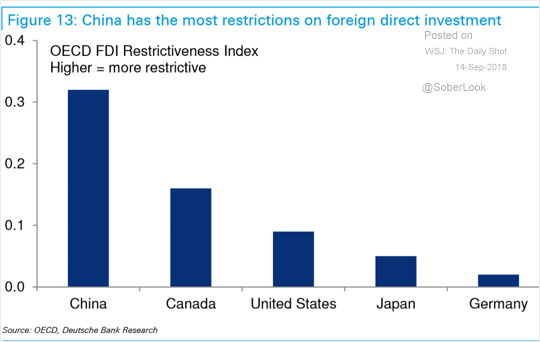
This is understandable given the economy remains centrally-planned with a crucial role for state-owned enterprises to keep growth high and legitimise Communist Party in power. But it’s not exactly fair or participating freely in said rules-based order.
So, if one takes a step back from the free trade dogma for a moment, the notion of who it is that is changing the rules is less clear.
This is really where the rubber hits the road for the Australian national interest. Jon Lee at The Australian explains:
American threats of escalating tariffs against Chinese goods is really about demanding reciprocity and payback for IP theft. Detested by Democrats for almost everything else, there is bipartisan political and popular support in Washington for Trump taking on China. While Trump’s needless salvos against other trading partners is hardly conducive to getting similarly aggrieved nations on side, advanced economies in Europe and northeast Asia are as resentful with respect to Chinese mercantilist policies even if they remain on the sidelines of the US-China fray for the moment.
What is becoming clear is that global pushback against China is only beginning. A similar dynamic is playing out with respect to the BRI. Promoted as a vast infrastructure investment scheme to increase prosperity throughout Eurasia and the Indo-Pacific, nations are catching on that the promises of trillions of dollars are inflated. Worse, the BRI increasingly is being blamed for burdening smaller nations with unsustainable debt, entrenching rather than lessening corruption, delivering disproportionate benefits to Chinese companies, and negative social and environmental impacts.
…Finally, China’s strategic grand plan of easing the US out of the region by weakening its alliances and partnerships has gone even worse than the economic masterplans. In the last decade of the previous century, a wiser and more cautious China concluded relatively generous treaties with Russia, Kazakhstan, Kyrgyzstan and Tajikistan to resolve border disputes and improve ties. With relations smoothed over, China’s economic weight eventually allowed it to replace Russia as the most significant player in Central Asia. Under Xi, China has been reigniting age-old territorial disputes or doubling down on selective and even fabricated history to justify extended claims. In doing so, Beijing has managed to alienate every significant naval power in the Indo-Pacific, which all happen to be US allies or security partners. Although Chinese strategists long have feared the formation of a hostile maritime coalition of great powers, Beijing’s hubris is pushing these countries in that direction.
From the larger strategic perspective, Trump is defending the international rules-based order. It won’t work with a dictatorial Chinese hegemon. It is not an impartial power in the region (understandably given historical enmities), it is an illiberal state, and its sharp power exchanges with Australia and other regional nations suggest firmly that its governance of the region, were it to come to that, would be a lot less free than the regime we enjoy today.
We can debate whether or not the Trump Administration has its tactics right. Certainly the trade disputes with allies takes away from any perceived defence of the liberal order. But, to my mind, those are family feuds that will pass in due course. The larger strategic goal of keeping the Chinese Communist Party at home is obviously in Australia’s national interest.
It’s about time we looked past a few dollars more.