
Let’s begin our political roundup today with Katherine Murphy, Guardian wordsmith and Queen of the Fake Left:
What’s now lost, beyond what remains of Turnbull’s authority, is a chance to combine the two policy challenges of climate and energy, and inch towards a major party truce that could have given Australia’s energy sector some of the investment certainty it needs to drive the transformation the country needs in something approximating orderly fashion.
That’s what the Neg was. It was that chance.
It was the fourth-worst policy, proffered because the great unreason meant the Liberal party had run out of viable alternative options, but the mechanism offered a chance to try and rebuild, step by step, after a decade-long debacle that has resulted in emissions rising across the economy, and high power prices.
That’s why, as a government, you take the pain of trying to land a policy in this area. You take the pain because you’ve caused the crisis, and you bear some responsibility for solving it.
Hmm, well, the NEG looked more the bastard offspring of an ideological divorce to me. It did little for any of its intended goals but what it did do was either a drag for emissions mitigation or a potentially catastrophic unintended outcome. Putting the long term emissions target in the hands of the parliament was particularly the MOTHER of all bad ideas.
I know the policy outcomes we get in Australia these days are like spinning the psychiatric chocolate wheel but let’s take what wins we can. The killing of the NEG is surely landing on “jackpot” if you give the slightest stuff about electricity prices or the environment. Murphy should be breaking out the champagne that the Coalition trogs have done it.
A truly, madly and deeply self-serving Coalition is now on the nationalisation crusade as an alternative, via Ben Potter at the AFR:
The Australian Competition and Consumer Commission baulked at splitting up big power companies as an “extreme measure to take in any market” and energy executives said the Turnbull government risked damaging market confidence by adopting such heavy-handed measures.
Prime Minister Malcolm Turnbull and Treasurer Scott Morrison announced a series of measures to stabilise the government and the National Energy Guarantee process on Monday.
They included a reference price cap for default retail electricity bills, underwriting of new “firm” supply capacity and new powers for the ACCC to police market manipulation by big power companies – right up to a US-antitrust style power to order companies to break up and divest key assets.
The first two were recommended by the ACCC in its retail electricity report but the latter two were rejected by the ACCC on the grounds they were a bridge too far and that less extreme measures – such as a new power to prohibit acquisitions that would give company more than 20 per cent of generation in a market – could do the job of improving energy affordability.
Who is it that has lowered the cone of silence over the gas producers? Does the gas cartel have total control of both the Coalition and the media? No lesser personage than Andrew Liveras – Australia’s most respected global energy executive – argued for a focus on gas supply and prices just last week yet the plea fell like a stone into the bottomless abyss of the coal versus renewables binary. Never to be seen again!
No doubt the gas cartel’s flackers are firing propaganda missiles as fast as they can but the the kind of abject silence that we are seeing around the real culprits in this mess can only be coming from someone dominating the agenda. That is the catastrophic ACCC who has for years formed, nurtured then protected a ghastly gas cartel of such magnitude that it is has gutted the entire east coast economy and its politics along the way.
The radical notions of intervention now being entertained for the relatively innocent power sector is precisely what should have been slapped on the thoroughly guilty gas cartel. It was they that sent power prices soaring when they stole all cheap east coast reserves under false pretenses. It was that that spiked gas then power prices (gas being the marginal price setter for electricity). The power firms themselves responded to the resulting price signals of course, maximising gains wherever possible, but the National Electricity Market (NEM) that they inhabit is the only thing in the energy sector that does work. Now it is to be virtually nationalised while the gas cartel sits on the sidelines without a scratch. The ACCC is directly responsible, having snowed the failure of the upstream gas market by sidelining domestic reservation, it is now defending its perverse integrity by destroying the downstream power sector. This is either control fraud or clown fraud and either way it is pure sovereign risk.
Now for the politics. Mark Kenny at Domainfax observes:
This is where the current proposition – the case for dumping Turnbull – stalls. Here we see a not unpopular prime minister – leading Bill Shorten by 12 percentage points as preferred prime minister 48-36 – being apparently torn down by colleagues who favour a little-known colleague whose approval as alternative Liberal leader consistently languishes in the low single figures.
It is true a “Prime Minister” Dutton might well perform better than his current 2 or 3 per cent support suggests.
But nobody’s even running that argument, which reveals this is more about dispatching Turnbull than the interests of the government.
Not for One Nation voters and that’s what matters. Unless the Coalition’s rift with ON is repaired then it has ceased to exist itself. Dutton is very likely going to lose his own seat unless the leader is changed so it might as well be him. Peter Hartcher captures the humour of it:
‘I really believed we could win the general election ’til the Longman byelection,’’ says a Liberal minister. ‘‘But with our votes deserting us for One Nation, it showed that we don’t have a problem on the Left of the voter spectrum, we have a problem with our base. Our furniture is walking out the door.
‘‘They won’t vote for us, they won’t hand out for us, they won’t raise funds for us.’’
Or, as Barnaby Joyce puts it: ‘‘When 16 per cent of your vote goes to a lady who’s holidaying on the Irish Sea, you know you’ve got a problem,’’ a reference to the absentee One Nation leader, Pauline Hanson.
Catherine McGregor provides the punchline:
Tony Abbott is the obvious choice to return to the leadership. In February 2017 I suggested to Abbott that Turnbull would implode on account of his total lack of political acumen. For his part I urged that he should emulate Paul Keating by forcing the party to come to him when it finally despaired of the Pretender. Far from being the monster caricatured by his detractors, Abbott is a vulnerable, passionate human being. He could not let his grievances go. His wounds were simply too deep and at times he was not the man I know he is capable of being. We clashed over marriage equality and I was disappointed at his flirtation with Pauline Hanson. But he is the only senior Liberal capable of stemming the defections among the party’s core constituency. He is the only proven election winner inside the Coalition.
Only as opposition leader, but then, that’s what he is now. Given the Coalition is now careening towards Tony Abbott’s nationalist policy platform that includes big immigration cuts, Budget tightening and crashing energy prices with a sledge hammer, it might as well have the architect to prosecute it. Even if the Turnbull dirty whore is available.
However, the news this morning is that Creepy Pete is the man, via The Australian:
Malcolm Turnbull has lost the confidence of half of his Liberal Party cabinet colleagues as the Prime Minister’s backers admit they are bracing for a leadership challenge from Home Affairs Minister and leading Queensland conservative Peter Dutton.
The loss of significant frontbench support follows the Prime Minister’s dramatic retreat yesterday in effectively dumping the ill-fated national energy guarantee and switching the focus to an electricity price war against energy retailers and generators.
Attempts to cauterise the damage across a broader range of political crises — including company tax cuts and school funding — have failed to win over rebel MPs, who claim it may be too little, too late.
As Mr Turnbull was ringing colleagues last night after reports of a collapse in cabinet support, Mr Dutton’s younger supporters were urging that he strike immediately for the leadership, maybe as early as this morning.
And Dennis Shanahan contemplates what he night do:
If Peter Dutton does challenge Malcolm Turnbull for the Liberal leadership and becomes prime minister he is going to have to do a lot more than change the name on the door.
The Home Affairs Minister will face imperative demands from his supporters not just to replace Turnbull but also to drastically change policy and personnel.
The immediate aim of policy changes and promoting conservative MPs is to draw back alienated Coalition voters to lift the Liberals’ fatal primary vote, while the long-term aim is to “save the Liberal Party” and its values.
…One thing Dutton can do is start talking like a Liberal leader on issues — such as religious freedom or law and order — that appeal to the base and don’t carry any financial cost.
Nonetheless, the only act of substance he can do to move the needle for the base is to materially cut immigration. Shane Oliver agrees:
Prime Minister Malcolm Turnbull appears set to face an imminent leadership challenge from former immigration minister Peter Dutton. AMP Capital chief economist Shane Oliver said that if Mr Dutton succeeds Mr Turnbull as leader, then a cut to immigration levels and a subsequent slowing in population growth could follow.
“That could pose a threat to house prices at a time when there’s a lot of supply coming on the market and that could be a threat to the wider economy,” Dr Oliver says.
“If I think back, there was a degree of optimism when Turnbull was elected,” Mr Oliver says, “He was seen as businessman with a firm grasp of macroeconomics. There may not be that optimism if Dutton takes over.”
The leadership and ideas might be completely random but the outcomes are predictable. The Aussie economy is suddenly shifting towards a different kind of post-mining boom adjustment. The emerging conditions will:
- be even harsher to house prices as a material immigration cut converges on negative gearing reform;
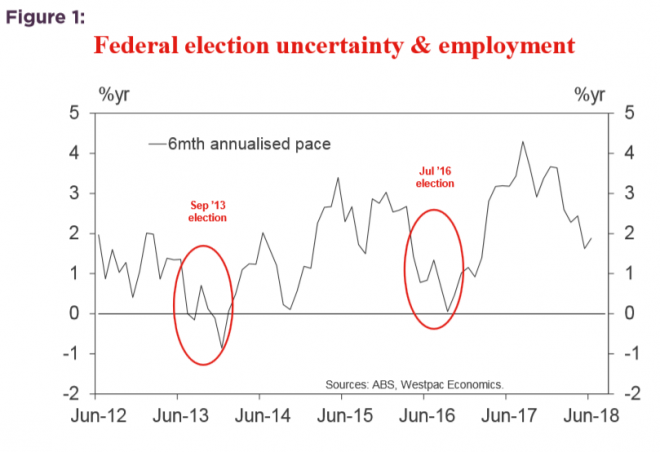
- weaken the economy, as a bewildered consumer and rocked investment environment are shut down by a non-stop 9-month election campaign reminiscent of 2013, from Westpac:
- and push the Aussie dollar lower, faster.
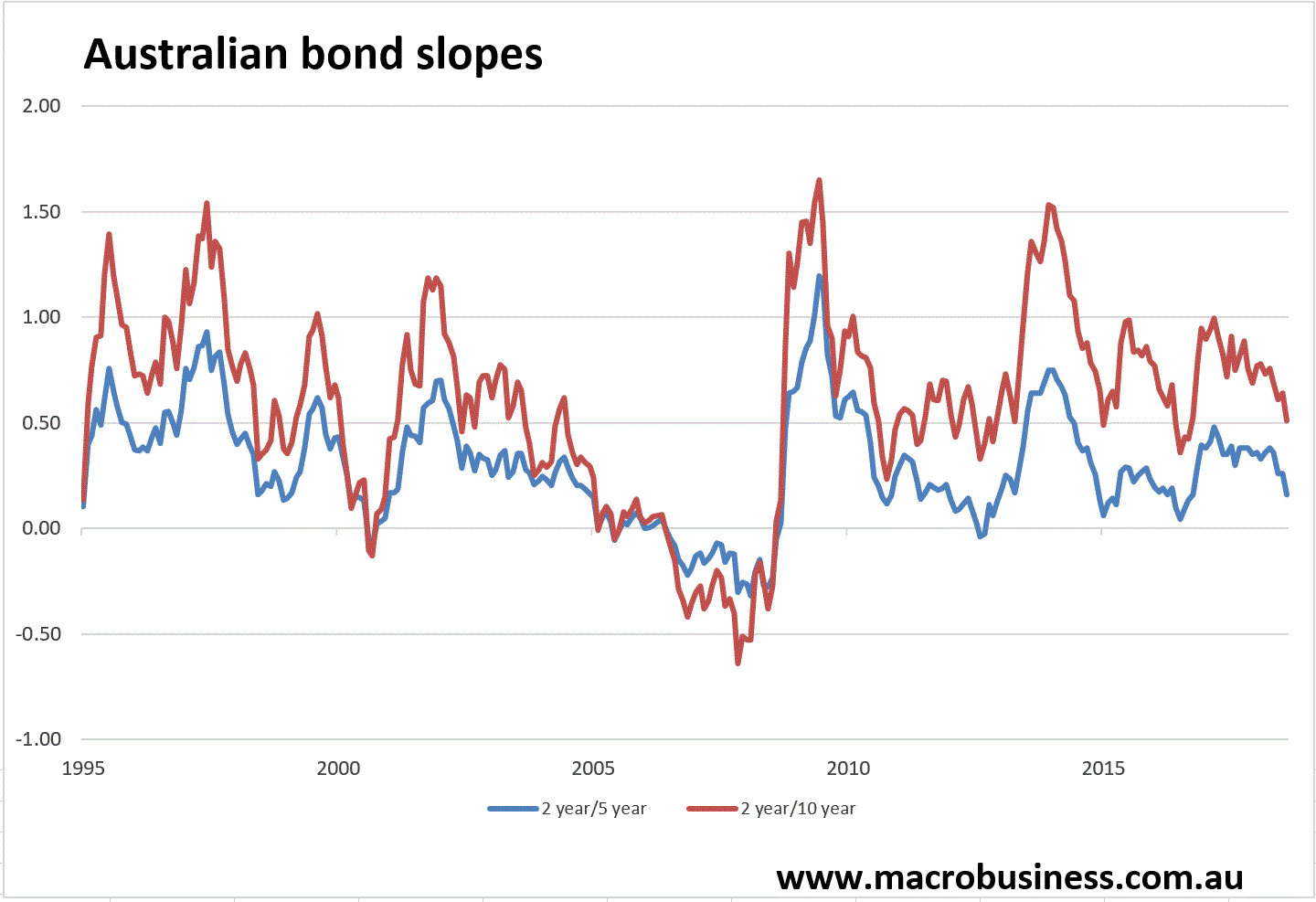
This has already begun to be priced with yields at the long end of the bond curve clearly breaking down and the curve entering free fall:
So, you might want to:
- sell property;
- pick up some long-dated Aussie bonds;
- buy more dollar-exposed industrials (though they are already nearly in bubble territory). Or equity yield plays;
- or get your money offshore.
Through the dumb luck of the Tony Abbott wrecking ball, the Australian economy appears about to get the tough love that it needs.
