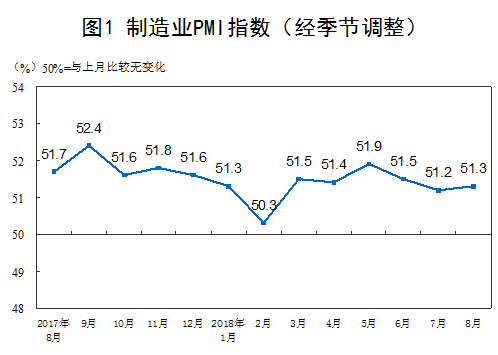
In August , the manufacturing PMI was 51.3% , up 0.1 percentage points from the previous month and unchanged from the annual average. Since the beginning of this year, except for the Spring Festival, the index has been operating within the 51.0% – 52.0% boom period, and the overall manufacturing industry has maintained a steady expansion. The main features of this month: First, production continues to expand, and market demand is generally stable. The production index was 53.3% , up 0.3 percentage points from the previous month , higher than the annual average of 0.2 percentage points; the new order index was 52.2% , down 0.1 percentage point from the previous month . Driven by the acceleration of production activities, the company’s willingness to purchase increased, with a purchase volume index of 51.8% , an increase of 0.3 percentage points from the previous month . Second, the development momentum of high-tech manufacturing industry is constantly accumulating and exerting strength. The PMI of high-tech manufacturing was 54.3% , up 1.7 and 2.4 percentage points year-on-year . Among them, the PMI of pharmaceutical manufacturing, special equipment manufacturing, computer communication electronic equipment manufacturing and other industries is significantly higher than the overall level of manufacturing, and the production index and new order index of these industries are both located at 55.0%.The above higher boom range. Third, the price index rose to a recent high. This month, due to factors such as the rebound in the prices of important production materials in the circulation sector, the main raw material purchase price index and ex-factory price index increased by 4.4 and 3.8 percentage points respectively from the previous month , which was 58.7% and 54.3% . Among them, the purchase price index of major raw materials in black, chemical, textile, metal products and other industries is at a high operating range of 60.0% or more. Fourth, the level of prosperity of small and medium-sized enterprises has increased. The PMI of large enterprises was 52.1% , although it was 0.3 percentage points lower than that of the previous month , but still higher than the overall 0.8 percentage point of the manufacturing industry. It is still the main driving force behind the growth of the manufacturing industry. The PMI of small and medium-sized enterprises was 50.4% and 50.0% , which were 0.5 and 0.7 percentage points higher than the previous month, respectively , both higher than the annual average. Fifth, due to factors such as the warming of international trade frictions and the uncertainty of the external environment, the import and export sentiment has declined. The new export order index and import index were 49.4% and 49.1% , respectively, lower than 0.4 and 0.5 in the previous month.Percentage points. However, the import and export of high-tech manufacturing continued to maintain its expansion. The new export orders index and import index were 53.9% and 54.3% , respectively , up 0.9 and 3.3 percentage points quarter-on-quarter, up 1.5 and 2.6 percentage points year-on-year .
According to the survey results, the proportion of enterprises that reflected the high logistics costs and the fluctuation of RMB exchange rate on production and operation this month was 27.7% and 18.3% , both of which increased from the previous month.
The full text of this article is available to MacroBusiness subscribers
David Llewellyn-Smith is Chief Strategist at the MB Fund and MB Super. David is the founding publisher and editor of MacroBusiness and was the founding publisher and global economy editor of The Diplomat, the Asia Pacific's leading geo-politics and economics portal.
He is also a former gold trader and economic commentator at The Sydney Morning Herald, The Age, the ABC and Business Spectator. He is the co-author of The Great Crash of 2008 with Ross Garnaut and was the editor of the second Garnaut Climate Change Review.