
The Minerals Council of Australia (MCA) has released the results of modelling suggesting that the Trans-Pacific Partnership (TPP) will boost Australia’s GDP by about 0.54% a year, which equates to a $15 billion increase in economic activity. CEO, David Byers, claims the 11-nation trade deal will bolster jobs, wages, economic growth and consumer choice in Australia, and has rejected ACTU concerns that the TPP will prompt a surge in temporary skilled migrant numbers. From The Australian:
Minerals Council of Australia chief executive David Byers… released analysis showing the average gain across 10 different modelling exercises showed an increase of 0.54 per cent, or more than $15bn, in GDP.
“The MCA has also debunked anti-trade scare campaigns claiming that the TPP’s temporary entry of business people and labour market testing provisions will lead to an influx of temporary migrants,” Mr Byers said…
Trade minister Steve Ciobo tabled the treaty in parliament, which is expected to endorse it, in late March…
The number of visas granted to Chinese nationals has fallen 35 per cent since the China-Australia free trade agreement began. Just under 400 were granted in the September quarter of 2017, the lowest number since early 2015…
The National Farmers Federation has also backed the TPP:
The National Farmers Federation also backed the deal. “Had TPP-11 been in effect in 2016-17, more than $5.5 billion dutiable agricultural exports would not have attracted tariffs,” it noted in its submission.
Whereas Professor Elizabeth Thurbon from the University of NSW is concerned the Investor-State Dispute Settlement (ISDS) provisions under the TPP would give foreign corporations the right to sue the Australian government and has called on a rigorous independent assessment of the deal:
[ISDS could] “violate the principles of the multilateral trade regimen, which Australia has long sought to defend”.
“In the absence of a comprehensive, independent analysis of the deal, it is impossible for Australians and their elected representatives to weigh the relative merits of the deal and to make an informed decision as to whether to support it,” she said in her submission.
You know what they say about economic modelling: garbage in, garbage out. The sad reality is that results from modelling tends to reflect the wishes of the party commissioning it – in this case the MCA – rather than providing a rigorous independent assessment.
In any event, separate modelling by Tufts University of the original TPP (including the US) estimated small job losses for Australia of nearly 40,000 people, as well as negligible gains in real GDP:
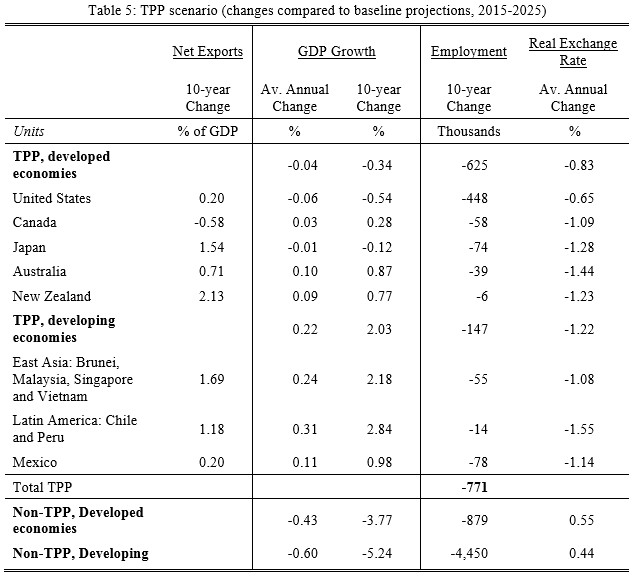
So, one can reasonably assume that the impacts of the TPP on both ‘jobs ad growth’ are likely to be tiny and equate to little more than a rounding error.
Moreover, we know that the TPP contains nasties including ISDS as well as potential extensions to patent and copyright protections, which are unlikely to be captured in the modelling.
Given the secrecy surrounding the TPP, as well as the vested interests pushing it, it is vital that the Productivity Commission (PC) assesses the deal for its economy-wide impacts. After all, the PC has previously called for greater oversight and scrutiny of FTAs before they are signed:
The emerging and growing potential for trade preferences to impose net costs on the community presents a compelling case for the final text of an agreement to be rigorously analysed before signing. Analysis undertaken for the Japan-Australia agreement reveals a wide and concerning gap compared to the Commission’s view of rigorous assessment.
Whereas a Parliamentary committee slammed the lack of adequate “oversight and scrutiny” pertaining to the original TPP, and lamented that “parliament is faced with an all-or-nothing choice” on whether or not to approve trade agreements and can only officially review trade laws once they have officially passed.
The TPP is an incredibly complex agreement whose text numbers some 6,000 pages and 30 chapters. It is far too complex for Parliament to comprehensively review and requires expert scrutiny from the PC prior to any vote to ratify the agreement.
Hopefully Labor, The Greens and the Senate cross-bench will call on the PC scrutinise the TPP before Parliament votes to ratify the deal. Parliament and Australians must be fully informed on what we are both giving up and gaining from this agreement.
