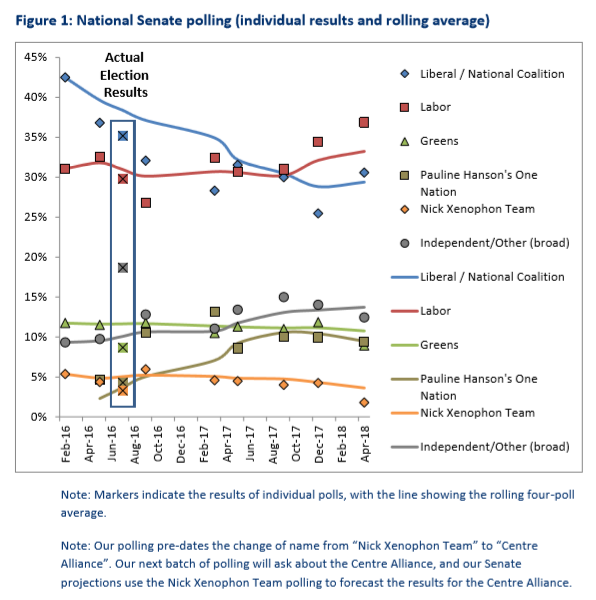
Malcolm Turnbull’s attempt to reform the Senate voting system has clearly failed, with new research from The Australia Institute (TAI) on voting intentions suggesting that the Senate will continue to have a large and diverse cross-bench:
Analysis by The Australia Institute of its regular Senate voting preference polling shows that the next government will have to negotiate with crossbenchers that are not their natural allies.
“Minor parties will have a major influence on the Senate after the next election – and the one after it” says Executive Director of The Australia Institute, Ben Oquist.
“The polling suggests that if the Coalition wins government, they will have to negotiate with the Greens or a variety of crossbenchers. A Labor government would have to negotiate with the Greens and other crossbenchers”.
Report author Bill Browne added: “Those predicting the demise of the Greens or One Nation are getting ahead of themselves – they may lose seats at the next election, but either party – or both – could increase their representation at the election after that”.
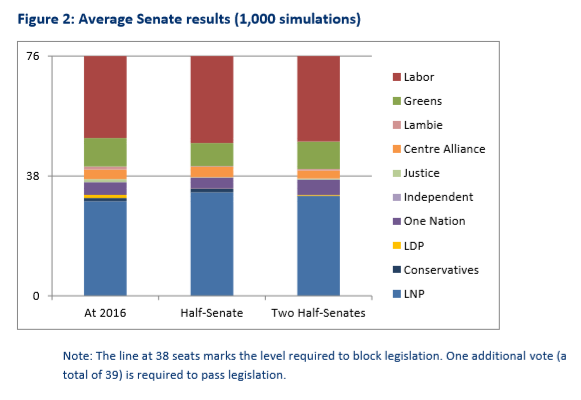
The Australia Institute’s report is the first in a planned quarterly series of Senate projections, each using a model developed to simulate election outcomes. Probabilities are calculated based on polling, historical performance, likely preference flows and qualitative analysis. The Institute then runs 1,000 election simulations to determine the range of likely results…
…our polling shows a further decline in the major party vote, leaving Scenarios B and C – where the government must negotiate with the Greens or with multiple crossbenchers – as the most likely outcome following a half-Senate election. The mean result across all simulations point to Scenario D in the case of a Coalition government, and Scenario C in the case of a Labor government – after both the first and the second half-Senate elections.
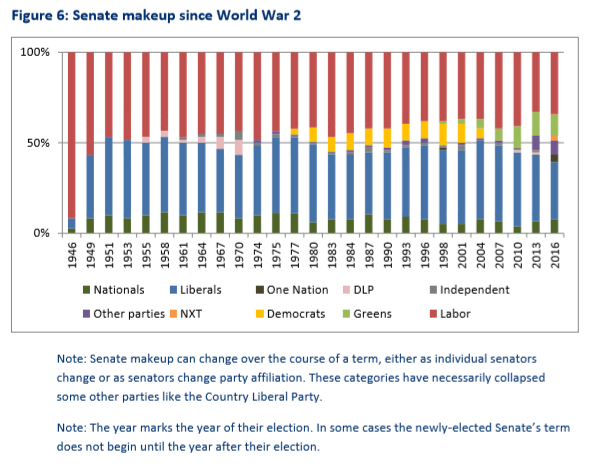
As shown in Figure 6, in the post-war period it has been common for a single crossbench party to hold the balance of power. The 2013 and 2016 elections represent a shift to a bigger and more diverse crossbench.
Leith van Onselen is Chief Economist at the MB Fund and MB Super. He is also a co-founder of MacroBusiness.
Leith has previously worked at the Australian Treasury, Victorian Treasury and Goldman Sachs.