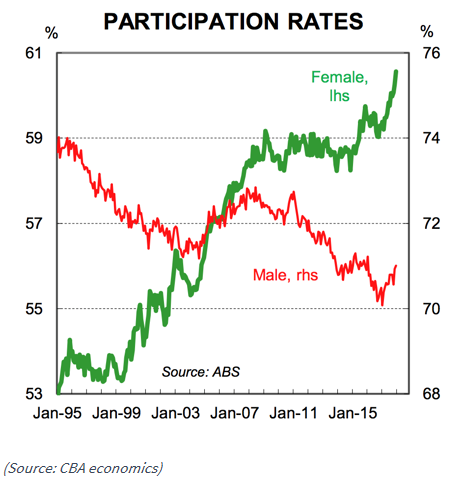
Domain’s Chris Kohler has penned an article arguing that higher female labour force participation, caused by rising housing costs, is lifting labour force participation and “saving” the Australian economy from an ageing population:
Women in the Australian workforce are coming to the rescue of the economy, with official data showing a huge rise in employment numbers was significantly boosted by middle-aged women.
Housing affordability issues could be a key trigger behind the jump in the number of women in full-time employment, according to a senior Commonwealth Bank economist Kristina Clifton, who notes a clear relationship between housing affordability and jobs figures.
The Australian labour market soared in 2017, with 403,100 jobs created – almost four times as many as the previous year and the most on record – and the participation rate for women entering the workforce jumped 1.3 percentage points to a record high 60.6 per cent, compared with just 0.5 percentage points for men.
That rise, if sustained, could be enough to stave off a serious economic concern for the nation.
“If female participation continues to steadily trend higher over the next ten years, then this would be enough to offset the effects of the ageing population,” Ms Clifton said.
But while a strengthening labour market is welcome news for the Australian economy, the rise in female workers could partially be a result of ongoing housing affordability issues.
“Rising house prices and issues around housing affordability are also likely to be important factors that have encouraged an increase in female participation,” the CBA economist said, adding that tax paid on two smaller incomes is often lower than that of one large income.
“The data shows an inverse relationship between housing affordability and overall labour market participation. That is, as affordability worsens, participation increases”…
“The largest increase in female participation over time has been in the older age groups. For example, participation has almost doubled between 1990 and 2017 for woman ages 55-64 years.”
There is certainly some truth in the CBA’s analysis. Research released in June from the Australian Housing and Urban Research Institute (AHURI) found that Australians are being made to work longer and retire later, thus potentially offsetting some of the lost labour force participation that generally arises from an ageing population. Here’s The AFR’s summary of this report:
Advertisement
Older people were more likely to be working for every $100,000 of additional mortgage debt they had, Curtin University professor Rachel Ong told Ahuri’s housing affordability conference in Melbourne on Thursday.
It was not clear whether people were delaying retirement because they had a higher debt to pay off or because they expected to live and work longer and were comfortable taking on ever-higher levels of debt.
Either way, it meant less of a loss to the economy of skilled workers as the Baby Boomer generation retires, said Professor Ong, deputy director of the Bankwest Curtin Economics Centre.
“This finding means that as mortgage debt levels rise, and working lives are extended as a result, it may help offset some of the productivity consequences that arise due to population ageing,” she said…
A home buyer aged between 45 and 54 with a $100,000 additional mortgage debt burden was 39 per cent likely to be working than a less indebted home buyer, it said.
People with more expensive homes – especially those between 55 and 64 – were also more likely to work longer, [the AHURI] said.
That said, a recent Bulletin Article from the RBA showed that rising labour force participation among women and older people has been common across developed nations, and has offset fears about population ageing:
The changing age structure of the population has been a persistent and increasing drag on labour force participation across advanced economies since the mid 1990s (Graph 5). The demographic drag has been widespread, reflecting the broad-based decline in the share of the prime-age population. It has been the largest in Japan, averaging around one-third of a percentage point per year over the past two decades.
Rising female workforce participation over the past few decades has largely made up for the demographic effects of ageing. This positive contribution from rising female participation has been common across advanced economies, although the timing has differed, with changes having occurred earliest and fastest in the United States and Canada. Australia has seen a consistent rise in female participation…
The increasing participation of older cohorts in the workforce has occurred alongside significant improvements in health outcomes and life expectancy. Furthermore, increasing longevity incentivises people to work longer to ensure they have adequate savings for retirement. The labour force participation rate of people aged 55 and over has been rising steadily since the mid 2000s across advanced economies, partially reversing a multi-decade decline in the average age of retirement (OECD 2015a). Over the past decade, the participation rate of people in advanced economies aged 55–64 years old and 65 years and over has increased by an average of 9 and 4 percentage points, respectively (Graph 7). For most countries, participation rates of older women have increased by more than those of older men from comparable age cohorts over this period…
Across advanced economies, the gap between the participation rates of older people and those of prime-age workers is gradually narrowing. This is particularly the case for the 55–64-year-old cohort, which now has a participation rate of less than 20 percentage points below the prime-age cohort in most advanced economies…
As the population in advanced economies ages further it will continue to put downward pressure on the supply of labour; the participation rates of specific cohorts are also likely to continue to change.
…while ageing will put downward pressure on participation rates in all advanced economies, increases in cohort-specific participation rates could largely offset this. Despite this, labour force growth is still expected to slow sharply in advanced economies due to slower population growth. This reduction in labour supply is likely to tighten the labour market, all else being equal…
Demographic change is a key driver of labour supply trends. Population ageing has reduced growth in the labour force across advanced economies, although strong migration has lessened some of this impact in Australia. Increased female and elderly workforce participation has partially offset the downward pressure from ageing. Projections show that continued growth in participation by these groups can continue to counterbalance some of the substantial effects of ageing on aggregate participation. Nonetheless, overall growth in the labour force and total hours supplied will continue to slow, all else being equal.
The broader macroeconomic consequences of these developments are uncertain, as demographic change can influence both potential and actual output. Subdued trend growth in labour supply will lower potential output growth and tighten the labour market, all else being equal. This would put upward pressure on wages and inflation.
Advertisement
In any event, is an ageing population really “a serious economic concern for the nation”, as claimed by Kohler? A recent study by Economists at MIT found that there is absolutely no relationship between population ageing and economic decline. To the contrary, population aging seems to have been associated with improvements in GDP per capita, thanks to increased automation:
If anything, countries experiencing more rapid aging have grown more in recent decades… we show that since the early 1990s or 2000s, the periods commonly viewed as the beginning of the adverse effects of aging in much of the advanced world, there is no negative association between aging and lower GDP per capita… on the contrary, the relationship is significantly positive in many specifications.
So what is the problem that we are trying to fix?
Advertisement
We know that Chris Kohler has previously described concerns about Australia’s rapid population growth (immigration) as “ignorant”, and claimed that Australia needs lots of population growth “to keep the country healthy”:
Rather than resorting to mass immigration – which as noted by the Productivity Commission can’t overcome population ageing anyway (because migrants also grow old) – Australia should manage the issue by: 1) better utilising existing workers, given there is significant spare capacity in the labour market; and 2) where required resort to technological solutions, as has occurred in Japan.
Leith van Onselen is Chief Economist at the MB Fund and MB Super. He is also a co-founder of MacroBusiness.
Leith has previously worked at the Australian Treasury, Victorian Treasury and Goldman Sachs.