

If you’re just back from the Christmas break you might be a little shocked at the rise in the Aussie dollar in the last couple of weeks:
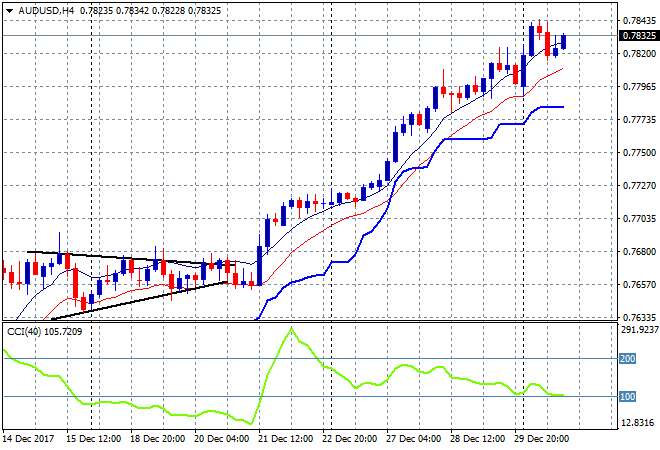
After breaking out above the 76.80 technical level just before Christmas itself, the Pacific Peso has been on a tear, bursting through the 78 handle against USD, but no so much against the other majors like Pound Sterling, Yen and Euro.
Alongside the epic comeback in gold – now over $1300 after nearly hitting $1200 before Christmas – and other undollar assets, this suggests the cause is not a specific Australian macro upgrade, but rather a rising tide carrying all boats as the USD bulls retreat over the break.
Before the holidays, Westpac was pushing for a 68c AUD by mid 2019, via the ABC:
That is according to Westpac’s forecast, which factors in a continued rebound for foreign economies including the US, UK and Canada, as they are likely to announce rate hikes over the next year.
Furthermore, the European Central Bank is in the process of “quantitative tightening” as it plans to slash its monthly bond purchases in half — to €30 billion ($45.6 billion).
Westpac expects the Aussie dollar to fall to 74 US cents within half a year (June 2018).
By the end of next year (December 2018) it is expected to slip further to 70 US cents, and then 68 US cents (by June 2019).
But even a Federal Reserve rate rise, that put the interest rate differential at its lowest in years, with projections for more rate rises in 2018 eliminating it completely, has completely unswayed the Aussie dollar bulls.
The RBA is caught between a rock and its own hardheadness, after years of pushing for a mass debt consumption orgy, it alongside the wet lettuce leaf eaters at APRA have put the brakes on the bubble that makes up over half the Australian economy – housing.
With little to no chance of interest rate cuts forthcoming and some minor pressure from the regulators, house prices are slowly coming off the boil.
So maybe its other half? The Holes that lead to China?
From CMC:
Increasing regulation in China for environmental reasons saw metal prices continue to rally on Tuesday and they are expected to continue.
Most recently Copper gained a boost, rising from a low of 2.92 at the start of December to a high posted on Tuesday, January 2, of 3.30 – given Australia is massive miner and exporter of metals the rise is sure to support the economy and demand for the currency.
“It seems increasingly likely that production cuts to protect the environment are going to be an ongoing feature of the metals market landscape. This will provide support for both mining stocks and the Aussie Dollar,” said CMC Markets Analyst Ric Spooner.
The effect on metal prices is likely to be an ongoing affair as China continues to ratchet up regulation to clean up its environment, suggesting a significant backdraught for the Australian Dollar both in the short, medium and potentially even long-term horizons.
Despite fears of deleveraging after the recent boom, China’s Caixin Manufacturing gauge beat expectations hands down when the results were released on Tuesday morning, sending an invigorating boost into Asian markets at the start of the new year.
Whilst it’s a little early to extrapolate, the data may have Aussie Dollar doubters starting to doubt themselves as visions of the perfect pairing of increased regulation strangling metals supply and continued Chinese economic growth provide Australia with the perfect opportunity, and the Aussie buck a buy on increased demand.
The rise in metals prices is just the sort of supply shock which can have major reverberations across the financial system.
Commodities have been low for too long now and are cyclically ready for an upturn.
These sorts of major turning points in markets are often caused by major regulatory shifts which affect price fundamentals.
If the Chinese economy continues to grow at a steady rate defying slowdown fears that would be a further impetus for the Aussie Dollar as it would provide a ready market for Australian exports.
The Holes strike again!
The weekly chart for AUDUSD holds more potential upside for the Pacific Peso, which has been in a rising channel from the near 68 cent low nearly 2 years ago:
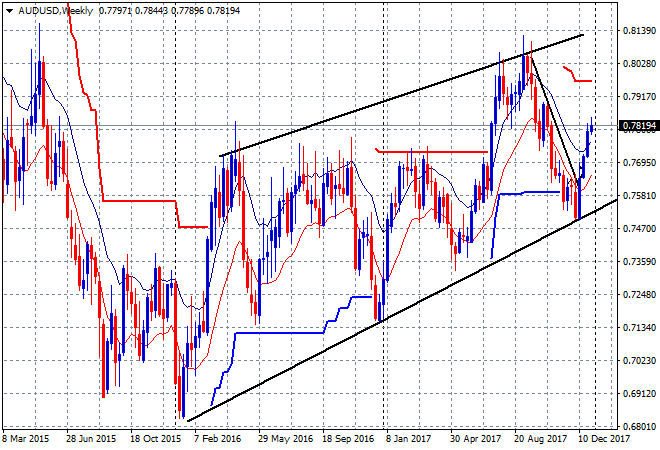
This recent move shows a respect of a series of higher lows ever since, with an upside target just above the 80 cent level. Given its already moved beyond the average true range for a month (something a lot of so-called market economists get confused with new trends), I expect a retracement soon, which is a natural move within this trend channel.
The catalyst is unlikely to come soon given the lack of economic data and the RBA not meeting until February, but one marker to keep an eye on is house prices and of course, the next numberwang that is unemployment.