Via The Age comes Victorian Treasurer Tim Pallas:
“We’ve known for a while that the technical and the specialist skills required for transport projects, particularly rail projects, have been hard to get. The more projects you start the harder it gets. We’ve only a handful of rail signallers in the entire state to manage not only the existing network but also the upgrades planned and under way.
“That’s just one illustration. We are also hearing of shortages in project management, finishing trades, commercial advisory skills, industry analysis, systems engineering and tunnelling. For high-end skills, it’s obvious, but its also a problem for entry-level skills.”
“Only on Friday I was meeting with the extractive industries representative body, and everybody around that table was saying there is so much demand for raw materials, quarry materials, cement and sand and so on that suppliers are choosing which jobs they bid on.
“You’ve got to expect pressure on price.”
“We are having to get people from further away and pay them more than we thought. Ultimately we have to pay what the market is prepared to offer.”
“Look at what happened with Sydney’s Westconnex. The entire industry in NSW put in one single consolidated bid that put the state government at a disadvantage. Here, we are facing the same sort of thing with the North East Link. You can only bring so many people in from interstate. You get to a point where you hit bedrock in terms of imported skills.”
“We are not seeing substantial blowouts. The Melbourne Metro should be on time, we are pretty confident about that.”
“There are plenty of young people looking for work. Youth unemployment is still 13 per cent. But what we don’t have is a skills base. We need to demonstrate to industry that this pipeline of work is here to stay, that it’s not ‘here today, gone tomorrow’. We need to make it clear that we are building to a plateau of projects, not a peak.”
“In my own electorate of Werribee we get 100 kids born every week. That’s a primary school every seven weeks. You don’t get a choice about these things.
“There is a capacity across this nation that will either get spent here or somewhere else. We are in something of a war for resources. If I were to say we starting to get nervous about this, it wouldn’t be clear we had the pipeline of work and the resources would go elsewhere.”
“The pace is a bit frightening, but it’s also a bit thrilling. The buzz and the congestion we are getting on our rail and road network is a direct consequence of all the work we are doing, and also all the work private firms are doing as a consequence. It is building on itself.”
“We’ve got problems but they are problems I would prefer to have than those associated with the downturn and malaise Victoria had just four years ago. In February 2013 your newspaper declared that the state was at a standstill. We’ve gone to the other extreme.”
“From my perspective I can’t take my foot off the accelerator at a time when the community is demanding improvements in their material circumstances.”
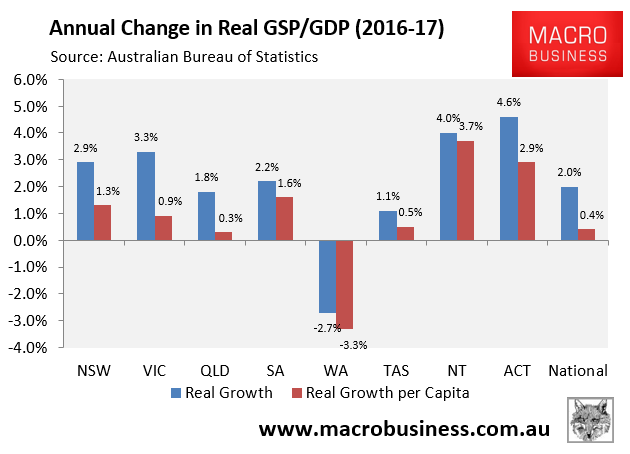
And, of course, what Ponzi Pallas doesn’t say is that all of this dizzying activity is actually sending Victorian’s backwards. Once population growth is taken into account, Victoria’s real GSP grew by only 0.9% in the year to June 2017, albeit above the national average (0.4%):
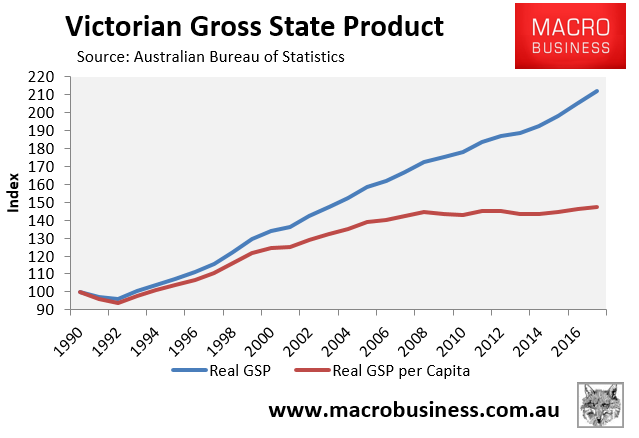
However, since the onset of the Global Financial Crisis (GFC) in 2008, per capita gross state product (GSP) in Victoria has barely risen at all:
Worse, Victoria has experienced by far the lowest increase in per capita GSP in the nation since the GFC:
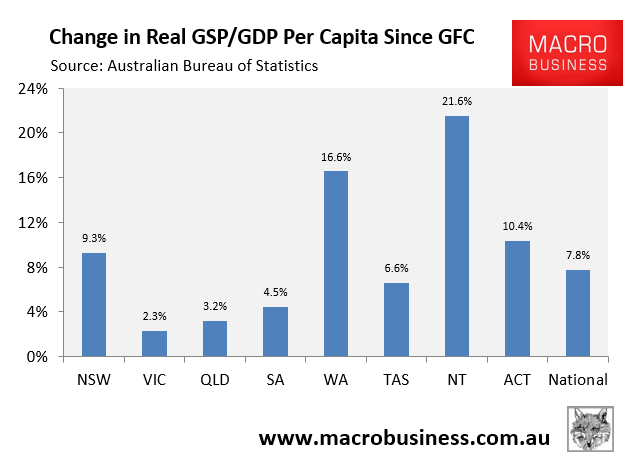
So what has been happening in Victoria is that the economic pie has grown due to population growth, but everyone’s slice of that pie has remained almost stagnant! But Ponzi Pallas can’t stop because the natives know it.
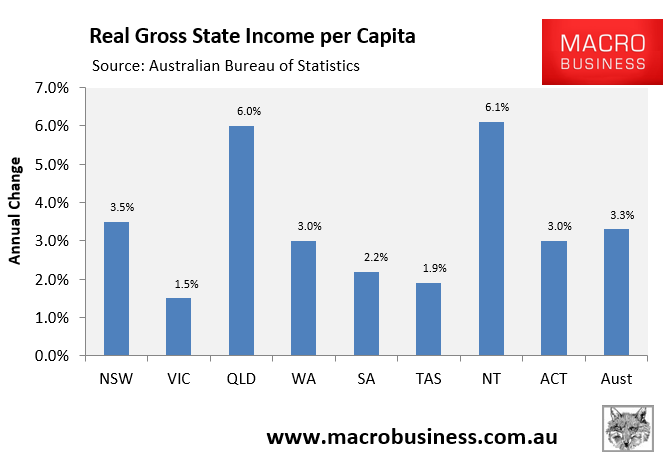
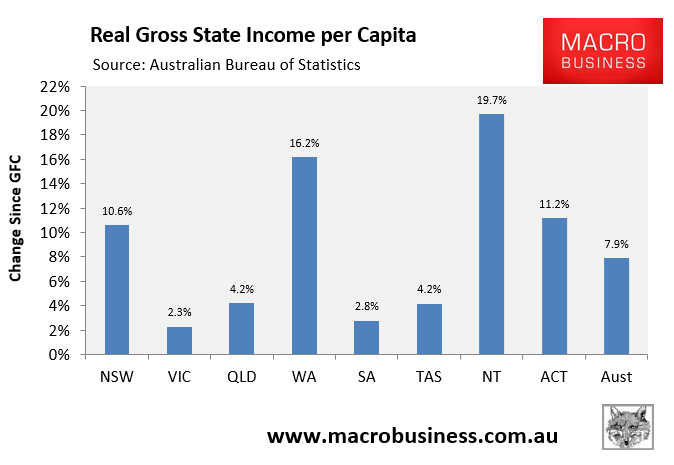
But wait, it gets even worse for Victorians. The growth in Real Gross State Income (GSI) per capita was the weakest in Victoria in 2016-17:
And also the weakest of all jurisdictions since the GFC:
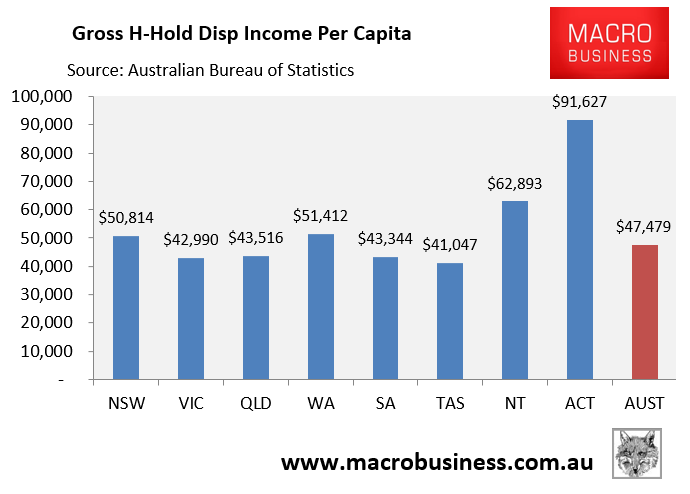
Moreover, because much of the income from production (GSP) goes to corporations or offshore, a far better measure of living standards is gross disposable household income per capita. Sadly for Victorians, they have the lowest per capita gross disposable income on the mainland, only beating out lowly Tasmania:
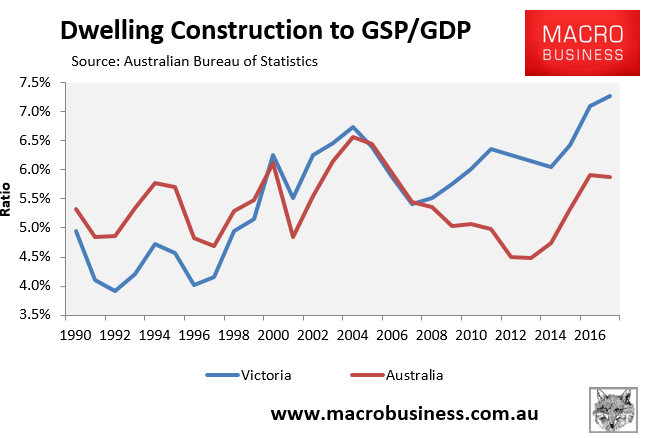
What should become abundantly clear is that Victoria is running a ponzi economy based on endless population growth (immigration), which in turn has juiced its services industries (think cafes, universities and financial services) and the housing construction industry (see next chart).
Meanwhile, Victorian business investment – the productive side of the economy – has flatlined in real terms since the GFC and fallen heavily as a share of the economy:
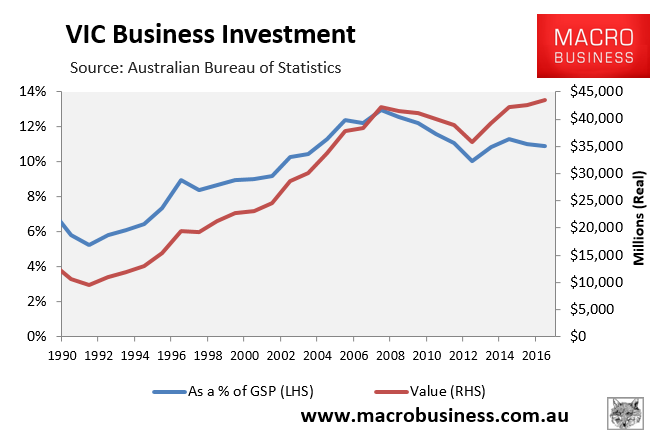
Victoria’s ponzi growth model is like a dog chasing its tail: as soon as the population growth stops, so does the growth in services/construction that it creates, raising a big question mark over the sustainability of the economy.
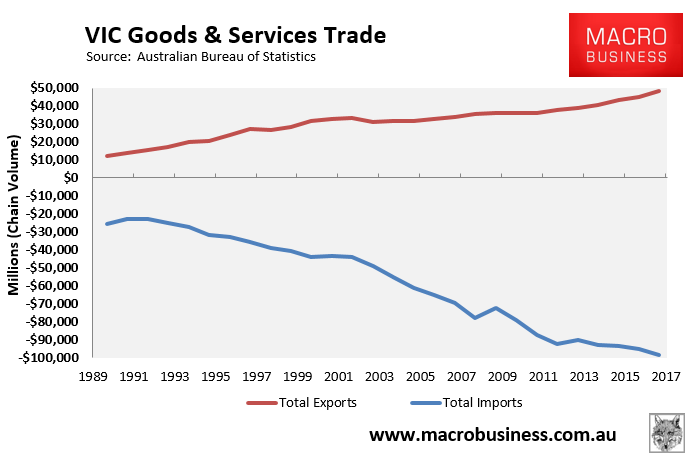
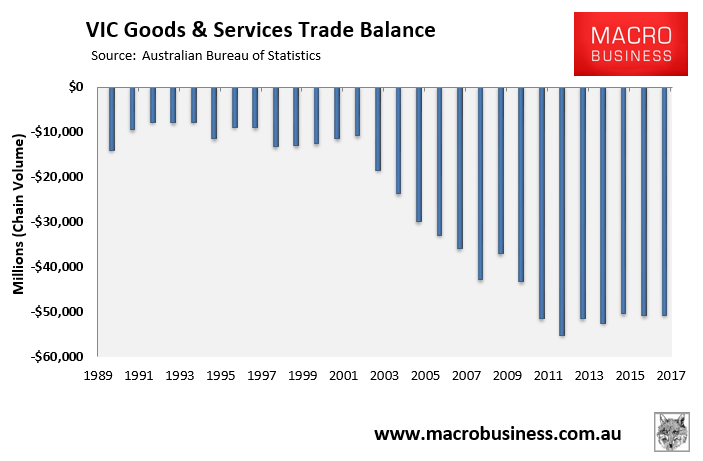
Further evidence of this false economy is found in Victoria’s trade performance. Exports have recorded slow growth over the past 15 years, whereas imports have more than doubled. Accordingly, the state’s trade deficit has blown out to a whopping $50.4 billion in the year to June 2017:
To sum up, Victoria (read Melbourne) is operating a ponzi economy that is growing for growth’s sake via mass immigration and debt accumulation, in turn pushing against infrastructure bottlenecks and reducing the living standards of incumbent residents via rising congestion, reduced amenity, and deteriorating housing affordability.
And now it will require more people to fix the problems of too many people so we can accelerate those falls in living standards.
Ponzi Pallas is trapped in a rat wheel economy of his own making. And you are too.