Prime Minister Malcolm Turnbull has labelled an “absolute disgrace” the Queensland Government’s plans to veto a $1 billion loan to India’s Adani Mining from the Northern Australian Infrastructure Facility (NAIF) if it wins the state election, claiming the State Government’s stance on the NAIF loan contrasts with its previous support for the coal and rail freight project. From The Australian:
Malcolm Turnbull has accused Queensland Premier Annastacia Palaszczuk of an “absolutely disgraceful abdication of responsibility” over her bid to veto a potential $1 billion commonwealth loan for the Adani coalmine…
Ms Palaszczuk’s first-term Labor government facilitated the Adani project, processing various approvals, resuming land needed for its proposed rail line and agreeing to not stand in the way of the commonwealth granting the Indian conglomerate a loan under the Northern Australian Infrastructure Facility.
But on Friday Ms Palaszczuk announced she would veto such a loan if re-elected, even though an application for NAIF to fund an alternative coal rail project proposed by Australian freight operator Aurizon would still be allowed. The Queensland government has shares in Aurizon.
Ms Palaszczuk initially said the veto was to neutralise a conflict of interest involving her partner, who did work on Adani’s application. In recent days, however, she has declared it to be honouring a 2015 election commitment that taxpayers not fund the Adani project…
Mr Turnbull yesterday described the veto as extraordinary, unnecessary and contradictory, saying that if Ms Palaszczuk believed the Adani project should not proceed she should tell Queenslanders they did not deserve the jobs.
“I think it is a real reflection of the conflict you see within that government, within the Labor Party, between trying to appease the green left and trying to support industry and workers, coalminers and power station workers and the industry that development would bring,” Mr Turnbull said.
“It is an absolutely disgraceful abdication of responsibility on her part.”
There’s no doubt that Premier Palaszczuk has opportunistically flip-flopped on Adani. But so what? She is merely responding to the massive public opposition to the Carmichael mega-mine project.
Advertisement
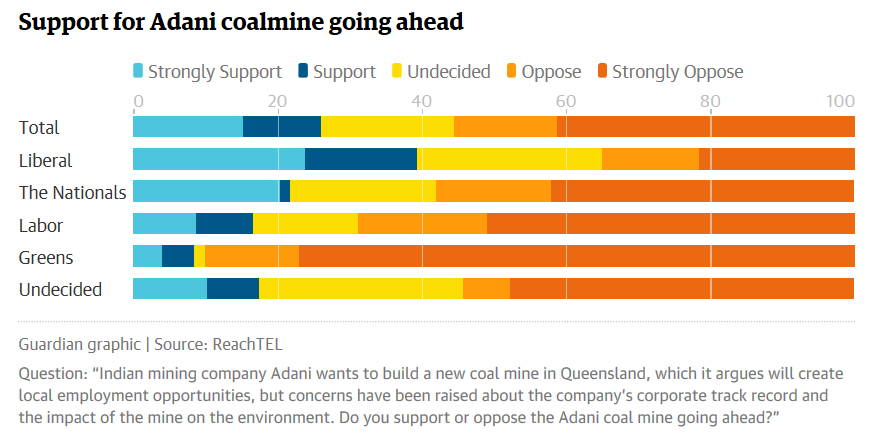
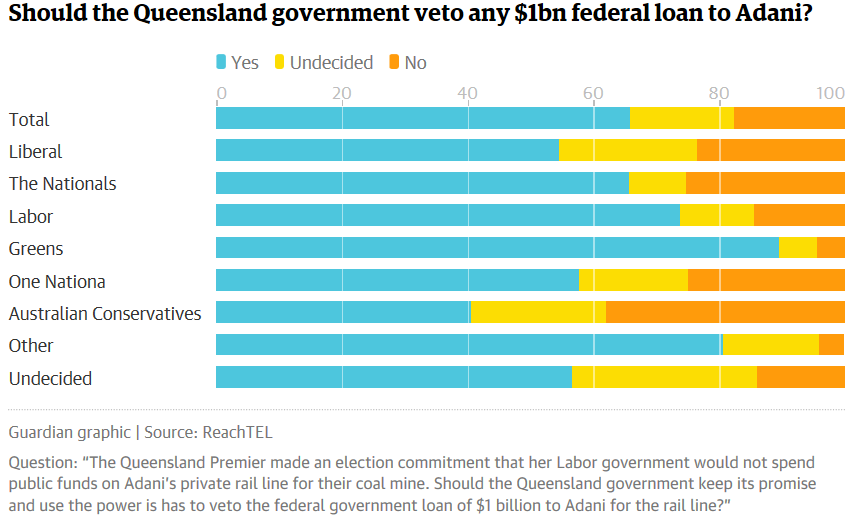
A ReachTel survey of almost 2,200 people conducted last month found 55.6% of respondents opposed the mine going ahead – more than twice the number who supported the mine. The overwhelming majority of those surveyed also wanted Premier Palaszczuk to veto the project. From The Guardian:
When told that the Queensland premier, Annastacia Palaszczuk, had made an election commitment not to spend public funds on Adani’s project, 65.8% of those polled said she should use her power to veto the possible $1bn loan the federal government might give the project through the Northern Australian Infrastructure Facility (Naif).
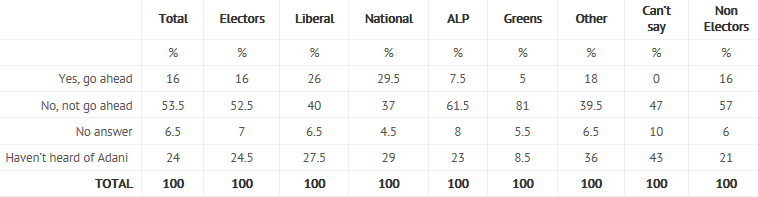
In a similar vein, a Roy Morgan Research opinion poll conducted last month also found the majority of Australians (53.5%) did not think ‘the Adani mine should go ahead’ – well ahead of the 16% that said the Adani mine should go ahead:
Advertisement
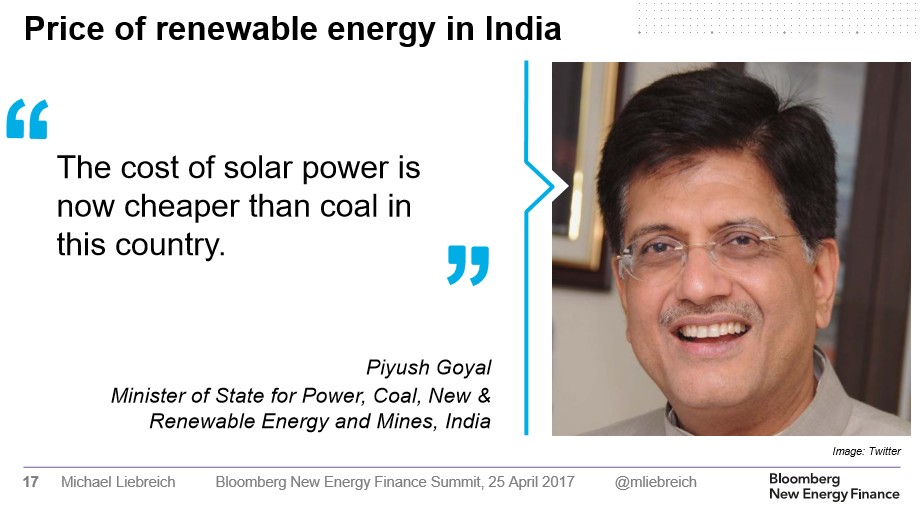
All of which raises the question of why the Australian government is so keen on extending a $1 billion concessional loan from Australian taxpayers to India’s Adani, especially given India’s Minister for State Power has already acknowledged that the cost of solar power is now cheaper than coal, meaning that the Carmichael Project risks becoming an unviable stranded asset, and Australian taxpayers risk losing their dough:
Advertisement
Not to mention the massive environmental costs attached to the project, nor that it would displace existing coal mines and workers in Queensland and New South Wales.
When it comes to Adani, Australian voters are not stupid. They know that the mega-coal mine represents a wasteful and destructive white elephant, and there is absolutely no way that scarce taxpayer funds should be used on the project.
Premier Palaszczuk appears to have listened to voters’ concerns. Tin ear Malcolm Turnbull should too.
Leith van Onselen is Chief Economist at the MB Fund and MB Super. He is also a co-founder of MacroBusiness.
Leith has previously worked at the Australian Treasury, Victorian Treasury and Goldman Sachs.