The Australian’s Judith Sloan has penned an article today attempting to dissect the various causes of Australia’s anaemic wages growth:
So what explains the low wage growth which, it should be noted, is not just an Australian phenomenon? There are several explanations, including the end of the mining boom. With the loss of many high-paid jobs in mining and their replacement by lower-paid jobs, often in the services industry, average wage rates will reduce by virtue of this structural change even though the wage rate attached to a particular job may not have changed much.
Another factor that could explain low wage growth is the surge in the number of university graduates and the associated decline in the wage premium attached to having a degree.
During the decade ending last year, the number of Australians with bachelor degrees rose by 57 per cent while the number with postgraduate degrees rose by 123 per cent. Note that the labour force increased by only 19 per cent.
Unsurprisingly, the wage premium attached to having a university degree has fallen significantly as new graduates flood the labour market. In 2009, recent graduates earned on average 83 per cent of male average weekly earnings; the figure is now closer to 76 per cent.
It’s tempting to link the decline in trade unionism to low wage growth. But the reality is that union density has been falling for years and there has not been a clear correlation with lower wage growth. To be sure, many new enterprise agreements are containing relatively modest pay rises but there is something else going on beyond the waning influence of trade unions…
The high rates of immigration to Australia also may be feeding into low wage growth… With an ample supply of new workers, it is not surprising that many employers are in a position to offer very modest pay rises. Technology, competition and globalisation are commonly cited reasons for slowing wage growth in many countries…
With a rate of underemployment of 8.5 per cent, there is clearly still a degree of softness in the labour market…
The trouble is there is no certainty that wage growth will pick up. In the absence of a sustained improvement in productivity growth, there is really no basis for higher wages and we know the government has achieved nothing on the productivity front.
That’s where it should be concentrating its efforts, particularly in terms of reducing the regulatory and tax burdens on business. I’m just not holding my breath.
A fair assessment by Sloan until the very last paragraph. Her claim that wages growth has slowed due to the rotation away from highly paid mining jobs towards services jobs, the huge oversupply of university graduates, mass immigration, the decline of trade unions, as well as significant labour market slack, are all spot on.
Advertisement
However, Sloan’s assessment that the government should simply cut business regulation and taxes to lift productivity is misguided. The Australian economy and labour market has already been hugely deregulated over the past 30 years, so there’s little evidence to suggest that continuing down this road would magically lift wages growth.
As for cutting business taxes, the Australian Treasury’s original modelling on the company tax cut package showed minimal benefits for either jobs or growth. As explained by The Australia Institute’s Richard Denniss:
According to Treasury’s in-house modelling, and the modelling it commissioned from Chris Murphy, if the company tax rate is lowered from 30 per cent to 25 per cent then gross domestic product will double by September 2038, while without the tax cut it won’t double until December 2038. Wow, a whole three months earlier. Both modelling exercises conclude that in 20 years’ time the unemployment rate will be 5 per cent regardless of whether we spend $50 billion on company tax cuts or not…
The “benefits” are more accurately described as rounding error than significant reform.
Advertisement
The same modelling also estimated that the full company tax cut package would cost the Budget $11.3 billion per year. However, this would be reduced to $8.2 billion due to “a gain in personal income tax and superannuation income tax of $3.1 billion as the cut in company tax automatically reduces the value of franking credits”.
This $8.2 billion loss of revenue per year would need to be made up somewhere, such as by raising personal income taxes, cutting government investment in infrastructure, or slashing welfare expenditure. Such cuts would necessarily reduce jobs and growth, as well as raise inequality.
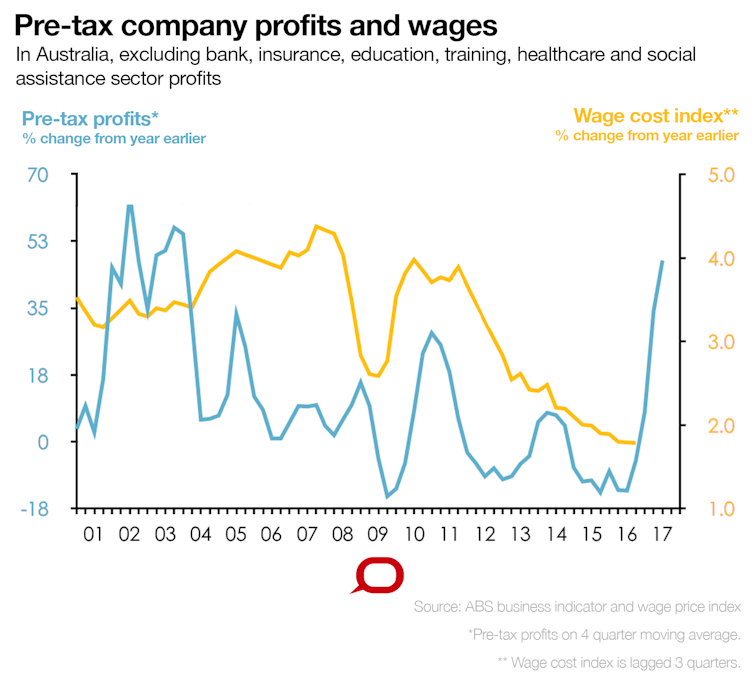
Recent research released by economist Saul Eslake also showed there is minimal link between company profits and wages growth:
Advertisement
…there is little data to support the idea that wages and profits are connected.
There does not appear to be any “leading” relationship between growth in pre-tax company profits and growth in wages, even if the mining sector (which accounts for a good deal of the fluctuations in profit growth over the past dozen years) is excluded.
Some relationship between profit margins (that is, profits as a proportion of sales revenue) and wages might have existed in the past. However, that appears to have broken down in the years since the peak of the commodities boom, in 2011-12, as you can see in the following chart.
Since then, aggregate profit margins have risen to levels not seen since the early 2000s, but wages growth has continued to slow.
Rather than being a precursor to faster growth in wages, the growth in Australian company profits in recent years appears to be part of a broader global pattern: the share of aggregate income accruing to capital is rising while that accruing to labour is falling.
…there’s absolutely no evidence that preferentially taxing small businesses will do anything to boost innovation, productivity, investment or employment. Hence, there’s no reason to think it will do anything to lift wages growth.
Nor is there any compelling empirical evidence to suggest that across-the-board tax cuts for larger companies will have any significant impact on employment and hence on wages.
Rather, an acceleration in wages growth is more likely to come from policies that directly boost economic and employment growth – such as increased spending on (well-chosen) infrastructure projects – and that boost productivity growth (including well-targeted education and training initiatives).
A more controversial proposition may be that measures designed to reverse, in part, the shifts in the shares of national income accruing to labour and capital over the past decade or so could also help accelerate wages growth.
Partly because real wages have grown more slowly than labour productivity since the turn of the century (as you can see in the previous chart), the “profits share” of Australian national income is well above its long-run average. The “wages share” is close to a record low…
In a nutshell, while labour has been doing a good job, as evident by its strong productivity performance, its efforts are getting killed by dismal capital productivity as savings are massively mis-allocated into profitless houses, profitless energy and a profitless government that wouldn’t know a reform policy if its life depended on it.
Advertisement
So, rather than this blind faith in flawed ‘trickle-down’ economics, Australia needs tax reforms that encourage capital to be once again deployed into productive investments.
Leith van Onselen is Chief Economist at the MB Fund and MB Super. He is also a co-founder of MacroBusiness.
Leith has previously worked at the Australian Treasury, Victorian Treasury and Goldman Sachs.