
Hooray! New Melbourne suburb to absorb one month population growth

By Leith van Onselen

On Sunday, Melbourne Planning Minister, Richard Wynne, was all over the media trumpeting a new suburb in Melbourne named Macaulay that would supposedly ease Melbourne’s housing affordability crisis. From the Herald-Sun:

THOUSANDS of new homes will be built near Melbourne’s CBD as the Andrews Government prepares to battle housing affordability by unlocking the new suburb of Macaulay.

Planning Minister Richard Wynne will today move to rezone industrial land northwest of the city with 10,000 residents expected to move in by 2051.

The new housing hotspot will be filled with medium-size high-rises and is expected to be popular with developers.

Resident’s can also expect top notch transport with the new Arden Station to be built nearby as part of the Metro Rail Tunnel.

Property Council executive director Sally Capp said the news was “absolutely brilliant” and urged a range of dwellings to be built in the area.

“This are is so well placed to develop with jobs at the core,” she said.

“Supply is absolutely part of the equation with the population growth and we have the opportunity to do density well with variety of dwelling types”.

Mr Wynne will announce the changes to the Melbourne Planning Scheme today and has pledged developments are range between nine and 12 storeys.

“This is proper planning at play,’’ Mr Wynne said.

“We’re building a flagship new community, protecting local character, making homes more affordable and giving more Victorians a chance to work close to where they live…

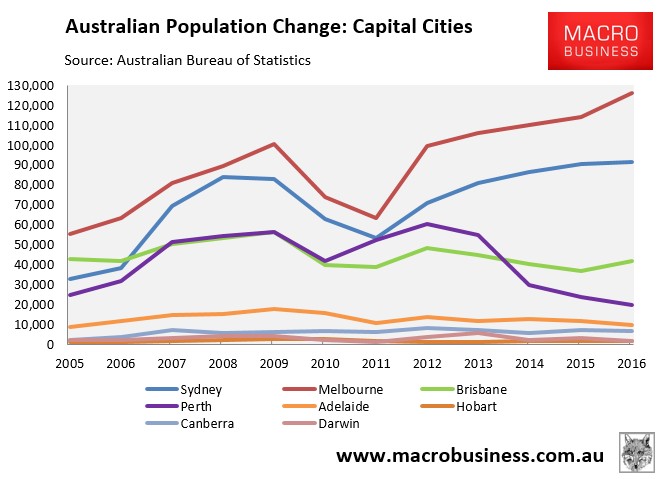
So, “10,000 residents [are] expected to move in by 2051”. Are they serious? Melbourne’s population grew by a monstrous 126,000 people in 2016:
And under the State Government’s own forecasts, which surely will be revised upwards given the latest Census, Melbourne’s population is projected to grow by 97,000 people annually for the next 35 years:
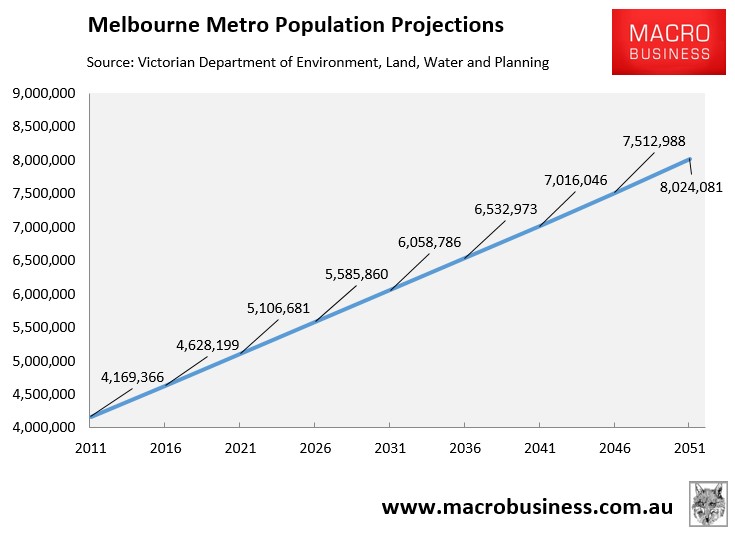
So this new suburb will eventually provide homes for roughly one month’s worth of current population growth.

I hope the Victorian Government is planning to release eight new suburbs like this each and every year ad infinitum (assuming densificaton as well), because that’s what will be required to outrun the population ponzi choking the state.

[email protected]

Comments

  1. DarkMatterMEMBER

    Just out of interest, suppose that you wished to maintain the standard of living in a big city like Melbourne or Sydney and increase infrastructure to match population growth, what is the infrastructure cost of an immigrant? Would it increase linearly, shrink with economy of scale, or are there physical limits that would cause the cost to rise sharply at certain population milestones? Exhausting the water supply would be a possible such milestone.

    I don’t believe I have ever seen figures for this and wonder if they have been estimated.

    • I thought an article running on mb recently had it at $100,000 a head. But I might have been skim reading.

      • I read the same. It was estimated at $100k. This is the economics of the nut house aka neoliberal economic bull crap which has right royally stuffed up this country.

    • sydboy007MEMBER

      Me thinks the cost per immigrant will continue to escalate as we build more $1M per meter tunnels under the cities.

      Lets hoping Elon Musk’s The Boring company can drive down costs by a factor of 10 like he’s proposing.

    • now we also have to see how much an immigrant contributes to the economy (in real way not by spending but rather by creating)

    • Certainly hospital beds for all these new arrivals won’t be a problem, somebody in Government obviously feels the population is getting so much healthier each week that you can just stop building them. As recently as 1980, Australia had 12 hospital beds per 1000 population, by 2010 that number had fallen to below 4: Hospital beds (per 1,000 people)

      Jump forward to 2016 and the inexorable growth in Australia’s population had seen that number had fall to 2.56 beds per 1000 population: Hospital resources 2015–16: Australian hospital statistics

      In Sydney in the face of 1800 new arrivals each week we have – can you believe it – a blanket ban on proposals for new tertiary hospitals. Try even suggesting the need for new tertiary hospital s in Sydney inside the public sector and see how long you last. Instead we have ineffective and expensive retrofitting and overbuilding at existing sites which in the increasingly dense traffic grow less and less accessible by ambulances with each passing week. Even as far out as Nepean our helicopters cannot land because of the danger posed by construction cranes building more residential units:

      Lives left up in the air by hospital helicopter ban in Sydney’s west

      I am not making this stuff up.

    • Working immigrants that come before 30 net out at zero cost. Any non-working dependents they bring cost ~$400k over their lives.

  2. KeenEyeKenMEMBER

    This part of Melbourne is ripe for development. However, we should remember that the old warehouse precinct has remained largely vacant/decrepid for decades now. The land was bought up by land-bankers, long ago, waiting patiently for government to change zoning from industrial/commercial to residential.
    The moment that happens, they will be handed untold millions in windfall gains. Essentially, it’s a free transfer of money from apartment buyers (will likely be first homebuyers) to existing owners of this prime land who have let it rot for decades.

    Will Victoria introduce a value-uplift tax, akin to the Lease Variation Charge in Canberra, that taxes the increase in land values attributable solely to the change in land zoning classification?

  3. If things continue as they are then in the years to come, Sydney and Melbourne are going to end up look like Mexico city does now. Little islands of great wealth surrounded by vast sprawling third world shanty towns full of crime, poverty and despair. Most people living in corrugated iron shacks, shitting in the street and carrying muddy water around in buckets.

    And that’s if we’re lucky.