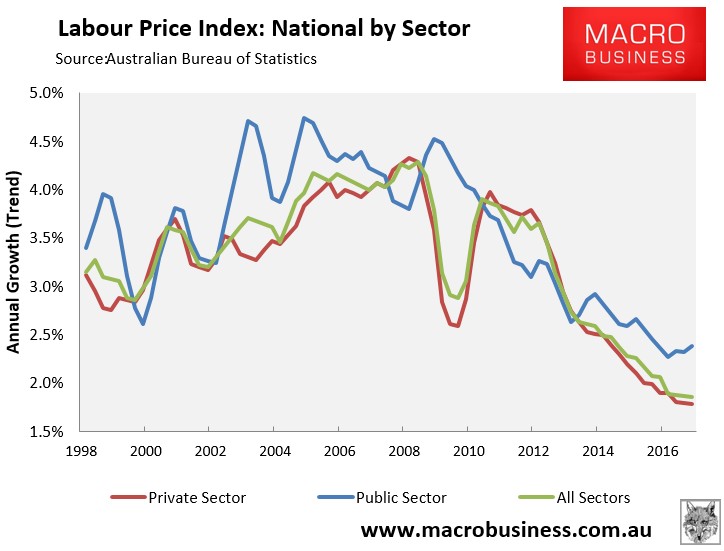
Public servants might be enjoying out-sized income gains compared to the rest of the population:
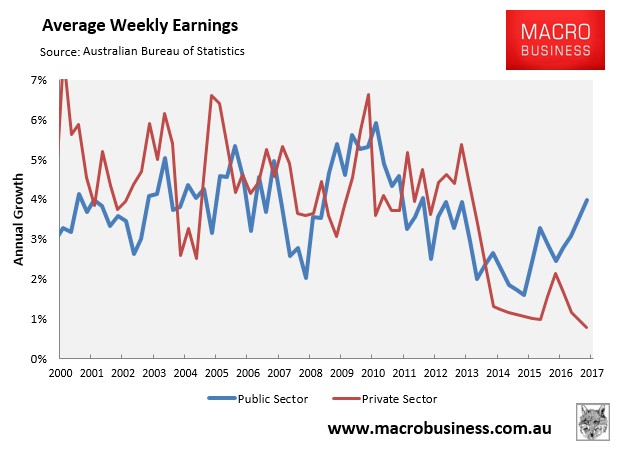
However, this earnings growth appears to be coming at the expense of headcount, with the number of bureaucrats working for the Australian Public Service (APS) is at its lowest level since 2006, with a total headcount of 152,095 employees. From The Australian:
Figures released today by Public Service Commissioner John Lloyd show a fall in employees from a peak of 167,331 in 2012.
The Australian can reveal more than half of the nation’s bureaucrats (57 per cent or 86,838 staff) work within four agencies, Human Services (DHS), the Australian Taxation Office (ATO), Defence and Immigration and Border Protection (DIBP)…
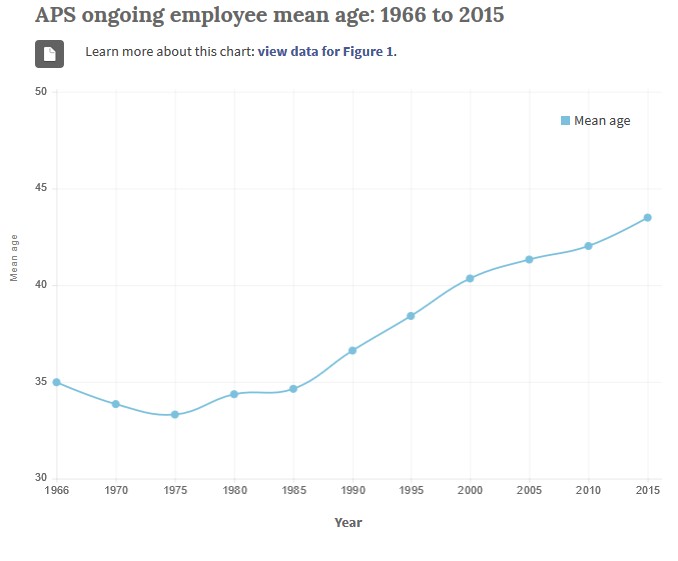
Other key findings in the report, which includes data from across 95 agencies, show the public service is ageing, with over-50s now representing 32 per cent of the workforce, up from only 25 per cent in 2007 and 21 per cent in June 2002.
The under-30 age group has fallen in parallel with increases in employees over 50 and is now running at 13 per cent — down from 18 per cent in 2002. Over the same period, the average age of the public service workforce has risen more than three years, from 40.2 to 43.3 years old.
Of the 152,095 staff, there are 137,255 ongoing workers (90.2 per cent) and 14,840 non-ongoing employees (9.8 per cent) of whom 6698 are employed on a “specified term or task” and another 8142 employed on an irregular basis…
The statistical bulletin shows the ACT is home to 38 per cent of public servants — where more than one in every four workers are employed by government — while another 19 per cent of staff work in NSW and 17 per cent in Victoria…
The proportion of public service staff with a non-English- speaking background rose from 12.7 per cent in 2007 to 14.2 per cent in June this year.
Clearly, the culling of the APS has come at the expense of under-30s, whose numbers have fallen significantly while the dead wood has remained (see next chart). This might reflect the lower graduate intakes over recent years, which has stifled job opportunities for those graduating from university – much like the rest of the labour market.