• The non-residential construction sector is enjoying better times in 2017.
• In our recent update, “Australian infrastructure construction, 2017 Q1”, we highlighted that commencements increased by 16% in 2016. Signs of improvement reflect: the waning of the mining investment downturn; an upswing in public investment; and a lift in private non-mining activity.
• Turning to non-residential building (referred to as building), there is positive news as well, underpinned by robust population growth and a lift in public investment.
• Notably, building approvals have trended higher for the past two years. The capital stock is set to expand to meet the needs of a growing population, as well as to service rapid growth in both international tourism and foreign student numbers.
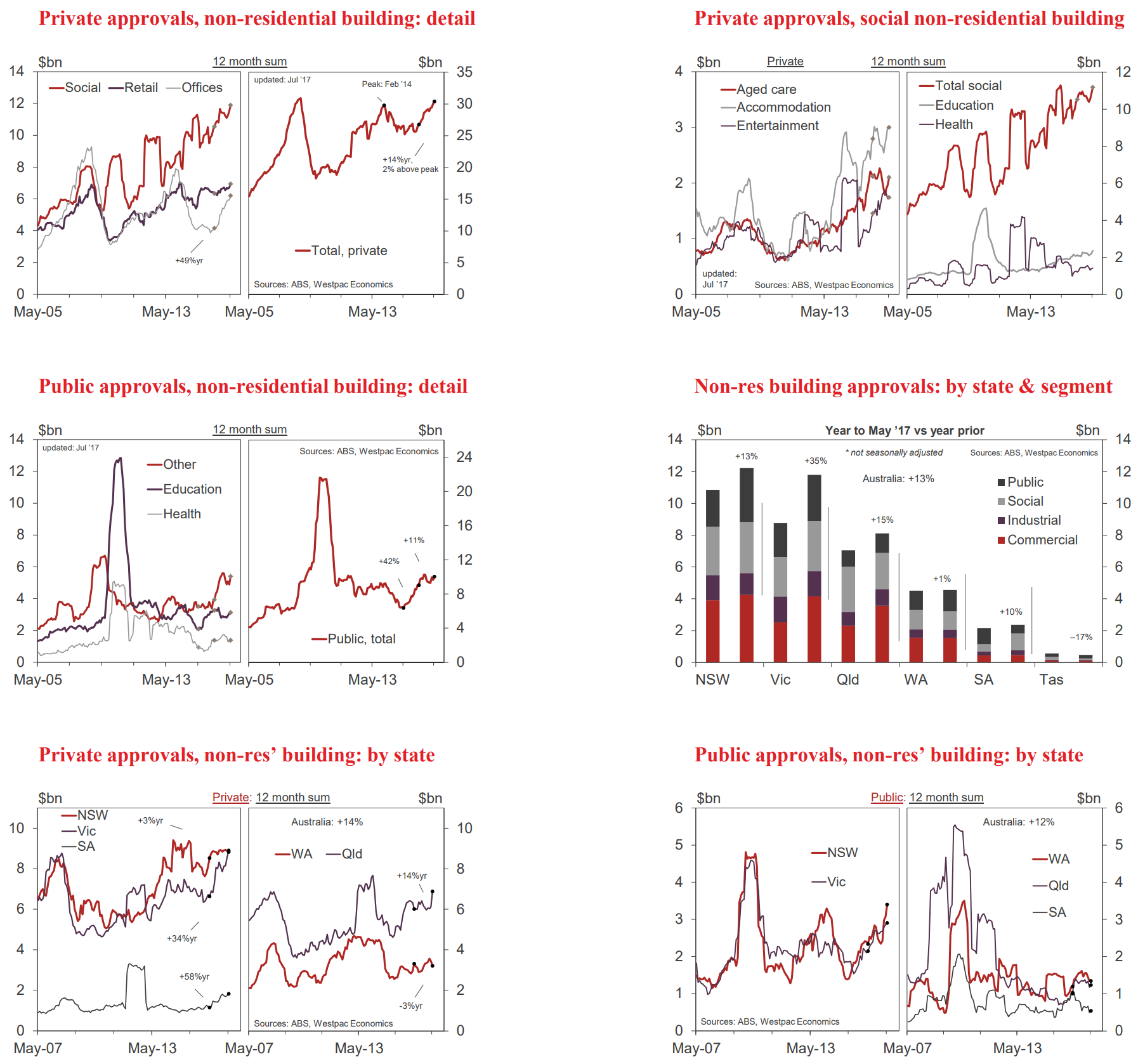
• As at May 2016, the 12 month sum of building approvals was 9% above that for the previous year. Move forward to May 2017 and approvals advanced by a further 13%. In dollar terms, total approvals for the year to May 2017 were valued at $40, an increase of $4.6bn on the previous 12 months.
• For May 2017, total approvals for the 12 months are 3.8% above the earlier peak of February 2014. Approvals for private building projects have eclipsed the 2014 peak by 2%, while approvals for public projects have increased by 9% over this period.
• Between May 2015 and May 2016, the uptrend in approvals was largely centred on additional investment by the public sector, jumping 42%. This provides further evidence of the turn around in public demand as fiscal pressures have receded. Government’s committed to additional investment in education, health and social building projects generally. Private sector building approvals marked time over this period, up 1%.
• Between May 2016 and May 2017, the lift in approvals became more broadly based, with private approvals increasing by 13.5% and public rising by 11%.
• Of the $3.6bn increase in private building approvals over the past year a little over half is accounted for by the office segments. Office approvals have jumped by 49%, +$2.0bn, up from the lows of a year ago.
• Retail, +$0.6bn, has contributed to the uptrend in total private building approvals, so too social building projects, +$1.4bn (with gains across education, health and accommodation).
• By state, total building approvals in the past year have strengthened in NSW, +10%; Qld, +12%; and SA; +9%; and surged in Victoria, +35%, where population growth is particularly strong. The upswing in public investment during the past two years is evident across each of the states, albeit with some differences in timing and magnitude. The lift in private building approvals in the past year is most apparent in Victoria, with gains also in Qld, SA and with NSW sustaining at a high level.
There’s your second round effects from the population ponzi coming through. It’s all good so long as you don’t mind getting poorer on a per capita basis.
David Llewellyn-Smith is Chief Strategist at the MB Fund and MB Super. David is the founding publisher and editor of MacroBusiness and was the founding publisher and global economy editor of The Diplomat, the Asia Pacific’s leading geo-politics and economics portal.
He is also a former gold trader and economic commentator at The Sydney Morning Herald, The Age, the ABC and Business Spectator. He is the co-author of The Great Crash of 2008 with Ross Garnaut and was the editor of the second Garnaut Climate Change Review.