After recently watering-down its already weak 457 visa reforms, the Coalition has now back flipped on executive visas as well.
The controversy began on Monday when The AFR criticised the Turnbull Government’s retrospective change to the skilled visa program because it would prevent many overseas-born executives (i.e. those earning over $180,000) from applying for permanent residency due to being required to undertake an English-language test and skills assessment, as well as imposing a new age limit of 45 years, reduced from 50 years.
Now, The AFR reports that the changes to executive visas will no longer be retrospective, and the changes will now only apply to applications lodged after 1 July 2017:
The immigration department has backed down on retrospectively applying new visa rules that would have excluded hundreds of foreign executives and senior managers from permanent residency.
…a department spokesperson issued a statement late Tuesday afternoon that “in implementing this change, the department will ensure it only affects applications lodged from July 1”.
“The business community should be assured that changes to the exemption to English language and skills assessment requirements for employer-sponsored permanent visas will not be applied to applications lodged before the changes came into effect on July 1, 2017″…
Migration agent Jackson Taylor said the new approach showed the government’s “command and control” style was conflicting with its support for economic globalisation.
To be honest, this is all dancing around the sides of Australia’s ‘skilled’ migration system. The key reforms that need to be made are:
- The permanent migrant intake needs to be at least halved, primarily through the ‘skilled’ stream, to reduce labour oversupply (and help boost wages growth), as well as reduce population pressures afflicting the big cities.
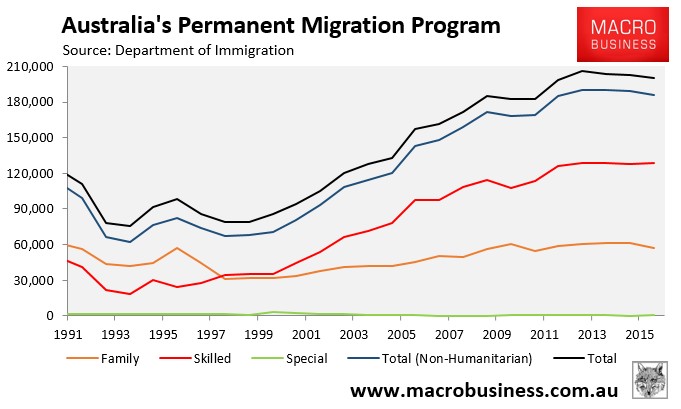
- The appallingly low pay floor of $53,900 (non-indexed) for temporary ‘skilled’ visas, which is 35% below the average full-time salary of $82,789, needs to be raised significantly to discourage employers from hiring cheap foreign labour over locals undermining the pay and working conditions of local workers. These are supposed to be ‘skilled’ workers after all, therefore their salary rates should be set above the national average (which includes unskilled workers), not well below it.
These are the threshold issues that need to be addressed in relation to Australia’s mass immigration program.
unconventionaleconomist@hotmail.com