
Mortgage stress accelerates across Australia

By Martin North, cross-posted from the Digital Finance Analytics Blog:

Digital Finance Analytics has released mortgage stress and default modelling for Australian mortgage borrowers, to end May 2017.  Across the nation, more than 794,000 households are now in mortgage stress (last month 767,000) with 30,000 of these in severe stress. This equates to 24.8% of households, up from 23.4% last month. We also estimate that nearly 55,000 households risk default in the next 12 months.

The main drivers are rising mortgage rates and living costs whilst real incomes continue to fall and underemployment is on the rise.  This is a deadly combination and is touching households across the country, not just in the mortgage belts.
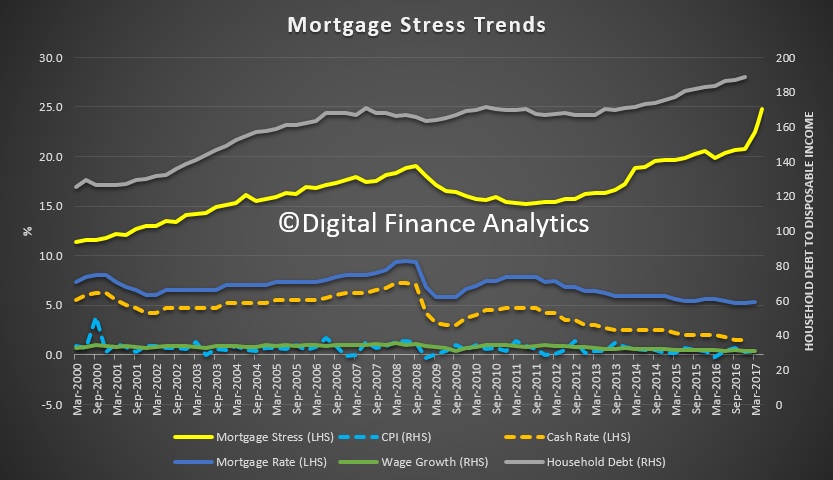
This analysis uses our core market model which combines information from our 52,000 household surveys, public data from the RBA, ABS and APRA; and private data from lenders and aggregators. The data is current to end May 2017.

We analyse household cash flow based on real incomes, outgoings and mortgage repayments. Households are “stressed” when income does not cover ongoing costs, rather than identifying a set proportion of income, (such as 30%) going on the mortgage.

Those households in mild stress have little leeway in their cash flows, whereas those in severe stress are unable to meet repayments from current income. In both cases, households manage this deficit by cutting back on spending, putting more on credit cards and seeking to refinance, restructure or sell their home.  Those in severe stress are more likely to be seeking hardship assistance and are often forced to sell.

Martin North, Principal of Digital Finance Analytics said “Mortgage stress continues to rise as households experience rising living costs, higher mortgage rates and flat incomes. Risk of default is rising in areas of the country where underemployment, and unemployment are also rising. Expected future mortgage rate rises will add further pressure on households”.

“Stressed households are less likely to spend at the shops, which acts as a drag anchor on future growth. The number of households impacted are economically significant, especially as household debt continues to climb to new record levels. The latest housing debt to income ratio is at a record 188.7* so households will remain under pressure.”

“Analysis across our household segments highlights that stress is touching more affluent groups as well as those in traditional mortgage belts”.
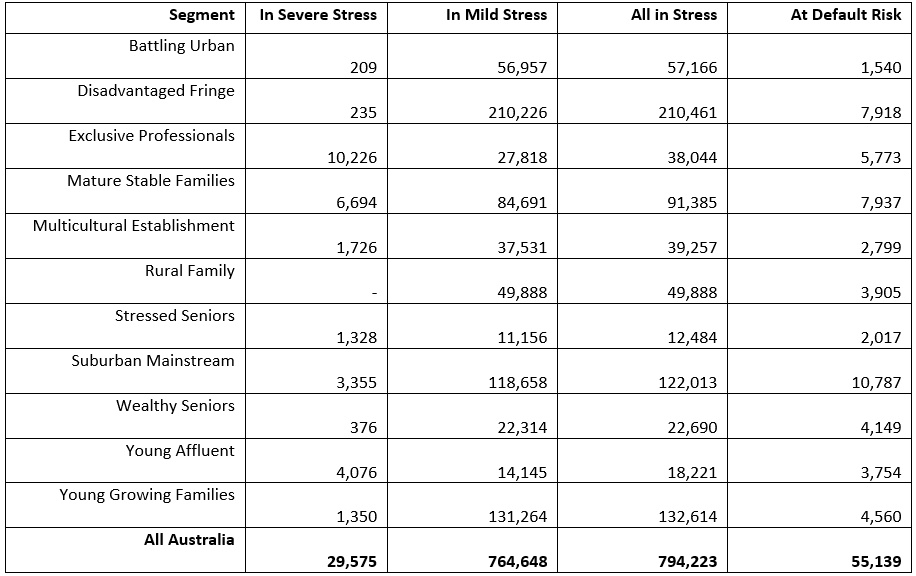
*RBA E2 Household Finances – Selected Ratios Dec 2016.

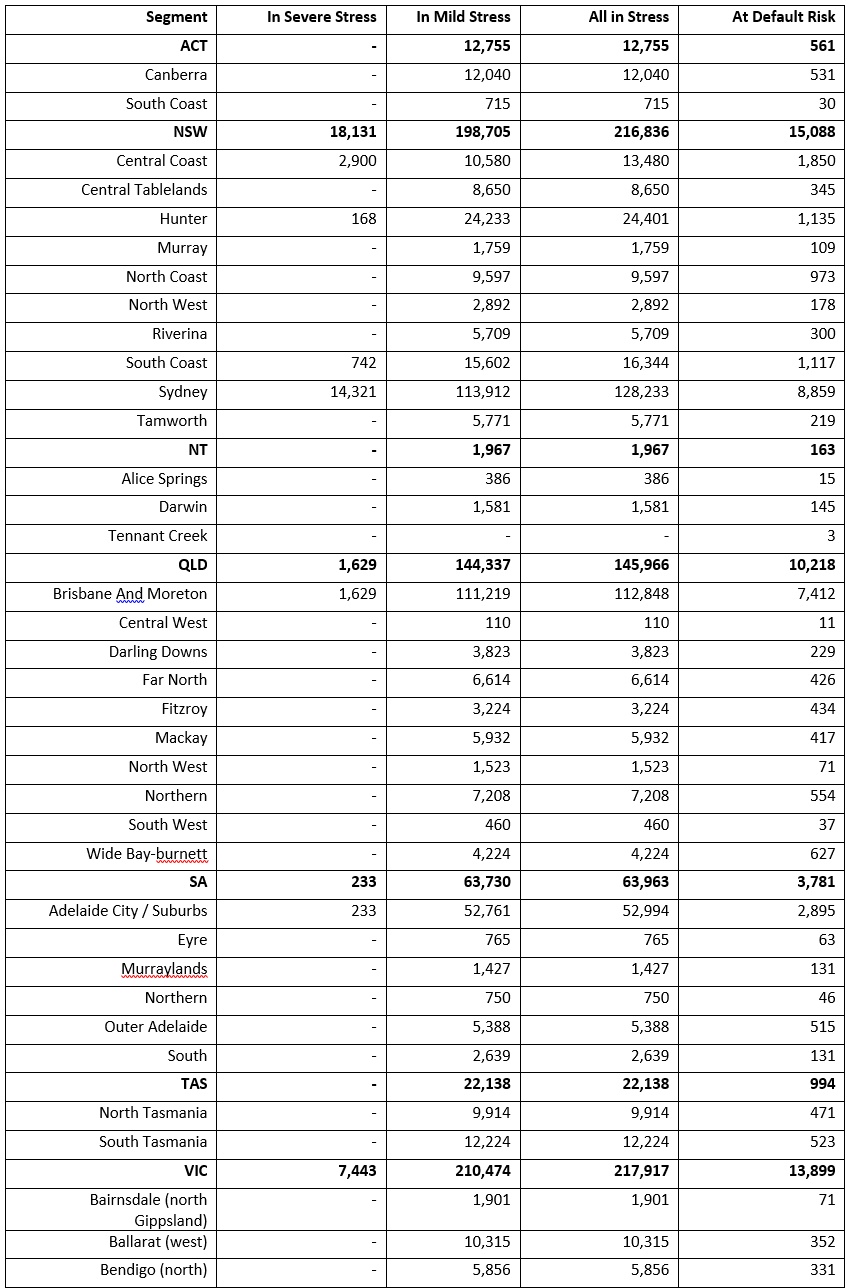
Regional analysis shows that NSW has 216,836 (211,000 last month) households in stress, VIC 217,000 (209,000), QLD 145,970 (139,000) and WA 119,690 (109,000). The probability of default has also risen, with more than 10,000 in WA, 10,000 in QLD, 13,000 in VIC and 15,000 in NSW.

Probability of default extends the mortgage stress analysis by overlaying economic indicators such as employment, future wage growth and CPI changes.  Regional analysis is included in the table below.
Comments

  1. Mortgage Stress is one of the required early rungs on the Property Clock where the hard but fearful worker needs to transform into a brave and savvy investor by limiting expenditure on avocado and iPhone. Within a few weeks, perhaps a month (maybe two) of this discipline and sacrifice will come a moment where suddenly the miracle of the Unique Australian Dream manifests in the form of a property that appreciates in capital value in ever greater amounts than the suddenly modest payments required to service the debt (hereafter referred to as Savvy Property Investment). This personal financial perpetuatual motion machine now requires no more attention than occasional toilet-top readings of Domainfax masthead articles relating to property for sale, infrastructure updates and building wealth by following simple principles such as Dubbles Every Seven Years, CutTehRates and lazy monitoring of successive weekly suburb record auction results. It is through these learn-ed disciplines debt becomes wealth, and stress becomes leverage.

    Mortgage stress? You can’t win in grasping the rings of the property ladder without a little discomfort in the early stages of post-auction euphoria. After digging deep and out-bidding the weak and fearful take a moment to reflect on what you won, and how you won it.

    Gold for you and your family! Gold, for Australia!!

    • Aptly put.
      All it takes is a leap of faith to turn the burden of peonage into ‘aspiration’.

      I guess with enough reframing one can learn to turn the discomfort or rape into an enjoyable sexual encounter.

    • I actually know few individuals that think this way and I am sure every one on this blog can name few.

    • http://www.smh.com.au/business/the-economy/australians-curb-spending-as-household-debt-balloons-20170605-gwl54y.html

      For consumers such as Sydney resident Marie-Aimee Guillermin, there’s little “play money” left after stepping into Sydney’s housing market with a $1.4 million, three-bedroom house last month.

      “We thought once we had the house we could take our foot off the brake a little bit but now that we have it I feel even less certain in terms of stability and financial security,” she told Reuters.

      “So whether we’ll end up spending a bit more on clothes and restaurants and going out and what have you, I don’t see that happening.”

      LOLz, but I invested 1.4M to buy into the dream of financial stability and endless capital gains, it’s all about the GAINZ bro! GAINNNNNNZZZZZZZZZZZ!

      SO I guess no Avacado on toast for her? That’s a shame because I thought once you bought the house it would rain luxury hipster meals from the sky thanks to redrawn equity mate..:P

    • Plagiarist! Thief! I’ve read this before!

      Sorry, my mistake. This is our collective experience.

  2. Martin North’s cohort ‘Exclusive Professionals’ are showing a lot of stress, despite their solid cash flows and access to knowledge.

    This group will be first to hit the exits and will whine about the discount from peak when they sell.

  3. TailorTrashMEMBER

    …….how come if they are “wealthy” seniors they are in mortgage stress ? …………..or is this that thing in Straya where debt is wealth ?……..until it isn’t !
    Guess the returns on the SMSF are getting eaten solidly by the creeping intrest on the mortgaged investment property real wealth generator part of the portfolio ……what a shame
    ……now they can suffer like the kids of Australia are suffering ……

  4. Wait for capital gains. Draw on equity. Service debt. Repeat forever. Live forever. Rich forever. #BoomerThoughtProcess