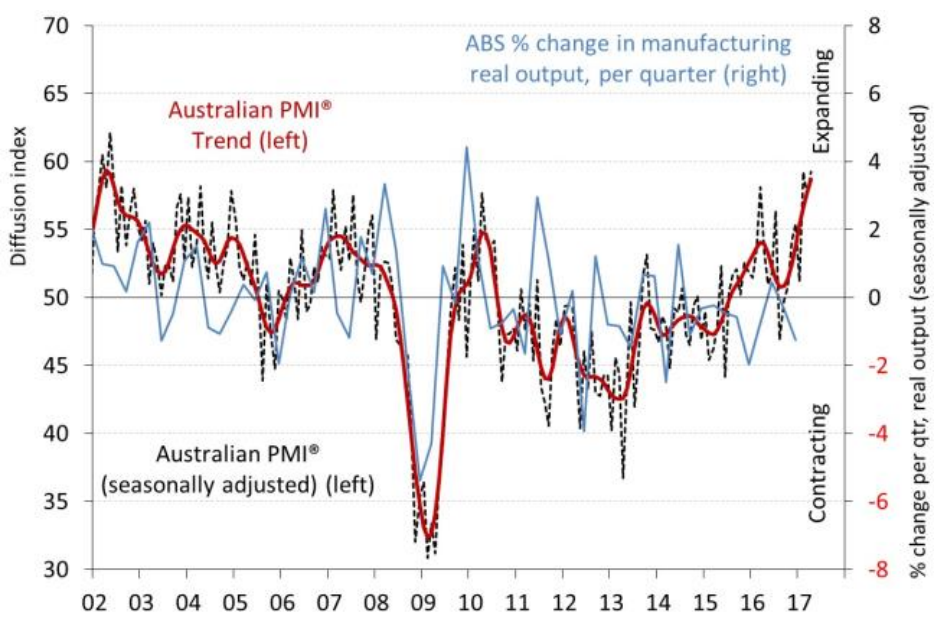
Australian manufacturing continued its recent recovery in April with the Australian Industry Group Australian Performance of Manufacturing Index (Australian PMI® ) climbing 1.7 points to 59.2 points (results above 50 indicate expansion with the distance from 50 points indicating the strength of expansion). This was the seventh consecutive month of expansion for the Australian PMI® and the strongest monthly result since February 2017 and before that, since May 2002.
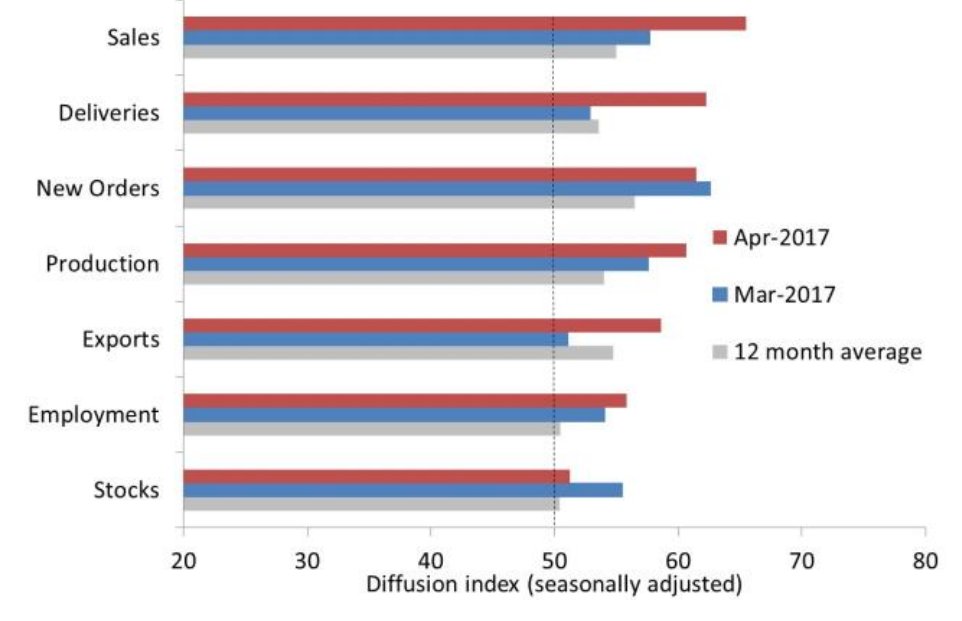
All seven activity sub-indexes in the Australian PMI® expanded in April. New orders remained elevated (61.5 points) while sales surged higher (65.5 points), as did production (60.7 points), exports (58.6 points) and employment (55.9 points). Inventories eased to a more modest rate of expansion (51.2 points) in April.
Seven of the eight sub-sectors in the Australian PMI® expanded in April (trend data), with six of them above 60 points. Food & beverages continued its strong run of expansion (60.1 points), as did wood & paper products (64.4 points). The recovery in printing & recorded media strengthened (61.7 points), as did non-metallic mineral products (63.3 points), metal products (61.2 points), machinery and equipment (60.5 points) and petroleum, coal & chemical products (56.4 points). The small but very diverse textiles, clothing, furniture and other products sub-sector contracted again in April and at a faster rate (44.8 points).
Comments from manufacturers in April indicate demand continues to improve. Increasing exports are a key theme, with several manufacturers reporting success in new markets in Asia. Stronger output and prices in the local agricultural and mining sectors is supporting demand for some types of machinery, equipment and chemicals, while large public infrastructure projects are fuelling demand for building materials, metals, transport equipment and others. Cyclone Debbie appears to have dampening activity in Queensland and Northern NSW, although the direct impact on manufacturing has not been severe.
Rapidly rising energy costs remains an urgent issue for many manufacturers. At the same time, selling prices are relatively subdued, with surpluses in some markets and intense overseas competition keeping margins tight.
David Llewellyn-Smith is Chief Strategist at the MB Fund and MB Super. David is the founding publisher and editor of MacroBusiness and was the founding publisher and global economy editor of The Diplomat, the Asia Pacific's leading geo-politics and economics portal.
He is also a former gold trader and economic commentator at The Sydney Morning Herald, The Age, the ABC and Business Spectator. He is the co-author of The Great Crash of 2008 with Ross Garnaut and was the editor of the second Garnaut Climate Change Review.