The market widely regarded CBRC‘s recent series of announcements (Article No 4, 5, 6, 7, 43, 45, 46, 52, 53) and President Xi‘s speech at the Politburo meeting as evidence that policy tightening has been ramped up, and PBoC may step up hiking. News on banks‘ Wealth Management Products (WMP) redeeming from delegated investment also led to the concern that a repeat of 2H13 may be in front of us.
However, we believe that deleverage has probably come to the second stage. In our view, the first stage was aimed at cracking down policy arbitrage by financial institutions, i.e., positive carry with capital gains on the expectation that monetary easing will continue. This stage started from July 2016, seen from higher value-weighted rates from PBoC, higher levels of repo and higher volatility.
The second stage of deleverage is about coordinated regulatory work aimed at cracking down regulation arbitrage, i.e., building up leverage via asset management products, regulated by different regulators in a relatively isolated manner. Typically, such business models involve multiple layers of products (WMPs, trust products, brokerages‘ asset management products (AMPs), mutual funds, insurers‘ AMPs) built on the same underlying assets, with each layer exposed to potential tenor mismatch, credit risk, redemption risk. We believe this stage started from Mar 2017, seen from formal implementation of PBoC‘s Macro Prudential Assessment and CBRC‘s announcements.
Indeed, a detailed comparison of CBRC articles with previous policy measures suggests that there are fairly limited new elements from CBRC articles; instead, they were emphasis of previous measures and calls for self-evaluation.
Historically, policy regulators have implemented the “cut–off rule“, i.e., no forced redemption or unwinding of positions on existing products, but imposed the rules on new products. We have no reason to believe that this time will be different.
…we expect the PBoC to take a pause at least for now, because, if not properly implemented, coordinated work could be associated with negative feedback effects, liquidity crunch, and systemic risk.
Meanwhile, tightening is rampant in China, Jiuzhou Securities says the PBoC has already effected a rate hike, iFeng: 九州证券:央行已经进行了实质性加息
Recently, with the frequent issuance of the CBRC, the market for regulatory concerns began to gradually increase, the bond market pessimism filled. And then the central bank monetary policy “anchor” DR007 continues to rise, and the early May capital prices remain high since April 10-year bond yields up nearly 25BP, the current 10-year bond yields have been hit in August 2015 The highest ever.
On the recent weakness in the bond market, Haiqing FICC channel that the main reasons include:
First, high-level co-ordination, “three lines will be” comprehensive and strict supervision, is the core of the bond market crash. April the CBRC regulatory documents introduced, the end of April public opinion and market sentiment has eased, that regulators will not be too strict to avoid triggering the risk of the outbreak, but since May the direction of public opinion again, Xinhua News Agency and other authoritative media position, Supervision of a comprehensive trend “to become the tone of policy.
Second, the central bank DR interest rate substantially raise interest rates, resulting in debt costs are expected to continue to rise. As the central bank monetary policy anchor DR007, since the beginning of the year has been sharply higher nearly 90BP, indicating that the “central mother” of the real tight currency has been “quietly”, although the central bank recently did not adjust the OMO interest rate, but the market real transaction interest rates continue to rise, enough Indicating that the central bank monetary policy continued to tighten the attitude;
Third, the behavior of financial institutions level, the CBRC self-examination led to the normal outsourcing business is difficult to carry out . Although the pre-media coverage of large-scale redemption of large-scale outsourcing outside the exaggerated elements, but in fact the bank redemption or expired not to continue to have been quite common, outsourcing agencies continue to pressurize the debt market, which also led to this The adjustment of the cash register is higher than that of the national debt futures.
Haiqing FICC channel that need to be alert to radical lever to lead to “trampling” debt and financial market risk outbreak, while the need to guard against the risk of economic recovery, it is recommended to leverage should be “soft landing” rather than “hard landing”
First, “full-scale supervision” + money market “substantial interest rate”, may lead to “trampling” debt, the extent may be even more than in December 2016, leading to similar to the 2015 stock market crash ” – to the lever – … … “cycle, and even lead to debt issuance of corporate default tide.
Second, the strong economic recovery since 2016, but the “comprehensive and strict supervision” may lead to the recovery of the collapse, especially the large-scale cancellation of bond issuance, non-standard financing is limited, may lead to the real economy of the financing activities are significantly inhibited in the presence of local government And state-owned enterprises “soft constraints” of the case, the squeeze effect for private enterprises will be more serious.
Third, it is recommended that “deleveraging” should be “soft landing” rather than “hard landing” to develop more explicit and enforceable regulatory standards and should not require banks to “speak politics” and self Supervision, in particular, should be clear the legitimacy of normal outsourcing business, to avoid the uncertainty caused by the irrational and “trampled” debt, to prevent the “radical deleverage” caused by the outbreak of financial system risk.
First, the regulatory changes are the core variables of financial markets since April
Since March 2017 , Guo Shuqing, chairman of the CBRC soon, in the banking industry, a wave of financial supervision to strengthen the storm , the main objective is to strengthen the banking risk control, make up the regulatory short board, strengthen the financial leverage, Arbitrage “,” three violations “,” four improper “,” ten chaos “and other documents on the banking industry, financial business, investment business, such as special rectification. China Banking Regulatory Commission frequently issued a document, and the CBRC issued a policy of policy, far beyond the market before the policy level supervision is expected, 10-year bond yields began to rise sharply in early April, the previous three weeks up nearly 25BP.
4 On May 25, the CPC Central Committee Political Bureau held a meeting , called “attach great importance to prevention and control of financial risks and strengthen supervision coordination, strengthen the real economy, financial services, and increase efforts to punish illegal violations.” At the same time, regulators began to pay close attention to the impact of the redemption and other events on the bond market , the media for the trend of regulation has also changed, the market began to think that the regulatory easing, that at least regulators will not allow ” “The second outbreak, which also led to 10-year bond yields have been down.
However, from the market research point of view, the Politburo stressed that after the supervision and coordination, many local banking regulatory authorities began to enter the local banks, urging commercial banks to self-examination, a direct result of many banks appear outside the expiration of non-renewal, or redemption Outside the situation.
5 On May 4, Xinhua News Agency issued a document “of the financial sector listed priorities to safeguard national financial security,” reiterated the official attitude to regulation, that is, “line 3 will be fully tighter regulation.” The article clearly pointed out that “at present, some areas still exist regulatory gaps, urgent need to fill the regulatory short board”, “China Banking Regulatory Commission said it will comprehensively sort out all kinds of banking business regulation and regulation, as soon as possible to fill the regulatory regulations blank, fill the regulatory system short board” , As well as ” to strengthen financial supervision, the departments should do both defensive responsibility, but also co-ordination , the formation of a national game” and so on.
The market is expected to change the regulatory policy is the core of China’s financial market since April: (1) CBRC regulation significantly higher than expected, the stock market, bond market double play → (2) regulatory attitudes and media easing loosening, market expectations Regulatory “not so strict”, the stock market, the bond market rebound → (3) regulators and media trends again more stringent, the market is expected to deteriorate significantly, stocks, bonds, goods three killed.
Second, the central mother DR weighted interest rate substantially raise interest rates, monetary tightening attitude “is not obvious but very clear”
Recently, the market rumors that the central bank will raise the operating rate of OMO, while rumors to improve MLF interest rates, the results eyebrows: Although the central bank did not adjust any interest rates, but the bond market but fell even more powerful.
We believe that the central bank’s attitude, not only to see what the central mother said, but should see what the central mother did: even if the OMO interest rate is not adjusted, but the weighted rate of investment from the DR trend, the central bank has carried out a substantial rate hike.
Since 2017 , the inter-bank deposit agency 7-day repurchase rate DR007 from the beginning of the year 2.30 level, up nearly 90BP to the recent level of 3.20, the current DR rate even higher than the end of March. In the end of June not to the case, the funds have been tight to the present level, how could the market up optimistic!
We think that DR007 interest rate rise, mainly from the two aspects of the bond market have an impact: First, DR007 is the bank’s capital costs, the interest rate of the substantial upward, will directly push the bank to buy government bonds cost of capital; Second, DR007 is Central bank monetary policy implementation report clearly pegged to the “anchor”, with a strong monetary policy signal significance, DR007 continued to reflect the central bank tightening attitude.
First, DR007 as an inter-bank deposit institutions into the cost of capital, the sharp rise in interest rate prices shows a substantial increase in the cost of bank funds , and banks are the main buying power of bond market interest rates , the substantial increase in bank capital costs, Will significantly reduce the bank’s interest rate debt demand, thus pushing up the 10-year bond yields.
Second, we have pointed out many times before, DR007 is the central bank monetary policy implementation report clearly proposed monetary policy pegged to “anchor”, with a strong policy signal. Therefore, the beginning of the year DR007 interest rates continued upward, reflecting the central bank to tighten the liquidity of the currency market continuity, and DR007 interest rates significantly reflects the central bank tightening efforts. Another point of view, we can also continue to go into the DR007 interpretation, the central bank in the money market is tightening is the central bank strict regulatory will, which coincides with a line of three strict supervision “coordination.”
Third, the CBRC self-examination, regulatory expectations are not clear, outsourcing “lying gun”
Recently, the CBRC strict regulatory policies continue to be introduced, as well as the local banking bureau stationed in banks to urge the bank self-examination, a direct result of outsourcing business has shrunk dramatically. Although the central bank at the beginning of the year to try to clear the legitimacy of the outsourcing, but in the absence of specific regulatory indicators in the face of self-examination, the bank insecurity, political correct consideration higher than the economic efficiency, outsourcing is not impossible, Become a problem.
Looking back before October 2016, the bond market has gone through nearly three years of the big bull market, the wheel of the bull market dominated the logic of two key points: First, the central bank monetary policy is loose , the capital rate fixed at a very low level, Investors generally adopt a long period of time, plus the lever method to carry out the telegraph operation; Second, commercial banks to take “peer debt + outsourcing” approach, first to expand the balance sheet to expand the scale, and then through the outsourcing of the way Into the bond market. Therefore, outsourcing a significant expansion of the scale + add leverage consistent policy on bond forming a huge demand, led directly to the bond market “asset shortage”, the great bull market.
At present, the central bank has continuously raised the capital cost of the bond market, as well as tightening the liquidity of the money market, making the bond market in the process of continuous to the process, then the outsourcing will become the bond market a strong support force. However, the recent introduction of strict supervision and control policies of the China Banking Regulatory Commission, as well as the local banking regulatory authorities stationed in banks to urge the bank self-examination, a direct result of outsourcing business significantly shrinking .
Specifically, the recent CBRC generally introduced nine documents, of which, No. 46, the text of the “three sets of benefits”, mainly on the requirements of the bank self-examination of financial funds outside the scale; 53 text proposed “four improper”, requiring banks to focus on inspection The same industry business, financial management, trust business, the same will affect the size of the outsourcing; 7, proposed to make up for the regulation of short board, to strengthen the risk of off-balance sheet business, financial management, the same bad business.
Although the central bank in the “on the normative financial institutions, asset management business guidance” (the market known as the “big capital” views) recognized the legitimacy of the outsourcing, but the CBRC’s self-examination is not on the legitimacy of outsourcing and scale Given a clear attitude, leading to the bank can only follow the most stringent standards – do not do outside the implementation of the commission, which led to the outsourcing market has been close to the frozen state, the trustee’s debt caused by the debt adjustment pressure even more than the national debt futures, which But also this round of the bond market fell in December 2017 (when the futures fell much more than the spot) significantly different characteristics.
Fourth, “radical to leverage” may lead to “trampling debt” and the economic recovery died
At present, strict supervision and control of a comprehensive increase, there may be “trampling” the possibility of debt; the same time, “comprehensive and strict supervision” may lead to economic recovery die.
On the one hand, the central bank continued to tighten monetary liquidity, leading to rising capital costs, making the bond yields rose sharply, since the beginning of the year, the whole market R007 capital costs have been up 130BP, 10-year Treasury bonds Yield has been up 40BP. If the future central bank to further maintain a high degree of tension in the money market liquidity, then the bond market may increase the degree of selling. On the other hand, with the CBRC continue to promote self-examination and on-site inspection, will make before the huge amount of outsourcing significantly decline in the size of the substantial shrinking will directly affect the needs of the bond market, the future bond market appears to sell of a substantial increase , therefore, if the strict regulatory policies to strengthen further in the future, then the “stampede-style debt disaster,” the possibility should not be overlooked.
On the impact of strict supervision on the real economy, there have been large-scale cancellation of bond issuance, non-standard financing is limited, may lead to the real economy of the financing activities are significantly inhibited, in the presence of local governments and state-owned enterprises “soft constraints” , The squeeze effect for private enterprises will be more serious. The current level of market bond issuance cancellation has become the norm, only in April on the 154 bonds canceled and postponed the issue, involving the scale reached 140.663 billion yuan, the number and scale has been the same as the first quarter of this year. It is not difficult to imagine, coupled with the supervision of non-standard “besieged”, then the future scale of corporate financing will be a sharp decline. Even if some companies are still issued bonds success, but its issuance rates have been nearly doubled over the same period last year, high financing costs on the production and operation of enterprises are greatly suppressed, business operations will face greater challenges.
Therefore, both the strict supervision may lead to a substantial decline in the scale of social financing, or a substantial increase in corporate financing costs, will mean that financial weak to weak economic transmission will be inevitable, bad real economy. From the national debt futures T1706 and T1709 trend can be seen, the recent decline in T1706 much larger than T1709, reflecting the regulatory market led to the economic pessimistic expectations.
In addition, due to the financing needs of private enterprises in the whole financial are in a relatively weak position, in the local government and state-owned enterprises there are “soft constraints” situation , strict supervision of financial conditions deteriorated, the first to be hurt must be private enterprises The The degree of leverage of private enterprises is the lowest in China, but in the radical to the lever in the sand, the private enterprises should not be leveraged will be seriously damaged.
Haiqing FICC channel suggested that “deleveraging” should be “soft landing” rather than “hard landing” to develop more clear and enforceable regulatory standards and should not require banks to speak of ” Self-regulation, in particular the legitimacy of the normal outsourcing business, to avoid the irrational and trampledness of debt due to uncertainty, and to prevent the outbreak of financial system risk caused by “radical deleveraging”.
And the fallout is, if anything worse than I’ve been expecting, also from iFeng: 国君固收:中国国广义信贷与财政周期正转向紧缩
Advertisement
Financial shrinking a wave is not even, the financial tightening of the impact of the attack, the regulation of the years do not be taken lightly. May 3, the Ministry of Finance, Development and Reform Commission, the Ministry of Justice, the central bank, the China Banking Regulatory Commission and the Securities and Futures Commission and other six ministries jointly issued “on the further regulation of local government debt financing notice” (financial [2017] 50), the Ministry of Finance At the same time a reporter asked. No. 50 on the impact of local financing as much as “three sets of benefits”, “four improper” on the impact of the banking system, which once again shows the policy layer from top to bottom to prevent financial and financial risks attach great importance to indicate that in addition to financial institutions Full-scale leverage and shadow bank scales, the financial sector is also opening a round of anti-risk regulatory remediation storm, marking China’s broad credit and fiscal cycle is from a comprehensive liberal to tightening, and under strong supervision, short-term contraction is likely to decline more sharp.
No. 50 key focus on the rectification of the rectification of local remedies, clean up local financing platform and PPP projects disguised covert financing and other acts, although most of the provisions in the 43, 16, No. 4, 88, etc., but also made, but also Some measures and requirements are new, mainly including four major aspects:
1) to prohibit local government breach of warranty, to carry out local financing guarantee clean up rectification. (2) in July 17, 17 years ago to clean up the rectification in place; (3) overdue departments, city and county governments, municipal governments, government departments, government departments, government departments, government departments, The responsibility of the responsible person shall be investigated according to law.
2) to strengthen the platform company financing management, to accelerate the transformation of market-oriented state-owned enterprises. (1) The local government shall not enter the platform with public welfare assets and reserve land, and shall not promise to use the government funds to intervene in the normal operation of the financial institutions as the platform company’s debt repayment income; (2) (3) A financial institution may not require or accept a letter of guarantee, a letter of promise, a letter of comfort, etc. from the local government and its subordinate departments, etc. (3) The financial institution shall not require or accept the local government and its affiliated departments to provide a guarantee letter, promised letter, comfort letter, etc. Any form of guarantee.
3) for the first time to standardize local PPP financing. (2) shall not in any way to the social capital side commitment to repurchase the principal amount of investment, commitment to investment principal loss, commitment to the lowest (1) not to borrow funds to invest in various types of investment funds, is strictly prohibited local use of PPP, (3) No additional terms may be added to any equity investment method, such as a limited partnership fund.
4) re-emphasize the regulation of local government financing. (2) not in any form, such as documents, minutes of meetings, leadership instructions, etc., to require or determine the enterprise for the local government disguised debts; (3) shall not be any unit (1) shall not be in any form of the State Council approved the issuance of local debt financing; And individuals in any way to provide security, shall not be committed to any unit and individual financing commitment to debt service.
50 to strengthen the financial risk supervision, to clarify the local government and financing platform, city investment platform and the boundaries of the main body of PPP, to avoid the local government or a large number of hidden financial risks brought about by rising, we believe that the year Local financing and urban investment risk valuation have a profound impact:
No. 50 marked the end of the generalized fiscal easing cycle that lasted nearly two years, and local quasi-finance, financing and investment were tightened. 15 years in the steady growth and financial liberal environment, all kinds of quasi-financial instruments emerge in an endless stream, creating a very relaxed generalized financial financing environment. The local government borrows the shadow bank, the PPP, the government industry fund, the project income debt to carry out all kinds of bright stock, the disguised financing and the violation guarantee, etc. In 2016 only the city investment debt, the special construction debt, the industry fund and the PPP related financing Up to 6.5 trillion. No. 50 marked the quasi-fiscal wind from the loose to tighten, the local cast investment platform, PPP and other implicit guarantees facing stripping, disguised limited debt. As the local government is the most important driving force for infrastructure investment, financing contraction will lead to increased risk of local investment and economic slowdown, pressure on the size of loans and social finance, debt pressure surge.
City investment debt credit spreads face further risk, but relative to the risk of industrial debt premium is higher. Since December 2006, the credit spreads of the City Investment and State Bonds have been extended from about 30Bp to above 110bp, despite a record high of 16 years, but only about 30% of the total score compared with the history. Credit contraction, the government implied security subsided, credit spreads are still further expansion of space. From the city investment and industrial debt relative credit spreads, the current 3Y, 5Y, AA city debt and industrial debt relative spread from the 16th quarter of the fourth quarter of the -40bp and -85bp (then the city vote into the country) soared to 180bp and 150bp, has been adjusted to a record high, in the absence of city investment breach of contract, the same period, the rating of the city has been relatively debt relative to industrial debt has a certain price advantage, relative spread up space is limited.
Tightening policy of multi-faceted, city investment debt level issue interest rate jumps will continue. Since April, the central bank, the finance, the banking supervision, the CSRC and the CIRC have escalated the supervision of the financial and financial risks. The generalized credit and the generalized finance have tightened tightly. The local guarantee has been cleared and the government has just broken the rescue and rescue. Institutions or the bond market financing is facing a comprehensive tightening. 17 years from January to April the city’s investment bonds 427.53 billion, net financing only -712.3 million, compared with the same period in 2016 fell 564.3 billion and 723 billion, the lowest level in history; not only the issue of shrinkage, a tender interest rate also jumped , By the card will be pledged bonds to raise the rating to AAA level, AA + and below the rating of the bonds will not be the impact of storage, the new city investment liquidity premium sharply higher, some banks also tighten the city investment platform lending Size, market demand in the cold, the first issue of interest rates jump will become the norm.
Because of their poor hematopoietic ability, city investment debt in the tightening cycle more vulnerable to “Davis double play.” In the tightening environment in 2011 and 2013, when the central bank and policy levels were tightening the local financing platform and shadow bank financing, while the real estate market cooling, land assets and transfer income fell sharply, local financial decline, leading to the city Investment companies face a double decline in net assets and operating income risk, especially in the central and western regions may be particularly evident, continuous financing capacity deterioration, until the arrival of a new round of loose period to be alleviated. Therefore, we are worried that if the current round of shadow banks, financial risk regulation tightening, local finance, financing, infrastructure decline risk will be a substantial warming, the city of debt follow-up adjustment space is still large.
China is going to slow materially. Possibly very sharply. Bloomie today asks how long before China blinks:
How much pain can Chinese leaders stomach? It’s becoming a key question for investors as the government’s stepped up campaign to rein in financial leverage ripples through markets.
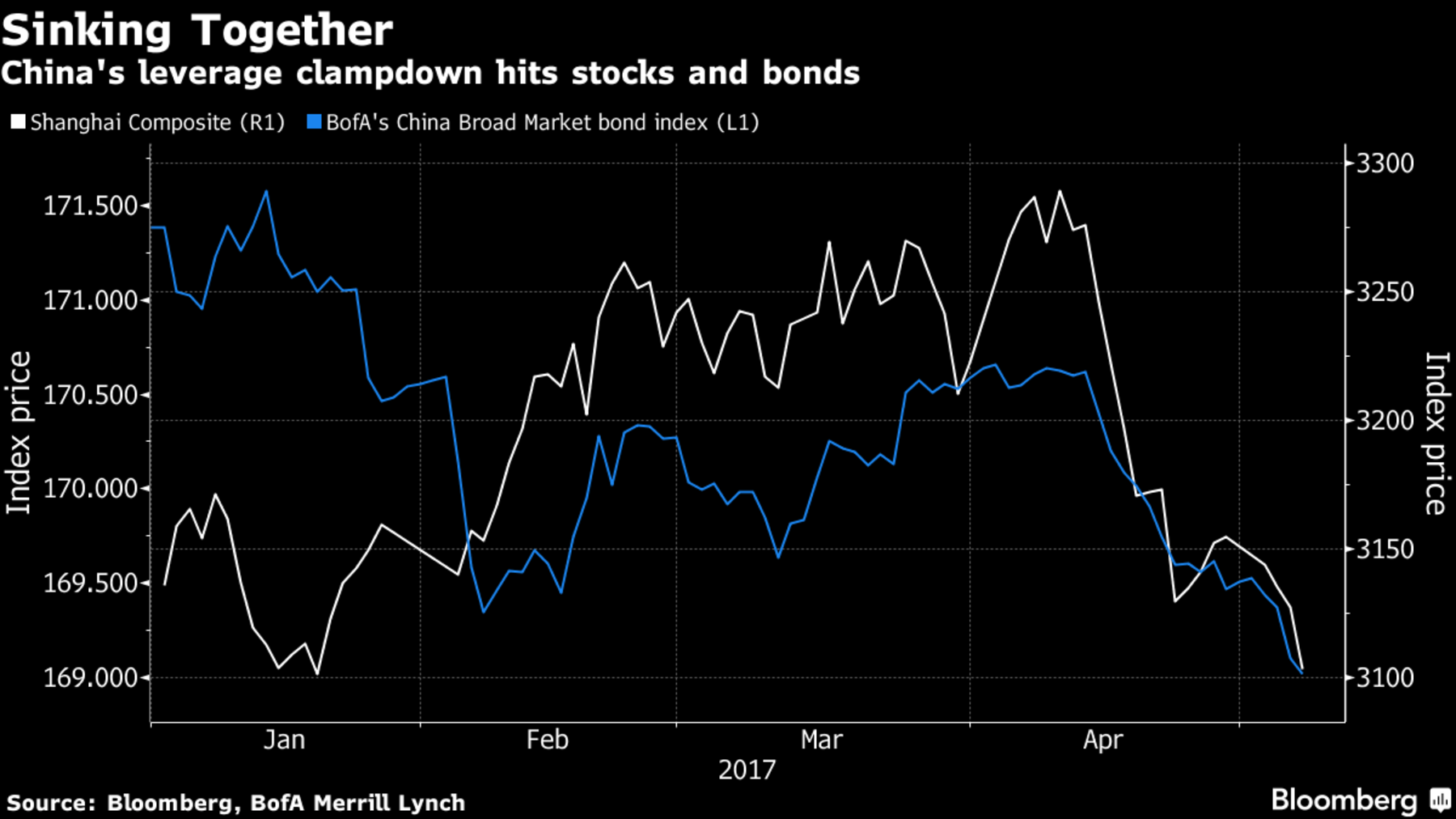
The clampdown has erased at least $453 billion from the value of Chinese stocks and bonds since mid-April, spurred $21 billion of canceled debt sales and compelled the People’s Bank of China to inject $48 billion into jittery money markets. Sales of asset-management products by lenders and trust companies have plunged by more than 30 percent, while domestic real estate transactions have slowed and metals prices have buckled.
…“It would take a lot for the country to move into easing mode,” said Howard Wang, the Hong Kong-based head of greater China at JPMorgan Asset Management, which oversees about $1.8 trillion worldwide. “They will adjust their policies if markets go down another 10 percent or the currency cracks under pressure. Only these very drastic swings will make them move the other way.”
Advertisement
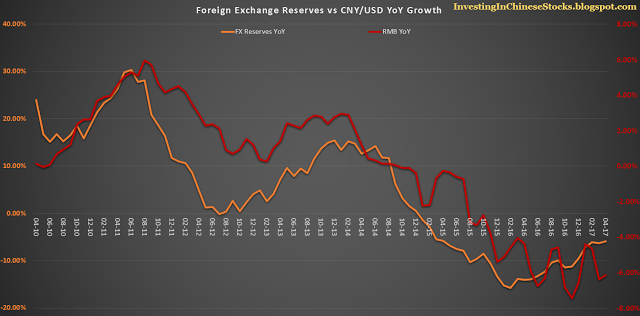
So far the yuan is holding. Indeed, currency reserves rose in April:
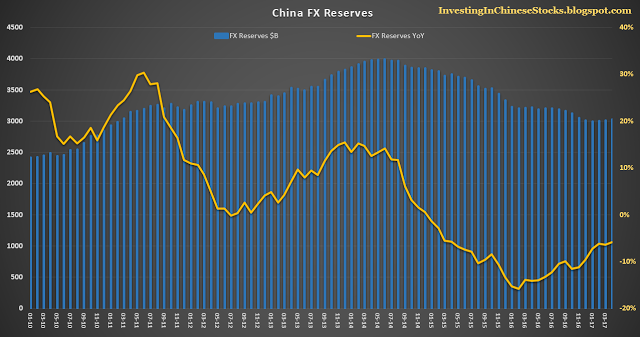
China’s foreign exchange reserves rose in April for a third straight month, beating market expectations, as capital control measures and a pause in the dollar’s rally helped staunch capital outflows
Reserves rose $21 billion during April to a total of $3.03 trillion, compared with an increase of $3.96 billion in March to $3.009 trillion.
Who knows how long before they blink? The last tightening round took growth to an official low of 6.7% but smart analysts reckoned in was closer to 4% in late 2o15. The fiscal pump is running more strongly this time and the yuan is much lower so there is more to support growth. As well, the real estate slowdown remains bifurcated, as opposed to 2015’s widespread downturn, though whether that can last as WMPs choke up is an open question.
Advertisement
Definitely more pain will be needed. The question is, will it be enough to make any change structural? That is, will the issuance of off balance sheet credit vehicles be retarded permanently? For that to happen, there will need to be some decent bankruptcies to remove moral hazard from the shadow banking system. That suggests pretty decent cyclical pain ahead.
Perhaps the more important point is that if structural change is the aim of deleveraging policy – and what else can it be – then whatever new level of growth we fall to will once again be a permanent “L-shaped recovery”.
David Llewellyn-Smith is Chief Strategist at the MB Fund and MB Super. David is the founding publisher and editor of MacroBusiness and was the founding publisher and global economy editor of The Diplomat, the Asia Pacific's leading geo-politics and economics portal.
He is also a former gold trader and economic commentator at The Sydney Morning Herald, The Age, the ABC and Business Spectator. He is the co-author of The Great Crash of 2008 with Ross Garnaut and was the editor of the second Garnaut Climate Change Review.