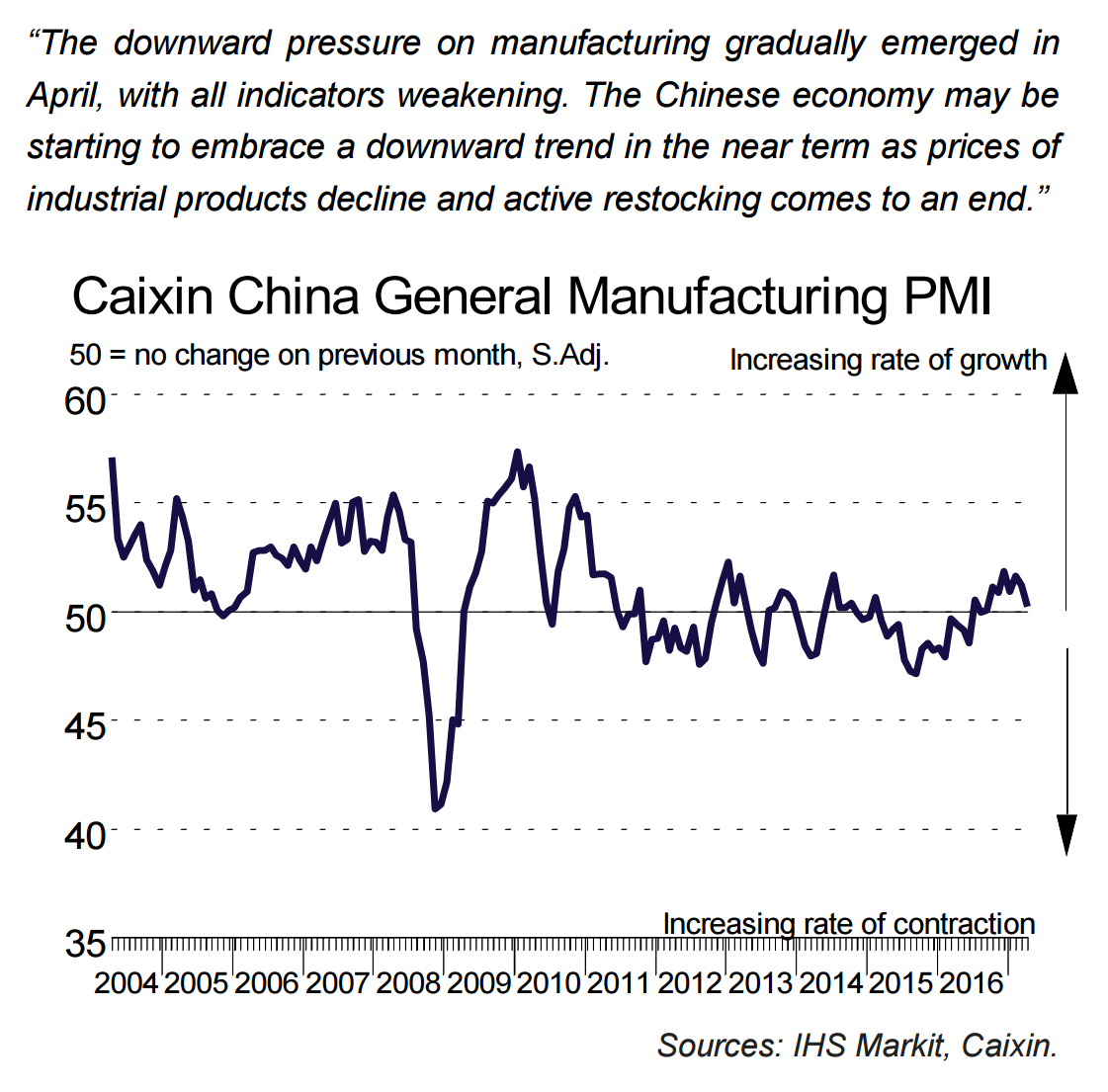
Latest data indicated that Chinese manufacturers started the second quarter with a further slowdown in production and new business growth. Employment across the sector meanwhile declined at the fastest pace since the start of the year and input buying rose only slightly. At the same time, optimism towards the 12-month outlook was the weakest seen in 2017 so far. Cost pressures continued to ease from the peaks seen at the end of last year, and contributed to only a modest rise in prices charged.
The seasonally adjusted Purchasing Managers’ Index™ (PMI™) – a composite indicator designed to provide a single-figure snapshot of operating conditions in the manufacturing economy – registered 50.3 in April, down from 51.2 in March to signal only a marginal improvement in overall operating conditions. Moreover, the latest upturn in the health of the sector was the weakest seen since last September.
Slower increases in output and new orders were key factors weighing on the headline index reading in April. Production growth softened for the second month running and rose only marginally overall. Total new business followed a similar trend, and rose at weakest pace since last September.
Softer growth in total new orders coincided with the slowest increase in new work from abroad in 2017 so far. While some companies indicated that new product launches contributed to higher new orders both at home and abroad, others commented that relatively muted customer demand had weighed on growth.
Manufacturers continued to reduce their workforce numbers at the start of the second quarter. Furthermore, the rate of payroll cuts was the fastest seen since January. According to anecdotal evidence, lower employment was due to cost-cutting initiatives as well as the nonreplacement of voluntary leavers. This in turn contributed to a further increase in the level of work-in-hand (but not yet completed), though the rate of accumulation was modest.
Reflective of the trend for production, purchasing activity growth weakened to a marginal pace in April. At the same time, companies reported a renewed expansion in inventories of purchased items, albeit fractional. Stocks of finished goods were meanwhile depleted for the fourth successive month, with some firms mentioning the use of current stocks for satisfying new orders.
A shortage of some raw materials at vendors underpinned a further increase in average delivery times. That said, the extent to which lead times worsened remained marginal.
Cost pressures continued to ease in April, with the rate of input price inflation softening to a seven-month low. As a result, companies raised their prices charged at a modest rate that was the weakest since last August.
Looking ahead, companies generally expect output to increase over the next year. However, the degree of confidence was the lowest seen in 2017 so far and below the historical average.
David Llewellyn-Smith is Chief Strategist at the MB Fund and MB Super. David is the founding publisher and editor of MacroBusiness and was the founding publisher and global economy editor of The Diplomat, the Asia Pacific's leading geo-politics and economics portal.
He is also a former gold trader and economic commentator at The Sydney Morning Herald, The Age, the ABC and Business Spectator. He is the co-author of The Great Crash of 2008 with Ross Garnaut and was the editor of the second Garnaut Climate Change Review.