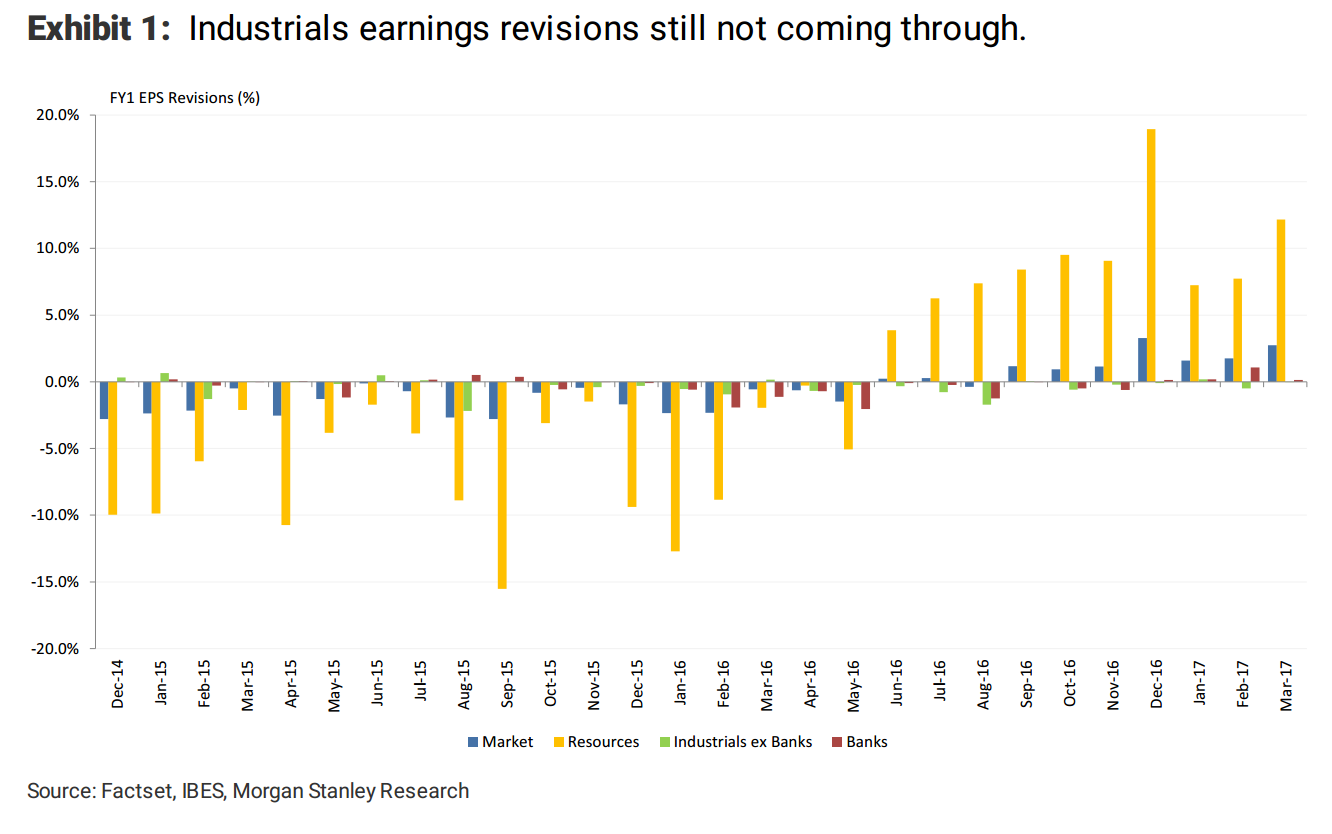
The strength in ASX200 performance CYTD ignores the absence of any positive momentum in Industrial earnings. Headwinds for Industrials are limiting growth and cost pressures are building – a negative mix to watch.
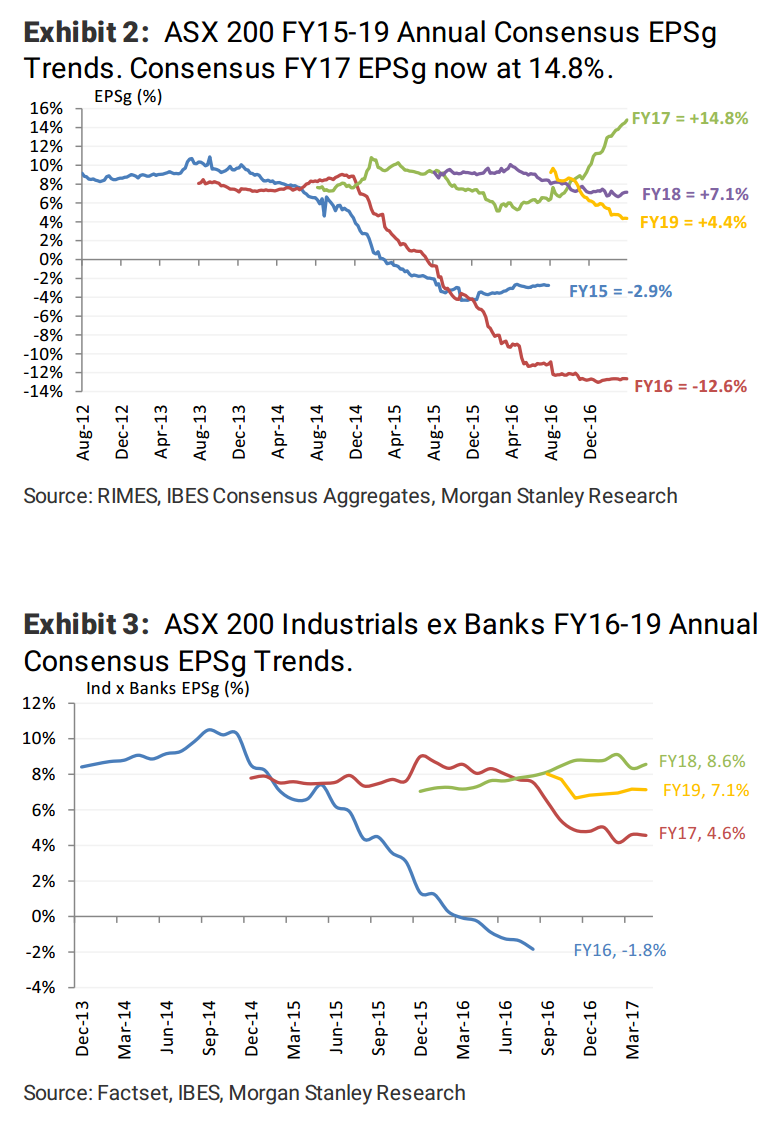
Market Optimism vs Industrial Pessimism: The ASX 200 returned 4.8% (TR) for the March quarter, well above Q1’s historical average of 3.2% (since 1950). Despite lagging the rally over this period, the Materials sector continues to drive consensus ASX200 EPSghigher, with FY17 now at 14.8% (from 13.7%) and FY18 at 7.1% (from 6.8%). However,FY19 EPSg forecasts have drifted from 4.8% (Feb) to 4.4%,given a lack of broader industrials growth conviction. This is illustrated in Exhibit 2that shows the aggregate consensus EPSg rates fading to low single digit by FY19 as the commodity forecasts fade to long run and the industrial earnings cycle remains stagnant. Industrials-ex-Financials are now trading at 19.4x, while the broader index (ASX 200) is trading towards its historical high of 15.9x.
Industrial Earnings Matter: Whilst it is tempting to get excited about double-digit growth for the market in 2017 – the sobering thought is that Industrial earnings momentum remains muted. Exhibit 3shows that Industrials-ex-Financials EPSg is 4.6% and our analysis on revisions momentum suggests low conviction with a negative bias.For the market to move meaningfully higher, we believe the outlook for “real economy”, domestic-linked industrial earnings must turn more positive – a prospect that looks unlikely at this juncture.
Growth Headwinds Building: The macro drivers of industrial earnings are intrinsically linked to the basic concepts of credit conditions, capital intentions, income growth and consumption. On all fronts, we see headwinds building,and would make the following observations:
Credit is Tighter – Bank repricing, credit rationing and continued expansion of the macro-prudential toolkit will all constrain system credit growth. This will dampen growth in the real economy. Capex is Muted- The first read on FY18 capex plans disappointed expectations, with non-mining sectors failing to offset a further steep drop in resources spending. We continue to see Australia as ‘behind the reflation curve’,and caution will grow as housing construction slows.
Wages are Weak – The household income picture stood out as the low point of the 4Q national accounts, with a -0.1% yoy drop in average non-farm employee compensation, marking the weakest result on the 44 year record, outside of a short-lived -0.7% fall during the GFC. Furthermore the savings rate has been increasingly tapped (down to 5.2% in 4Q16, from a peak of 10% in FY12). And with the recent strength in the commodity deck not likely to trigger a hiring/capex cycle, we see limited scope for other sectors of the economy to turn wages growth around.
Consumption is Lagging- Retail sales missed in February and the trends have been mixed at best. The outlook for jobs remains a real negative influence and unemployment is not just too high, but is rising – with the pool of unemployed increasing in absolute terms for the first time since 2011.
And Cost Pressures are Real: As outlined by our Australia Utilities team ‘Inside Industrials: Pool prices are strong… will retail prices follow? (27 Mar 2017)’ the cost of gas and electricity is spiking. Exhibit 14, shows the cost of spot wholesale electricity in major Australian states has increased by 2-3x in recent years. Our retail team highlights that Energy is the largest cost for retailers after labour and rent, with recent pricing increases likely to be spread over the next 3-4 years and that the cost of energy for households will rise double digit and likely dampen consumer cash flows and sentiment over the coming year (Australia Consumer: Impacts of Rising Energy Prices (02 Apr 2017)). Add to this pressure from insurance costs,health,education and labour/construction costs in housinglinked – and the unhealthy mix of a slowing top line and cost-push inflationary pressures looms.
Exactly right. Mining and banking are reversing. The former is going to fall hard in H2 and the latter at some unknown pace as housing rolls. Industrials never picked up.
Get your money out while the dollar is still high.
The MB Fund will launch in one month to aid you in that (it is 80% international assets at launch).
Advertisement
Register your interest today (if you have not already).
David Llewellyn-Smith is Chief Strategist at the MB Fund and MB Super. David is the founding publisher and editor of MacroBusiness and was the founding publisher and global economy editor of The Diplomat, the Asia Pacific's leading geo-politics and economics portal.
He is also a former gold trader and economic commentator at The Sydney Morning Herald, The Age, the ABC and Business Spectator. He is the co-author of The Great Crash of 2008 with Ross Garnaut and was the editor of the second Garnaut Climate Change Review.